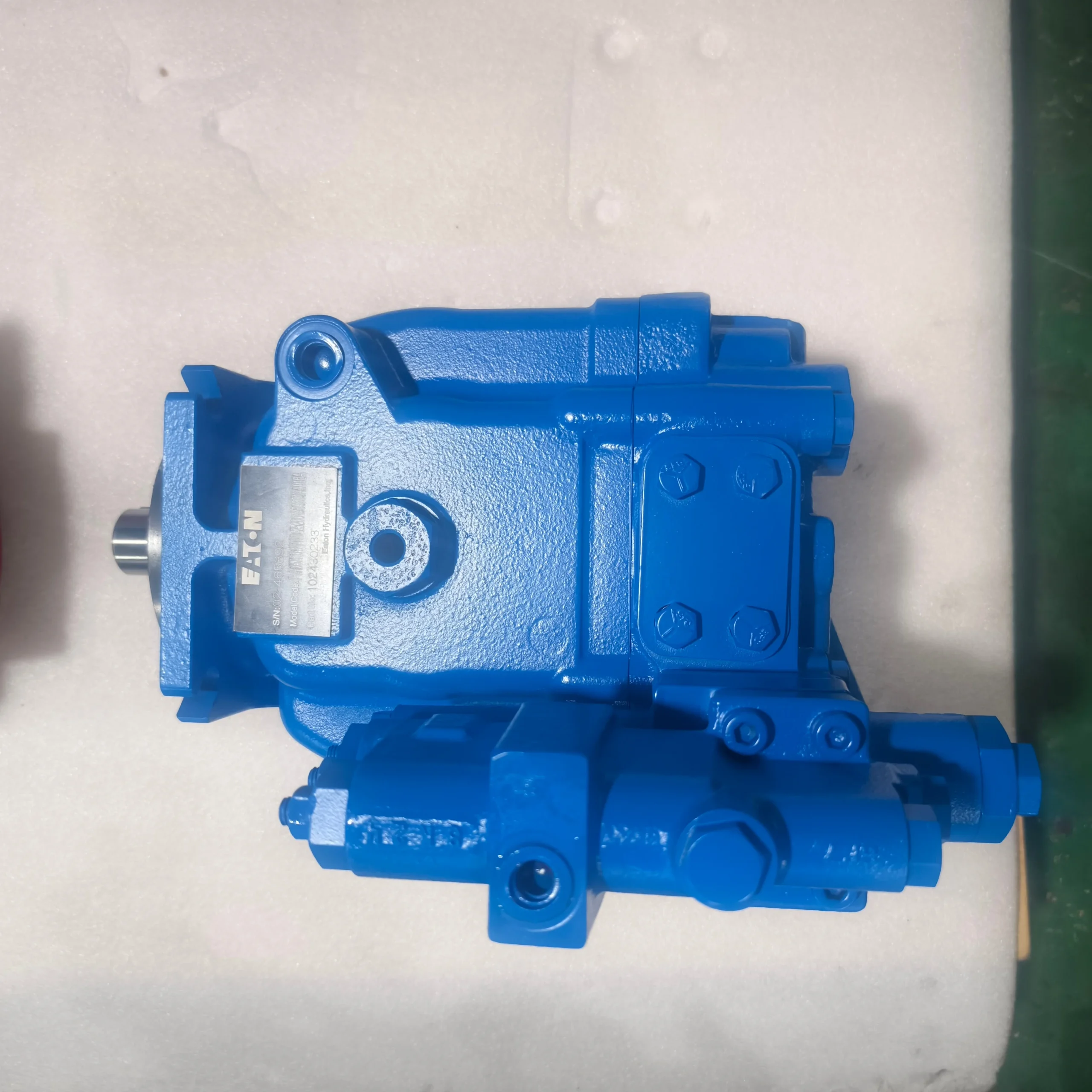
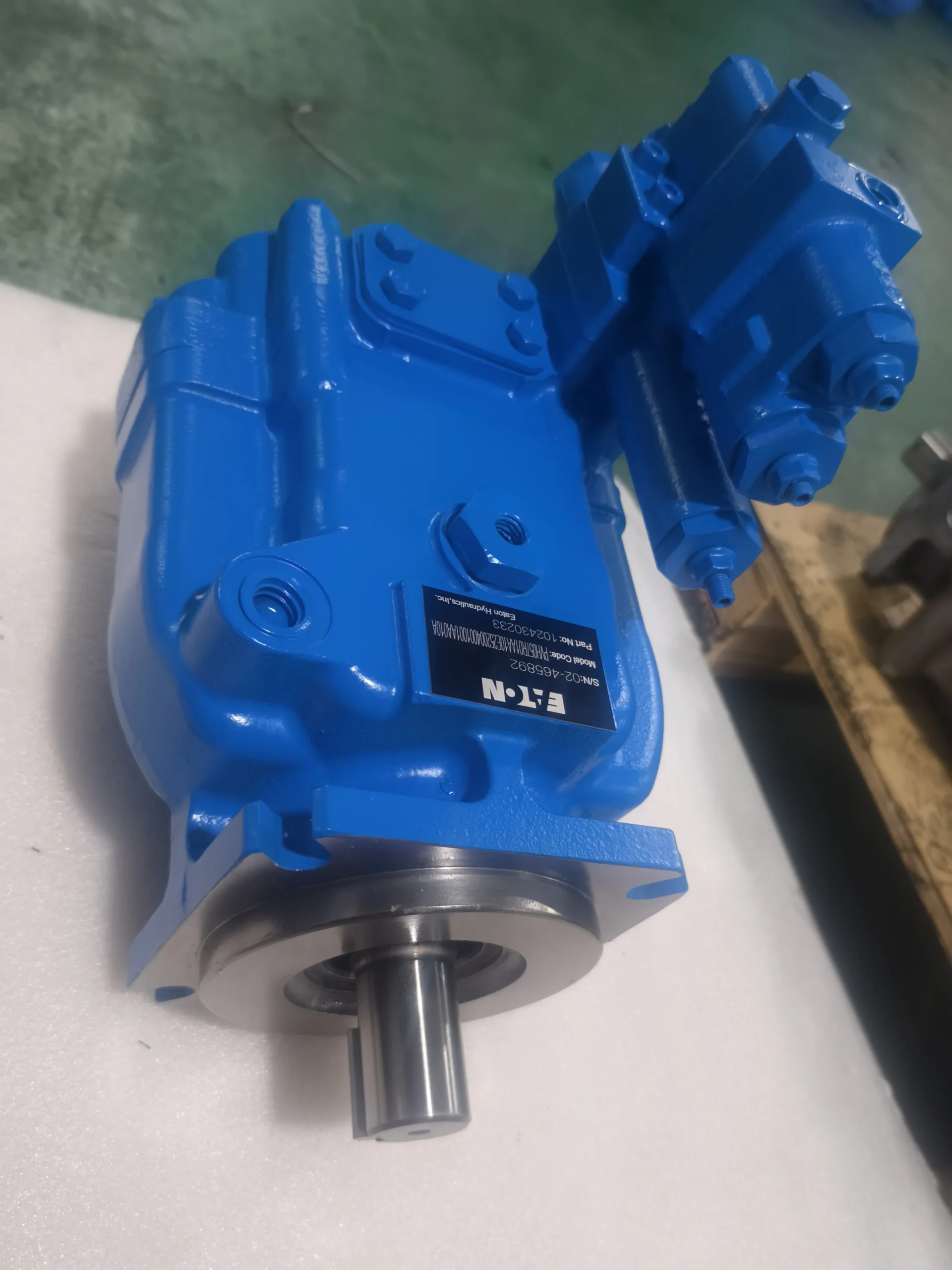


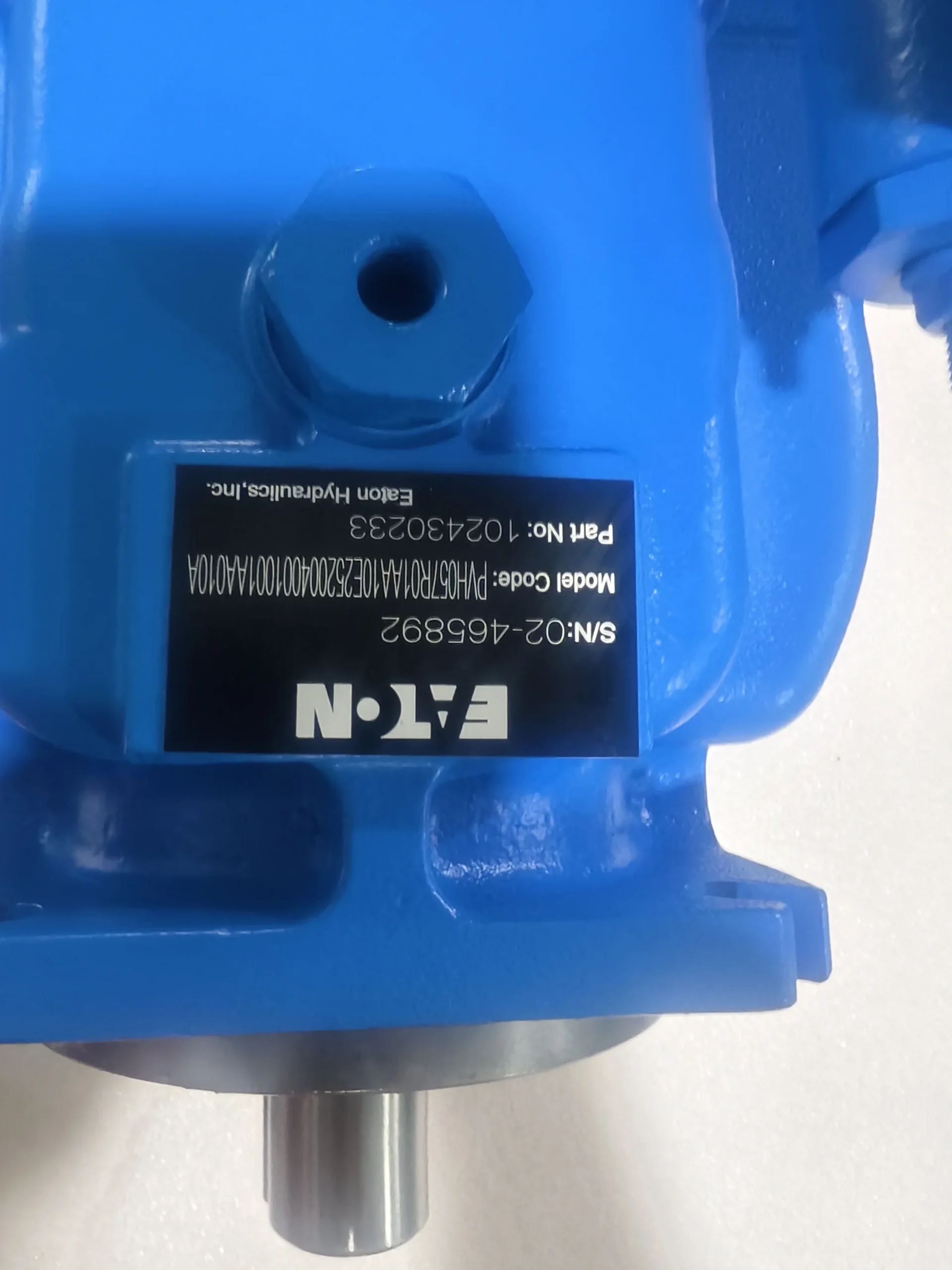
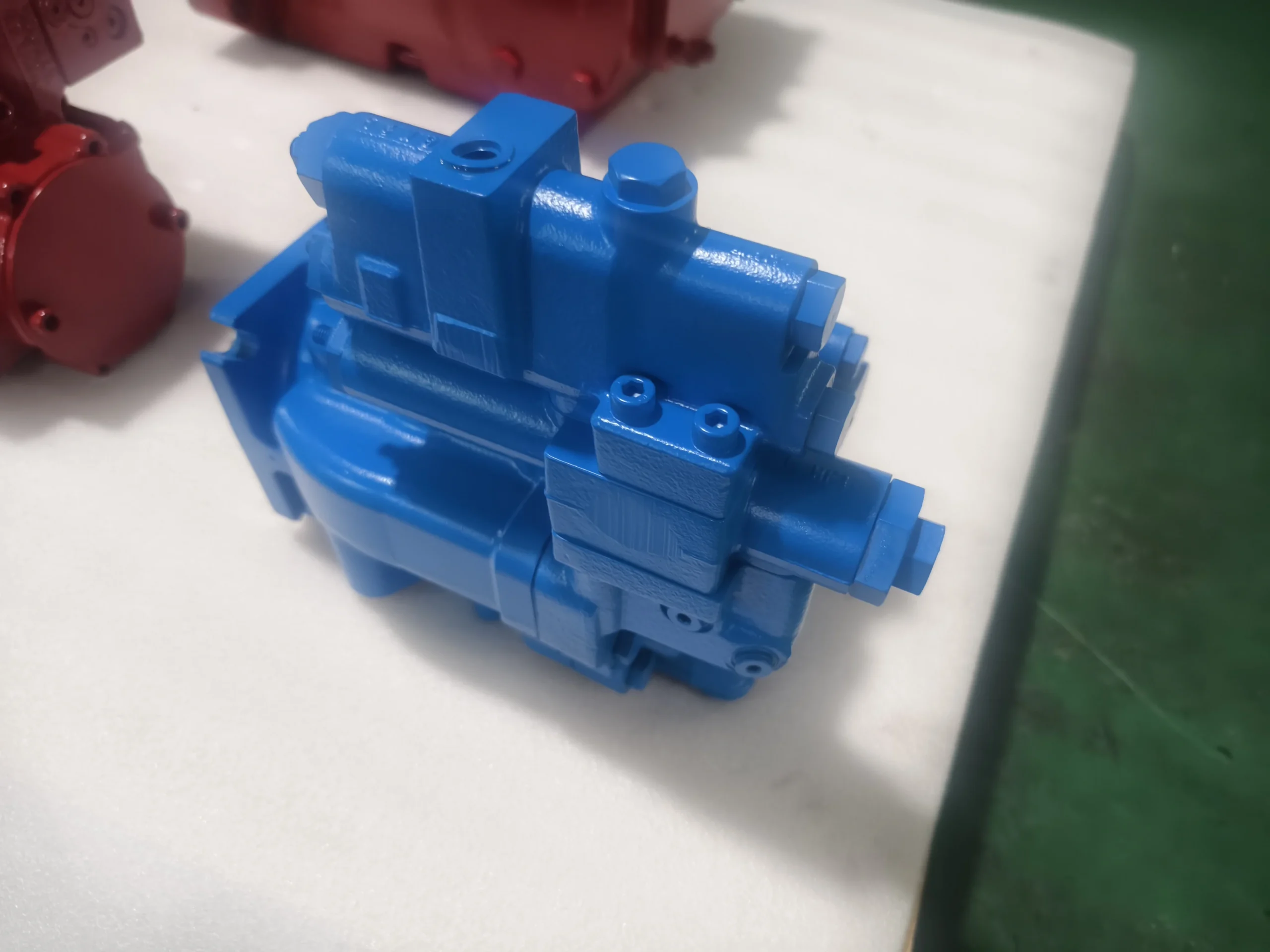
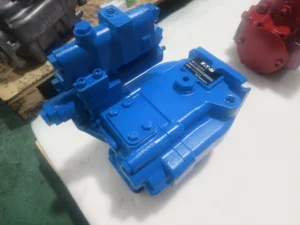
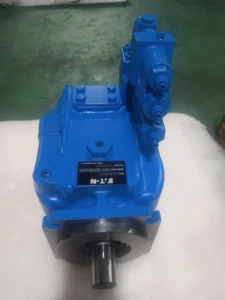

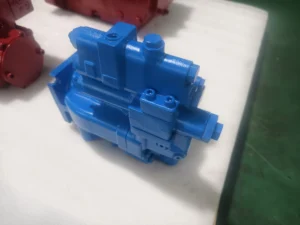
PVH057R01AA10E252004001001AA010A Hydraulic Piston Pump PVH057 PVH074 PVH098 PVH131 High Pressure Variable Pump Parts
Core performance parameters
– Pump type: Swash plate axial piston variable pump, with dual control structure for pressure and flow, suitable for high-pressure and heavy-load hydraulic systems. It supports independent operation of a single pump or parallel expansion of two pumps, and can be connected to open-loop or closed-loop power transmission systems.
– Pressure rating: Rated working pressure 28 MPa, continuous operating pressure ≤28 MPa; The instantaneous peak pressure is 35 MPa (lasting for ≤3 seconds). The back pressure at the return oil port is allowed to be ≤2.5 MPa. In case of overpressure, a relief valve should be configured for coordinated protection.
– Displacement and rotational speed: Rated displacement 57 mL/r (corresponding to model “057” marking); Rated speed: 1500 r/min, maximum speed: 1800 r/min (short-term continuous ≤1 minute); The speed adaptation range is 800-1600 r/min, and the flow rate is linearly matched with the speed and displacement (the flow rate is approximately 85 L/min at full displacement of 1500 r/min).
– Efficiency and power: Under rated working conditions, the volumetric efficiency is ≥93%, and the total efficiency is ≥88%. When the full displacement is 1500 r/min, the input shaft power is ≤85 kW, and it is recommended to choose 110 kW for the matching motor power.
2. Structure and connection parameters
– Structural type: Horizontal installation, swash plate driven axial plunger layout, integrated electro-hydraulic proportional variable mechanism, constant power regulation device and pressure shut-off valve, adopts pressure forced lubrication + splash lubrication combined method, supports forward and reverse oil supply switching.
– Core material: The plunger is made of 42CrMo alloy steel (nitrided, surface hardness HV900-1000); The swash plate is made of QT600-3 ductile iron (surface quenched + precision ground). The cylinder block is made of 35CrMo forged steel (quenched and tempered). The seal is made of high-pressure resistant polytetrafluoroethylene composite material (with a temperature resistance range of -30℃ to 130℃).
– Connection specifications: The diameter of the oil suction port (S port) is Φ 65mm, and the diameter of the oil pressure port (P port) is Φ 50mm. Both are metric threads (M76×2/M64×2). The flange installation complies with the ISO 7005-1 standard. The input shaft is splined (splined specification 36×6), and the weight of the pump body is approximately 36 kg.
3. Medium and Environmental requirements
– Medium requirements: It is recommended to use L-HM 46 anti-wear hydraulic oil. For low-temperature environments (below -30℃), L-HV 46 anti-wear hydraulic oil should be selected. The kinematic viscosity of the oil is 20-500 mm²/s, and the moisture content is no more than 0.05%. It is strictly prohibited to mix oils of different grades.
– Cleanliness standard: The oil cleanliness must reach ISO 4406 16/13 grade. The system must be equipped with a 5 μm fine filter, and a 100 μm coarse filter must be placed in front of the oil suction port. The pressure difference of the filter should be monitored regularly to ensure the filtration effect.
– Environmental parameters: Operating environment temperature -30℃ to 85℃, relative humidity ≤98% (short-term condensation is allowed); With a protection grade of IP67, it is suitable for dust, mud and water, and high-vibration working conditions in steel mills, mines, construction machinery, etc.Ii. Working Principle
This pump is a swash plate type axial piston variable pump. Its core converts mechanical energy into hydraulic energy through the mechanism of “swash plate driving the piston to reciprocate → periodic change of sealed volume → variable regulation of electro-hydraulic ratio”. The specific process is as follows:
1. Basic oil suction and discharge process
The motor drives the input shaft to rotate the cylinder block. Under the action of pressure oil, the 9 plungers inside the cylinder block are tightly attached to the surface of the adjustable swash plate through the sliding shoes. When the plunger rotates with the cylinder body to the “oil suction zone”, the inclined surface of the swash plate causes the plunger to extend outward, expanding the volume of the plunger cavity to form a vacuum, and the hydraulic oil is sucked in through the oil suction port and the oil suction window of the distribution plate. When rotating to the “oil pressure zone”, the swash plate squeezes the sliding shoe to push the plunger to retract inward, reducing the volume of the plunger cavity. The oil is then squeezed and pressurized to the system’s required pressure and continuously output from the oil pressure port. Multiple plungers alternate to ensure a stable flow rate.
2. Variable regulation and safety protection
– Variable adjustment: By using a 4-20 mA electro-hydraulic proportional control signal, the control pressure of the variable mechanism (1.5-5.0 MPa) is adjusted to change the tilt Angle of the swash plate (adjustment range: -15° to +15°). When the inclination Angle increases, the plunger stroke increases and the displacement increases accordingly (up to 57 mL/r). When the inclination Angle decreases, the displacement reduces (minimum 5.7 mL/r), achieving a 10-100% stepless adjustment of the flow rate. When the inclination Angle is reversed, the oil output can be reversed to meet the system’s reversing requirements.
– Safety protection: Equipped with dual protection of constant power regulation and pressure cut-off. When the system pressure reaches 28 MPa, the pressure cut-off valve automatically reduces the displacement to limit the pressure. When the input power approaches the rated value, the constant power device limits overload by reducing the displacement. It also integrates an oil temperature excessively high alarm interface to monitor the pump body temperature in real time and ensure the safe operation of the system in all aspects.
Iii. Product Features and Advantages
– Strong adaptability to high pressure and heavy load: With a rated pressure of 28 MPa, it can drive heavy-duty hydraulic systems. With a full displacement of 85 L/min (1500 r/min), it can meet the compound actions of multiple actuators, such as the simultaneous operation of steel rolling mill pressing down and excavator digging and rotating, and is suitable for high-intensity continuous operation requirements.
– High variable energy-saving efficiency: The flow rate can be adjusted steplessly from 10% to 100%, and the output can be matched in real time according to the load. When the load is light (such as when the equipment is running empty), the flow rate can be reduced to below 10%, saving 35-45% energy compared with the fixed displacement pump. Constant power regulation optimizes power distribution and avoids energy waste.
– Wear-resistant, fatigue-resistant and long service life: After nitriding treatment, the surface hardness of the plunger is high, which is wear-resistant and anti-seizing. The swash plate is precisely ground to Ra≤0.2 μm. The sliding shoe is equipped with an internal self-lubricating structure to reduce friction loss. Under rated working conditions, the trouble-free operation life reaches 15,000 hours, which is 20% longer than that of ordinary variable pumps.
– Flexible scene adaptability: Supports forward and reverse fuel supply switching without the need for additional directional control valves; With an IP67 protection rating, it can prevent mud, water and dust from entering. It starts smoothly at -30℃ and maintains stable sealing performance at 85℃. It is suitable for harsh scenarios such as high-cold mines and high-temperature steel mills.
– Easy maintenance and high reliability: The modular cylinder block design allows for the replacement of vulnerable parts such as the plunger and sliding shoe by removing the front cover, with a maintenance time of no more than 2 hours. The key components have strong universality, and the failure rate is 30% lower than that of pumps of the same type, which is suitable for the continuous production requirements of industrial equipment.
Iv. Usage Functions and Purposes
1. Core usage functions
– High-pressure and high-flow oil supply: It provides a stable oil source for high-pressure and heavy-duty systems. With a pressure of 28 MPa and a flow rate of 85 L/min, it can ensure the multi-action coordination of heavy equipment, improve operational efficiency, and is suitable for continuous production or high-intensity operation scenarios.
– Precise flow and direction regulation: Electro-hydraulic proportional control enables precise flow control, suitable for scenarios with large load fluctuations. The reverse inclination Angle of the swash plate can achieve reverse oil output, meeting the frequent reversing requirements of the system, such as the reciprocating motion of the machine tool worktable.
– Multiple safety protections: Dual protection of pressure cut-off and constant power prevents overpressure and overload. Oil temperature alarm provides early warning of abnormalities, reducing the risk of damage to the pump body and pipelines, and ensuring the safety of equipment operation.
– Parallel expansion: Supports two pumps in parallel (with a flow rate of up to 170 L/min), meeting the flow upgrade requirements of large-scale systems. It can increase production capacity without replacing the main pump and reduce equipment upgrade costs.
2. Main application fields
– Metallurgical industry: Medium-sized steel rolling mill lowering system, heating furnace lifting mechanism, main span uncoiling machine hydraulic system, suitable for high-temperature and high-dust working conditions in steel mills.
– Construction machinery: Main hydraulic systems for 20-40 ton excavators, lifting and drive systems for 15-25 ton loaders, and lifting systems for large crawler cranes.
– Industrial manufacturing: Clamping and injection systems for injection molding machines over 1,000 tons, hydraulic systems for heavy forging equipment, and worktable drive systems for large machine tools.
V. Applicable Machines and Scenarios
1. Adapt to the core machine
– Metallurgical equipment: Medium-sized hot-rolling steel mills, steel plant heating furnaces, main span uncoiling machines.
– Construction machinery: 20-40 ton crawler excavators, 15-25 ton wheel loaders, 20-ton crawler cranes.
– Industrial equipment: 1000-2000 ton injection molding machines, heavy-duty forging presses, large gantry machine tools.
2. Typical application scenarios
– Scene of steel rolling mill pressing down: As the main pump of the medium-sized hot-rolled steel rolling mill’s lowering system, it outputs 28 MPa pressure oil to drive the adjustment of the lowering roll. With a flow rate of 85 L/min at 1500 r/min, it ensures a stable lowering speed (0.1-0.3 m/min), meeting the precise control requirements of steel plate thickness. It can operate continuously without failure for more than 1200 hours.
– Application of the main pump for excavators: As the main hydraulic pump for 30-ton excavators, it drives the combined actions of excavation, rotation and walking. When fully loaded, it outputs a pressure of 28 MPa and a flow rate of 85 L/min to ensure sufficient excavation force. When unloaded, the flow rate drops to 10 L/min, significantly reducing fuel consumption. It is suitable for scenarios such as hard rock in mines and earthwork in infrastructure construction.
Injection drive for injection molding machines: It supplies fuel to the injection system of a 1500-ton injection molding machine. During the injection stage, it achieves rapid advancement at full flow rate (85 L/min) (speed ≥0.6 m/s), and during the pressure-holding stage, it reduces to a stable pressure of 15 L/min, improving the forming accuracy of large plastic parts (error ≤0.5%), and is suitable for batch production of automotive bumpers and home appliance shells.
Six. Similar models
1. Alternative models of the same series
– PVH045R01AA10E252004001001AA010A: This small-displacement model of the same structure has a rated displacement of 45 mL/r (with a flow rate of approximately 67.5 L/min at 1500 r/min), a rated pressure of 28 MPa, and the installation dimensions are the same as the original model. It is suitable for excavators under 20 tons and small steel rolling mills, and the cost is 20% lower than that of the original model.
– PVH074R01AA10E252004001001AA010A: The large-displacement model of the same series has a rated displacement of 74 mL/r (with a flow rate of approximately 111 L/min at 1500 r/min), a rated pressure of 28 MPa, and the same structural materials. It is suitable for 40-50 ton excavators and large steel rolling mills, but the cost is 25% higher than that of the original model.
2. Cross-series alternative models
Upgrade models – PVH057R01EP10E252004001001AA010A: high pressure, pressure rated 35 MPa, 57 mL/r, displacement plunger using ceramic coating processing, wear-resisting performance increase 50%, adapter heavy mining broken hammer, large forging equipment, costs are 45% higher than the original model.
– PVH057R01EO10E252004001001AA010A: fixed displacement simplified model, displacement 57 mL/r, no variable institutions, more compact structure, stable adaptive load scenarios (such as fixed speed conveyor belt, small rolling mill auxiliary system), 35% lower cost than the original model.
– PVH057/057 dp1aa10e252004001001aa010a: The dual-pump model has a total displacement of 114 mL/r (57+57 mL/r), a rated pressure of 28 MPa, and is suitable for dual-circuit independent oil supply systems (such as injection molding machine ejection + feeding linkage, double-roll pressing of steel rolling mills). Its cost is 65% higher than that of the original model.
Vii. Precautions for Use
1. Oil management
– Only L-HM 46 or L-HV 46 anti-wear hydraulic oil must be selected. It is strictly prohibited to mix different grades and types of oil. After the new pump has been in operation for 500 hours for the first time, change the oil. Subsequently, change the oil every 1,500 hours. Before changing the oil, thoroughly clean the oil tank, pipelines and two-stage filters to avoid residual impurities.
Check the oil level and cleanliness every week. Replace the filter element immediately when the pressure difference of the fine filter exceeds 0.5 MPa and that of the coarse filter exceeds 0.3 MPa. When emulsification, discoloration or presence of metal debris in the oil is detected, the system should be thoroughly cleaned and the oil changed to prevent abnormal wear of the plunger and swash plate.
2. Installation and commissioning
When installing, the coaxiality error between the pump shaft and the motor shaft should be no more than 0.1mm (for rigid connection) or no more than 0.2mm (for elastic connection), the flatness of the flange surface should be no more than 0.03mm /m, and the connecting bolts should be evenly tightened with a torque of 900 N·m to avoid eccentricity causing overheating and abnormal noise of the bearings.
Before the first start-up, fill the pump body with hydraulic oil and manually turn it by hand for 8 to 10 turns to ensure smooth operation without any jamming. After startup, run it unloaded for 20 minutes (1000 r/min). When the oil temperature rises above 40℃, gradually increase the load. The pressure increase rate should be no more than 0.5 MPa/ minute to avoid cold start shock damaging the sealing parts.
When debugging the variable mechanism, test the linearity of the flow corresponding to the 4-20 mA signal to ensure that the deviation is ≤±2%. Calibrate the pressure shut-off valve and the constant power device to ensure that the protection is precisely triggered when the pressure and power reach the rated values, avoiding overpressure and overload operation.
3. Operation and Maintenance
During operation, real-time monitoring of the pump body temperature (normal ≤80℃, maximum ≤85℃), inlet and outlet pressures, and vibration values (≤ 5.0mm /s) is conducted. If a sudden temperature rise of ≥10℃, pressure fluctuation of > 1MPa, or abnormal noise is detected, the machine should be immediately shut down to check for issues such as oil cleanliness, slipper wear, and jamming of the variable mechanism.
– Regular maintenance every 3,000 hours: Replace seals, plunger sliders and filter elements; Check the surface wear of the swash plate (grinding and repair are required if the wear amount is greater than 0.05mm) and the wear of the splined shaft (replacement is required if the clearance is greater than 0.08mm). Disassemble and check the sealing performance of the cylinder block and the distribution plate every 10,000 hours. Replace the components if necessary.
Before starting after long-term parking, remove the end cover of the variable mechanism to check if the valve core is stuck, and apply special lubricating grease to the meshing surface. Before starting at low temperatures (< -10℃), the oil should be heated to above 10℃ to prevent component damage caused by cold start.
4. Security and storage protection
Before shutdown or maintenance, pressure relief treatment must be carried out. Open the system pressure relief valve to release the residual pressure and prevent injury from high-pressure oil spraying. Operators should wear protective gloves, goggles and other equipment to avoid direct contact with high-pressure oil.
When stored for a long time, seal the oil port with a metal plug, inject anti-rust oil (90% of the shell volume), apply anti-rust grease to the splines of the input shaft, and wrap it with a waterproof and dustproof cover. Store in a dry and well-ventilated place (0-40℃, humidity ≤60%). Manually turn the machine three times a month to prevent components from sticking and rusting.
Before the pump is put into use after being idle for more than 12 months, thoroughly clean the interior of the pump body and replace the sealing parts. Test the rotational flexibility by passing low-pressure oil (2-3 MPa), load in stages to the rated pressure, and only put it into use after confirming that the variable mechanism and pressure protection device are normal.