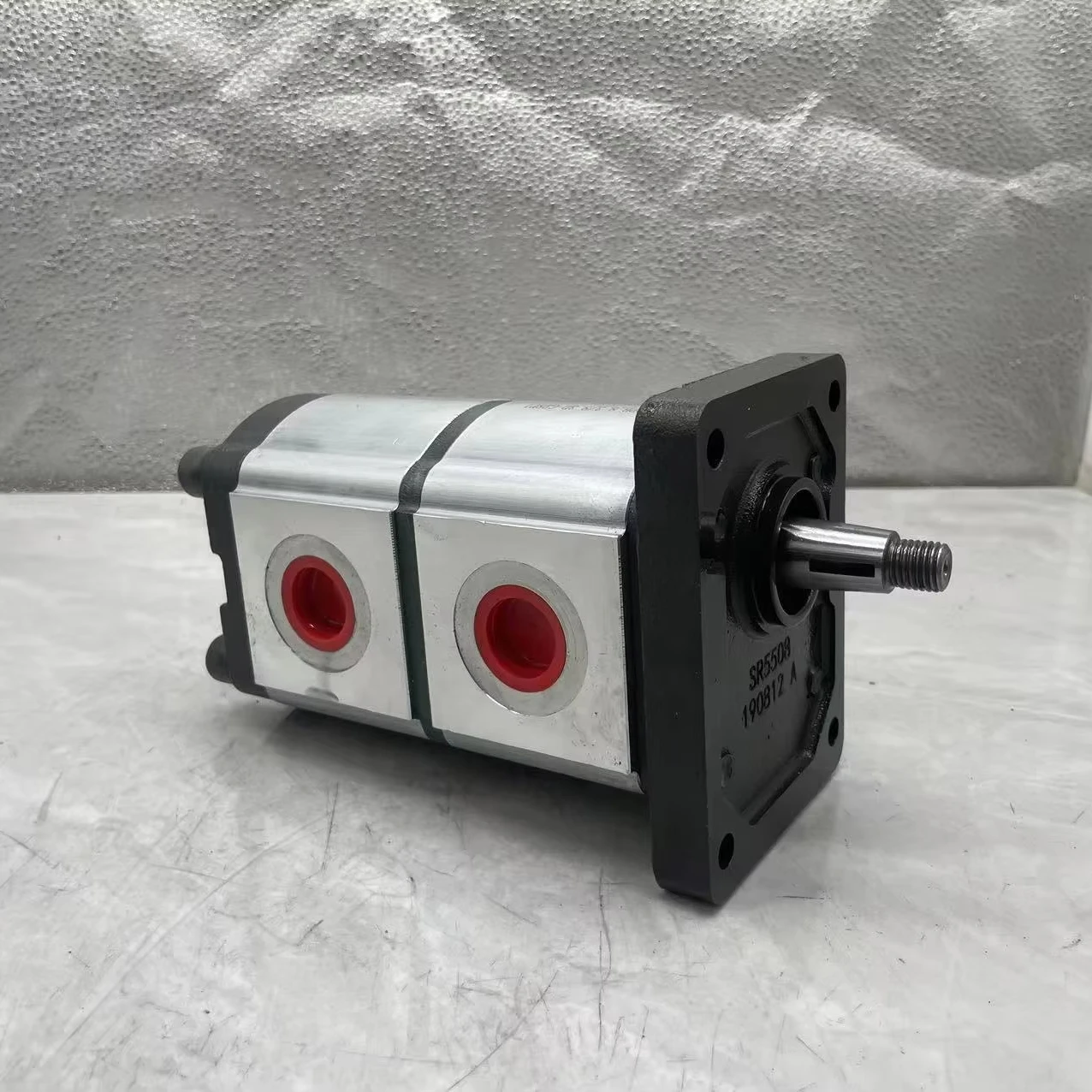
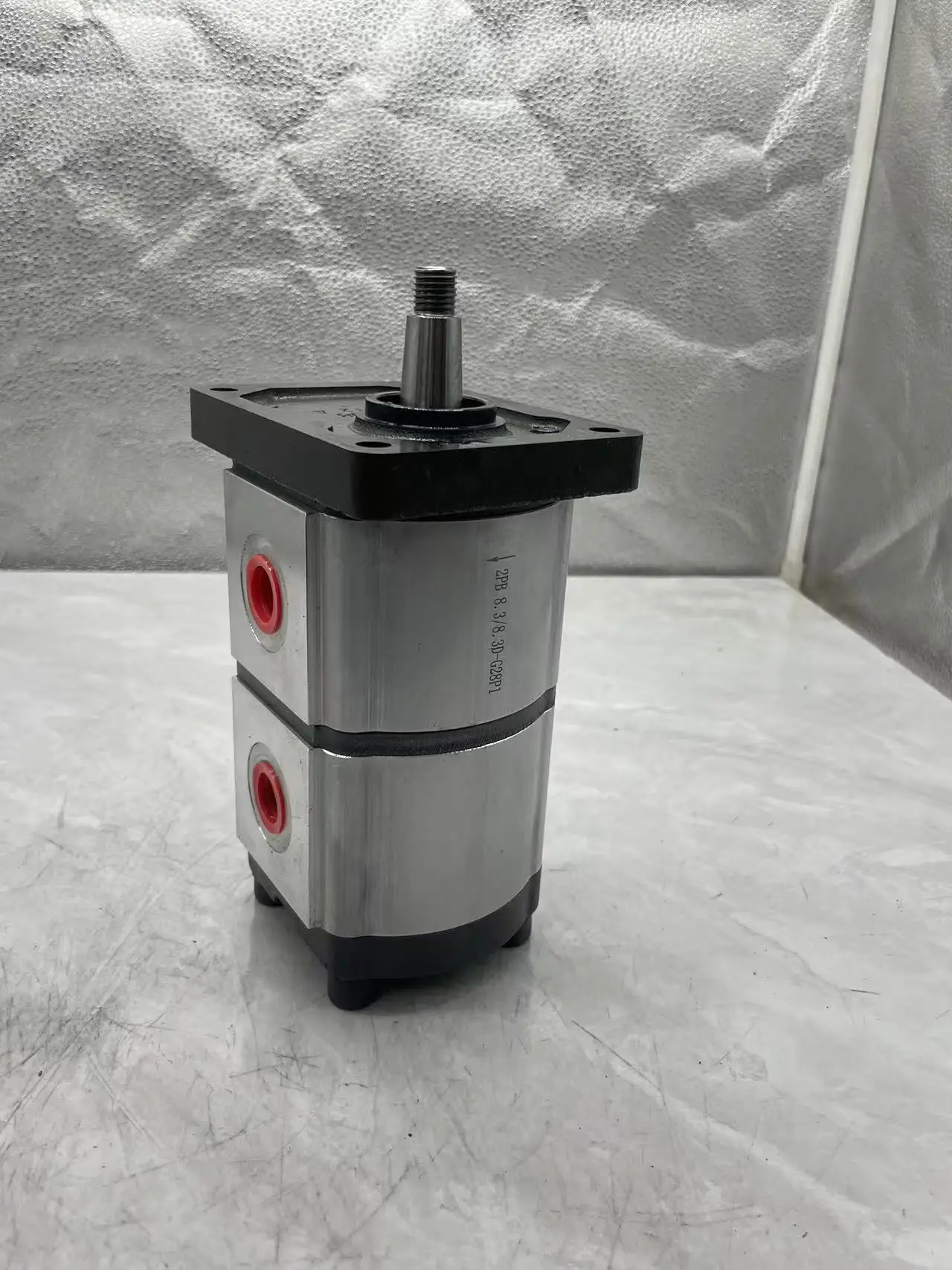
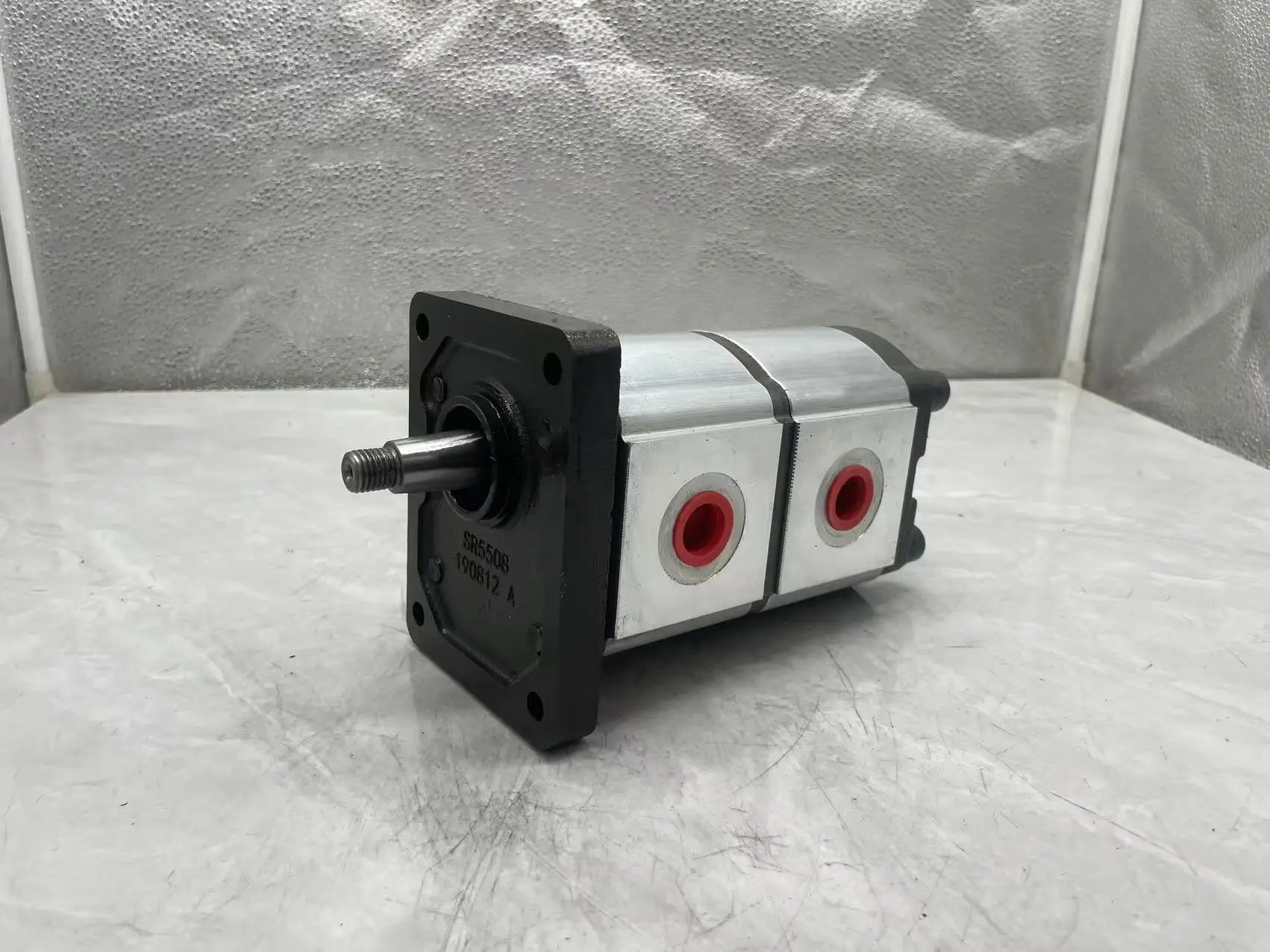
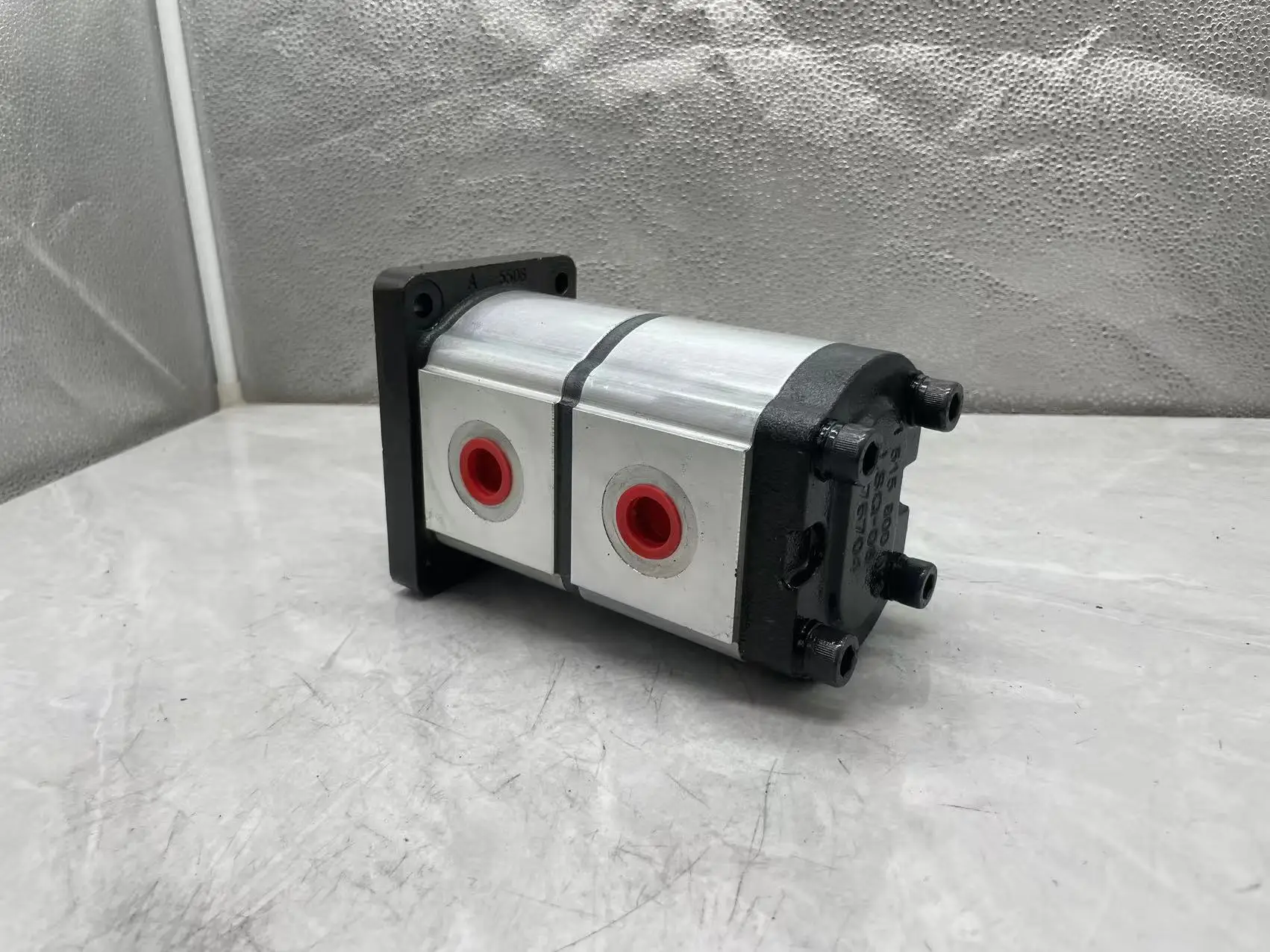
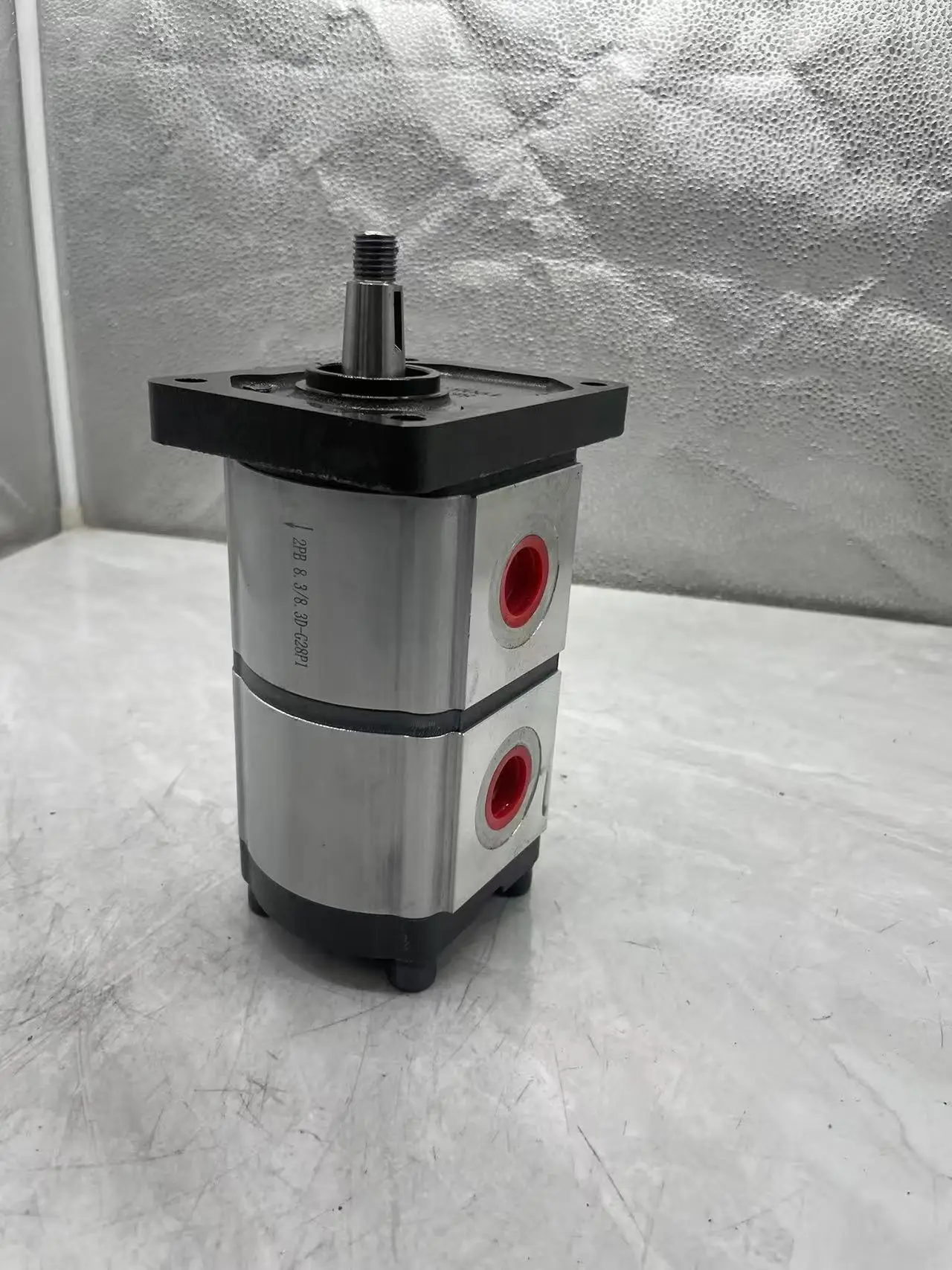
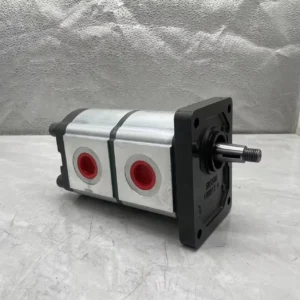
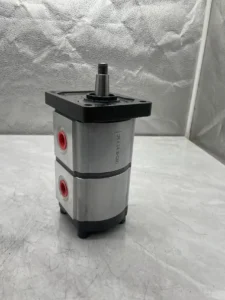
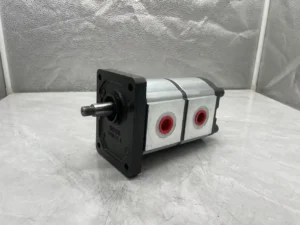
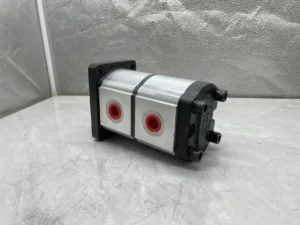
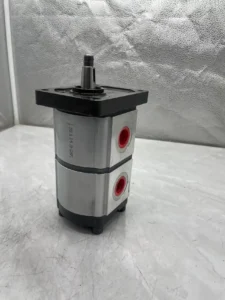
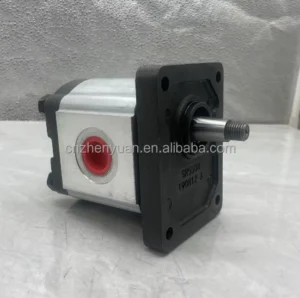
Hydraulic Double Gear Pump 2PB 8.3 8.3D-G 28P1 Hydraulic Gear Oil Pump 2PE 1.5PE 2.5PB 2PB Series Hydraulic Pump OEM
Core performance parameters
•Pump type: Double external meshing gear oil pump, with a dual-pump coaxial integrated design, featuring dual independent oil supply functions, suitable for power supply in low-pressure and medium and small flow hydraulic systems.
•Pressure rating: Rated working pressure 16 MPa, short-term peak pressure 20 MPa (lasting ≤3 seconds); The pressure consistency of the two pumps is ≤±0.5 MPa, and the allowable back pressure at the return oil port is ≤1.5 MPa.
•Flow parameters: Rated displacement of single pump 8.3 mL/r, total displacement of double pump 16.6 mL/r; When the rated speed is 1500 r/min, the flow rate of a single pump is approximately 12.5 L/min, and the total flow rate of two pumps is approximately 25 L/min. The speed adaptation range is 800-1500 r/min, and the flow rate is linearly matched with the speed.
•Efficiency parameters: Volumetric efficiency ≥85% under rated working conditions, total efficiency ≥80%. At 1500 r/min, the input shaft power should be ≤7.5 kW, and the power of the matching motor is recommended to be 5.5-7.5 kW.
2. Structure and connection parameters•
Structural type: Horizontal installation double-shaft structure. The two pumps share one input shaft, and the pump body integrates two oil suction ports and two oil pressure ports. The gears are meshed with straight teeth, and an overflow valve (with an overflow pressure of 18 MPa) is installed inside the pump body to achieve overpressure protection.
•Core material: The driving/driven gears are made of alloy structural steel (40Cr, quenched, hardness HRC50-55). The pump body is made of gray cast iron (HT200, aged treatment). The seal is made of nitrile rubber (with a temperature resistance range of -10℃ to 100℃).
•Connection specifications: The suction port (S1/S2) has a diameter of Φ 32mm, and the pressure port (P1/P2) has a diameter of Φ 25mm. Both are metric threads (M36×2/M30×2). Flange installation, compatible with standard mounting surfaces. The input shaft is connected by a flat key (keyway specification 8×7).
3. Medium and Environmental requirements•Medium requirements: It is recommended to use L-HM 46 anti-wear hydraulic oil. L-HV 46 hydraulic oil should be selected for low-temperature environments. The kinematic viscosity of the oil is 20-300 mm²/s, and the moisture content is ≤0.1%.
•Cleanliness standard: The oil cleanliness shall reach ISO 4406 18/15 grade, and a 60 μm filter shall be installed at the oil suction port.
•Environmental parameters: Operating temperature -10℃ to 70℃, relative humidity ≤95%; The protection grade is IP54, suitable for general industrial dust and oil contamination environments.
Ii. Working Principle
This pump is a double external meshing gear pump. Its core achieves power output through “oil suction and discharge due to volume changes in gear meshing + coaxial collaborative operation of the two pumps”. The specific process is as follows
1. Basic oil suction and discharge process
The motor drives the input shaft to rotate the driving gears of the two pumps synchronously, and the driving gears mesh with the driven gears to rotate in opposite directions. When the gear tooth grooves change from the meshing state to the separated state, the sealed volume of the pump cavity increases to form a vacuum, and the hydraulic oil is sucked into the tooth grooves through the oil suction port. The gears continue to rotate, and the tooth grooves carry the oil to the oil pressure area. The gears mesh again, reducing the sealed volume, and the oil is squeezed out from the oil pressure port. The two pumps share the input shaft, allowing for the simultaneous output of two pressure oil streams, or each pump can operate independently.
2. Pressure protection mechanism
The integrated relief valve in the pump body is connected to the oil pressure port. When the system pressure reaches 18 MPa, the valve core of the relief valve opens, and the excess oil flows back to the oil tank to prevent the pump body from being damaged by overpressure. Each of the two pumps is equipped with an independent pressure feedback channel to ensure stable output pressure on both channels and meet the independent operation requirements of the dual actuators.
Iii. Product Features and Advantages
•Dual-pump integrated design, high space utilization: The two pumps are coaxially integrated into one, reducing the volume by 40% compared to two single pumps connected in parallel, thus saving installation space for the hydraulic station. Dual independent fuel supply can adapt to the simultaneous operation of two actuators in the system, simplifying the pipeline design.
•Low-pressure stable operation with strong reliability: The gears are quenched with 40Cr, ensuring high tooth surface accuracy and smooth meshing. There is no abnormal wear at a rated pressure of 16 MPa. The built-in relief valve provides overpressure protection, and the fault-free operation life under rated conditions reaches 8,000 hours.
•Easy to operate and widely adaptable: Flow rate and rotational speed are linearly matched, without the need for complex variable mechanisms. The wide speed range of 800-1500 r/min can be directly matched with standard motors, adapting to different power demand scenarios.
•Controllable cost and convenient maintenance: Simple structure, with only gears, seals, etc. as vulnerable parts; The modular design enables the replacement time of vulnerable parts to be no more than 1 hour, and the maintenance cost is 20% lower than that of similar double-pump units.
Iv. Usage Functions and Purposes
1. Core usage functions
•Dual independent oil supply: Two pumps simultaneously output two pressure oil lines (each line 12.5L /min@1500 r/min), which can drive two independent actuators (such as hydraulic cylinders, hydraulic motors) to work synchronously or asynchronously.
•Low-pressure power supply: It provides a stable low-pressure oil source for the system, suitable for actions with low pressure requirements (such as clamping, steering, and conveying), and a single pump can meet the requirements of actuating elements with a power of ≤ 5kW.
•Overpressure protection: Built-in relief valve automatically unloads to prevent system overload. The dual pumps have independent pressure regulation. The output pressures of the two channels (≤16 MPa) can be set respectively through the relief valve knob.
2. Main application fields
•Agricultural machinery: steering and suspension systems for large tractors, header lifting and conveying systems for combine harvesters.
•Light industry machinery: small injection molding machine clamping system, strapping machine pressing mechanism, conveyor belt drive system.
•Construction machinery: steering and lifting systems for small loaders, lifting assistance systems for forklifts.
•General equipment: Small and medium-sized hydraulic stations, lubrication systems, and power sources for cooling systems.
V. Applicable Machines and Scenarios
1. Adapt to the core machine
•Agricultural machinery: Tractors with over 100 horsepower, self-propelled combine harvesters.
•Light industry machinery: Small injection molding machines under 50 tons, fully automatic strapping machines.
•Construction machinery: 1-3 ton small loaders, 3-5 ton forklifts.
•General equipment: Small and medium-sized hydraulic test benches, equipment lubrication stations.
2. Typical application scenarios
•Tractor operation: The pump supplies fuel through dual channels, respectively driving the steering mechanism and the suspension system. When steering, a single channel outputs a flow rate of 12.5 L/min to ensure flexible steering. When the suspension is lifted or lowered, the dual channels converge to increase the speed, making it suitable for field farming scenarios.
•Strapping machine operation: Dual oil channels respectively drive the pressing mechanism and the belt feeding mechanism. During pressing, the pressure is stable at 12 MPa, and during belt feeding, the flow rate matches the conveying speed, making it suitable for batch strapping scenarios of cartons and plastic bottles.
•Small hydraulic station: As a power source, it provides oil for two small hydraulic cylinders, achieving the coordination of clamping and pushing actions. The pressure control accuracy meets the general processing positioning requirements (± 0.5MPa).
Six. Similar models
1. Alternative models of the same series
•2PB 6.3 6.3D-G 28P1: Consistent dual-pump structure, single pump displacement 6.3 mL/r (single pump flow rate approximately 9.5 L/min at 1500 r/min), rated pressure 16 MPa, compatible installation dimensions, suitable for small flow scenarios (such as small lubrication systems), cost 10% lower.
•2PB 10 10D-G 28P1: Large-displacement dual-pump model, single pump displacement 10 mL/r (single pump flow rate approximately 15 L/min at 1500 r/min), rated pressure 16 MPa, suitable for high-flow scenarios (such as large tractors), with a cost 20% higher.
2. Cross-series alternative models
•PB 8.3-G 28P1: Single pump model, displacement 8.3 mL/r, rated pressure 16 MPa, simple structure, cost 30% lower than double pump, suitable for single actuator scenarios (such as separate steering systems).
•3PB 8.3 8.3 8.3D-G 28P1: Three-pump model, three pumps integrated, total displacement 24.9 mL/r, suitable for three-way fuel supply scenarios (such as complex light industrial machinery), cost 40% higher than the original model.
Vii. Precautions for Use
1. Oil management
•Select L-HM 46 anti-wear hydraulic oil. Oils of different grades must not be mixed. The oil of the new pump should be changed after the first 500 hours of operation, and then every 1,500 hours thereafter.
•Replace the filter element when the pressure difference of the oil suction filter exceeds 0.2 MPa. Check the moisture content of the oil (≤0.1%) every month. Change the oil immediately if it emulsifies or deteriorates.
2. Installation and commissioning
•The coaxiality error between the pump shaft and the motor shaft should be no more than 0.2mm, and the height of the oil suction port should be no more than 0.5m to avoid cavitation. The flange bolts are evenly tightened to prevent leakage.
•Before the first start, fill the hydraulic oil and manually turn the wheel three times to confirm there is no jamming. After running without load for 5 minutes, gradually load. It takes ≥3 minutes for the pressure to rise to 16 MPa.
3. Operation and Maintenance
•During operation, monitor the pump body temperature (≤75℃), pressure (≤16 MPa) and noise. If any abnormality occurs, stop the machine for inspection, with a focus on checking the cleanliness of the oil and gear wear.
•Maintenance every 2000 hours: Replace the seals and filter elements; Check the gear wear (replace if the tooth thickness wear is greater than 0.1mm); Check the internal wear of the pump body every 4,000 hours.
4. Storage protection
•When stored for a long time, seal the oil port with a plug, inject anti-rust oil (80% of the pump body volume), and place it in a dry and well-ventilated area (temperature 5-35℃). Turn the pump by hand once a month.
•Before putting the pump into use after being idle for more than six months, flush the pump body twice with new oil, run it idle for 10 minutes, then load it. Only after confirming that there are no abnormalities can it be put into use.