


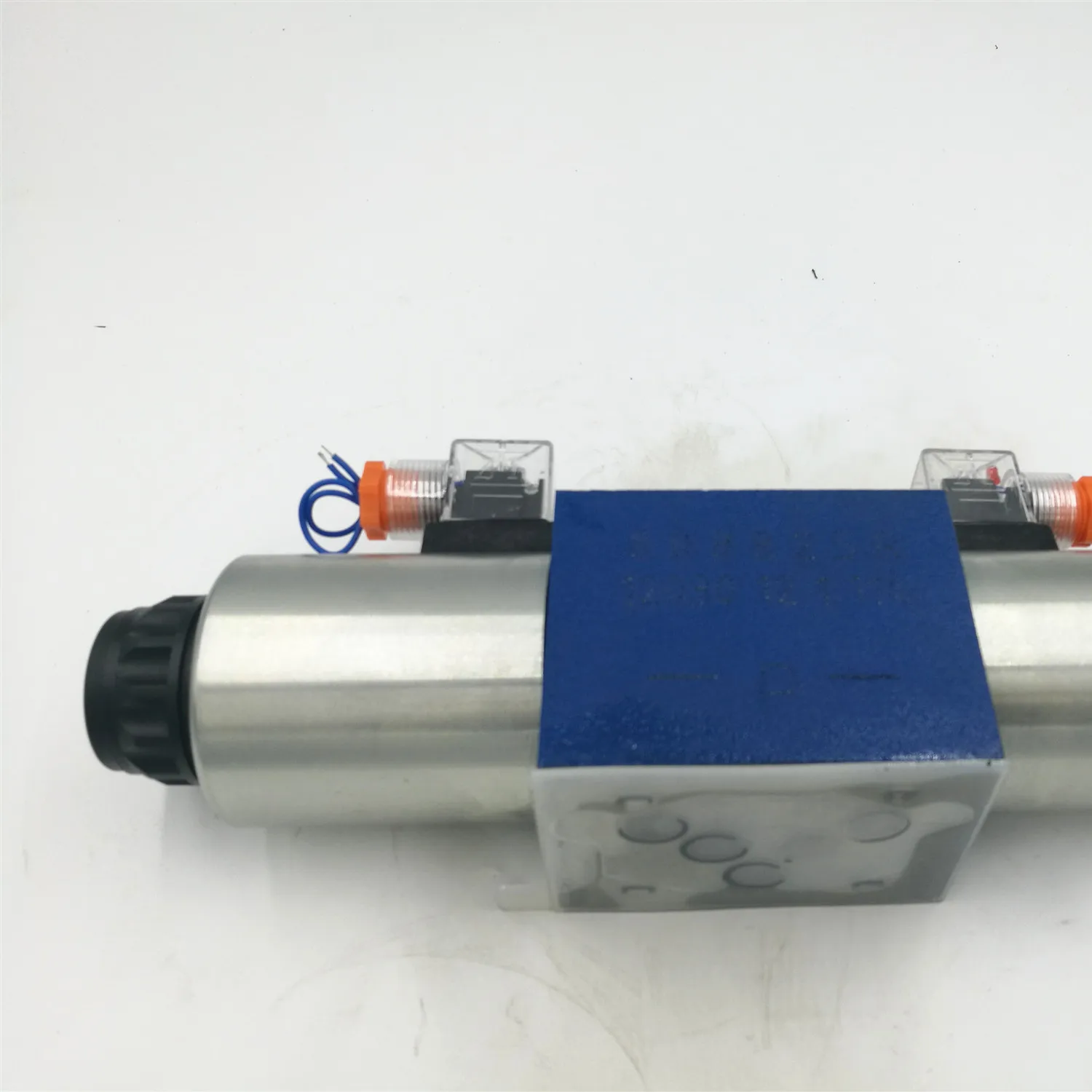

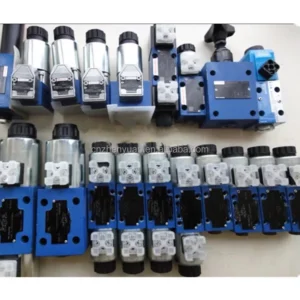

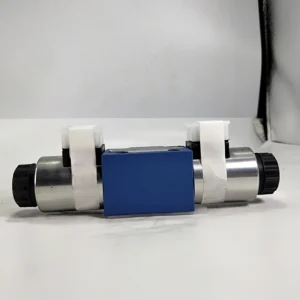

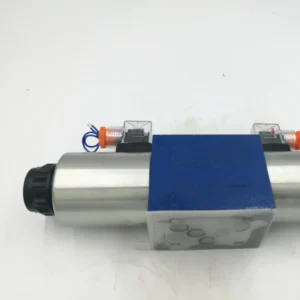
Hydraulic Solenoid Valve 4WE 4WE6 4WE10 4WE6A/B/C/D/E/F/J/H/G/L/M Series 4WE6C6X/EG24N9K4 Solenoid Operated Directional Valves
Core performance parameters
– Valve type: Four-way electromagnetic directional control valve, single electromagnet control (normal position by spring return), medium position function is C type (P port closed, A/B/T ports do not communicate with each other), suitable for medium and small-sized medium-pressure hydraulic systems, to achieve direction switching of the actuator.
– Pressure and flow parameters: Rated working pressure 31.5 MPa (P port), 21 MPa (T port); Rated flow rate: 60 L/min (at a pressure difference of 1 MPa); The working pressure difference range is 0.3-31.5 MPa, suitable for different load pressure scenarios.
– Control and response parameters: Control voltage 24 V DC (fluctuation range ±10%), electromagnet power 18 W; The reversing response time is ≤50 ms, and the reset response time is ≤40 ms. The working cycle frequency is ≤10 times per second.
– Operating characteristics: Working oil temperature -20℃ to 70℃; The temperature rise of the electromagnet during continuous operation is ≤ 60K. With a protection grade of IP65, it is suitable for scenarios such as industrial workshops and hydraulic stations of construction machinery.
2. Structure and connection parameters
– Structural type: Integrated cast iron valve body, precision slide valve, single electromagnet, reset spring and sealing assembly; It adopts a wet electromagnet design (in contact with the oil for heat dissipation), with a valve core made of stainless steel and a fluororubber seal.
– Connection specification: The oil port connection is threaded (all P/A/B/T ports are G1/4″). The electrical connection is a DIN 43650 standard plug. The installation method is plate mounting (conforming to ISO 7368 standard), and the weight of the valve body is approximately 1.8 kg.
3. Medium and Environmental requirements
– Medium requirements: L-HM 46 anti-wear hydraulic oil is suitable for normal temperature, and L-HM 32 is selected for low temperature (below -15℃). The allowable medium viscosity is 10-400 mm²/s, with a moisture content of no more than 0.03%. Solid particles (particle size > 10 μm) are strictly prohibited.
– Cleanliness standard: The oil cleanliness should reach ISO 4406 16/13 grade. A 10 μm fine filter should be placed in front of the oil inlet. The filter should be replaced when the pressure difference of the filter is greater than 0.1 MPa.
– Environmental parameters: Operating environment temperature -20℃ to 70℃, relative humidity ≤95%; With a protection grade of IP65, it can resist dust and water spray, making it suitable for damp industrial scenarios.Ii. Working Principle
This valve is a single electromagnet controlled four-way directional control valve. The core realizes the direction control of the actuator through the mechanism of “electromagnet on-off – valve core displacement – oil port on-off switching”. The specific process is as follows:
1. Median initial state
When the electromagnet is not energized, the reset spring stabilizes the valve core in the neutral position. At this time, port P (oil inlet) is closed, and ports A/B (working oil port) and port T (return oil port) are not connected. The actuator has no oil supply and remains stationary, achieving neutral pressure holding.
2. Reversing working process
When the electromagnet is energized, the electromagnetic force overcomes the reset spring force to push the valve core to move to the right, achieving the switching of the oil port passage: Port P is connected to port A, and Port B is connected to Port T. High-pressure oil enters the first chamber of the actuator through port P and port A, driving its forward movement. The return oil from the other chamber of the actuator is discharged through Port B and Port T.
3. Reset process
After the electromagnet is de-energized, the electromagnetic force disappears. The reset spring pushes the valve core back to the neutral position, the oil port returns to the closed state, and the actuator stops operating. If reverse action is required, the double electromagnet model (4WE6C6X/EG24N9K4-DC of the same series) can be selected. By energiizing the other side of the electromagnet, the valve core can be displaced in reverse, and the connection between port P and Port B, and Port A and Port T can be switched.
Iii. Product Features and Advantages
– Excellent median pressure holding performance: The C-type median can seal the P port and cut off the A/B ports. After the actuator stops, there is no oil leakage. The pressure holding time is ≥2 hours (under a load of 10 MPa), making it suitable for scenarios that require long-term static pressure holding (such as hydraulic fixtures).
– Quick response and smooth reversing: The reversing response time is ≤50 ms, and the reset response is ≤40 ms, allowing for rapid switching of the actuator’s action direction. The valve core adopts a buffer structure design. When reversing, the pressure shock is ≤3 MPa, avoiding system vibration.
– Anti-pollution and good heat dissipation: The wet electromagnet is in direct contact with the oil, and its heat dissipation efficiency is 40% higher than that of the dry type. The continuous working temperature rise is ≤ 60K. The fit clearance of the valve core is reasonable. The cleanliness requirement of the oil is only ISO 4406 16/13 grade, and the anti-pollution ability is superior to that of the precision servo valve.
– Easy installation and strong versatility: The plate installation complies with international standards and can directly replace products of the same specification but from different brands. The standardized electrical plug and threaded oil port design reduce the installation and commissioning time by 50% compared with custom valves, and the rated working condition fault-free life is ≥ 10,000 hours.
Iv. Usage Functions and Purposes
1. Core usage functions
– Actuator direction switching: A single valve enables the forward movement and stop control of the actuator (hydraulic cylinder, hydraulic motor). When combined with a check valve, it can achieve bidirectional movement, replacing the traditional manual directional control valve and being suitable for automated control scenarios.
– Median pressure holding control: The C-type median can close the oil port when the machine stops, allowing the load to remain stationary for a long time without the need for an additional pressure holding valve, such as pressure holding when a hydraulic lift stops at a floor or after a fixture is clamped, simplifying the system structure.
– Automated interlocking control: By controlling the on-off of the electromagnet through PLC or sensor signals, interlocking with other equipment can be achieved, such as the coordinated action of the hydraulic pushing mechanism and the conveyor belt in the production line, thereby enhancing the efficiency of automation.
2. Main application fields
In the field of industrial automation: hydraulic fixture clamping/releasing control, reversing of the push mechanism in automated assembly lines, and driving for the extension and retraction of machine tool worktables, suitable for precision manufacturing scenarios.
In the field of small and medium-sized construction machinery: auxiliary actions for 5-15 ton small excavators (such as bulldozers), reversing of the lifting mechanism for 3-5 ton forklifts, and power steering circuits for small loaders, suitable for light-load operations.
– General hydraulic system field: Hydraulic lift lifting and reversing, main cylinder action control of small pressure machines, oil circuit switching of hydraulic pump stations, suitable for various medium and small-sized hydraulic equipment.
V. Applicable Machines and Scenarios
1. Adapt to the core machine
– Industrial automation equipment: Hydraulic clamping machines, automated assembly line pushers, small hydraulic robotic arms.
– Small and medium-sized construction machinery: 5-15 ton small excavators, 3-5 ton forklifts, 5-10 ton small loaders.
– General hydraulic equipment: 1-5 ton hydraulic lifts, 50-200 ton small presses, medium and small-sized hydraulic pump stations.
2. Typical application scenarios
– Hydraulic fixture scenario: As A control valve for machine tool hydraulic fixtures, when powered on, port P and Port A are connected, driving the fixture to clamp the workpiece (with a pressure of 15 MPa). After power-off, the median pressure is maintained for more than 2 hours to ensure that the workpiece does not loosen during the processing, making it suitable for precision parts milling.
– Forklift lifting scenario: Equipped with A 3-ton forklift lifting mechanism. When powered on, the P port and A port are connected, driving the lifting cylinder to rise (flow rate 40 L/min). After power off, the neutral pressure is maintained to prevent the goods from sliding down when the forklift stops at the floor. It is suitable for warehouse goods loading and unloading operations.
– Automated material pushing scenario: It is used in the material pushing mechanism of automated assembly lines. Through PLC signals, the on-off of the electromagnet is controlled to achieve the “material pushing – stopping – resetting” cycle (with a reversing frequency of 5 times per second). Combined with sensors, precise positioning is achieved, which is suitable for the assembly operation of electronic components.
Six. Similar models
1. Alternative models of the same series
-4WE6D6X /EG24N9K4: Models with the same structure but different median performance (D type, P port through T port, A/B port closed), suitable for systems requiring median unloading (such as hydraulic motor circuits), with consistent pressure and flow parameters and the same cost.
-4WE6E6X /EG24N9K4: The median performance is of type E (all P/A/B/T ports are open), suitable for system unloading and actuator floating scenarios (such as crane luffing mechanisms), with other parameters remaining the same and costs being the same.
2. Cross-series alternative models
-4WE6C6X /CG24N9K4: Dual electromagnet model, capable of achieving bidirectional action of the actuator (no additional check valve required), suitable for frequent forward and reverse rotation scenarios (such as conveying equipment drive), with a cost 30% higher than the original model.
-4WE10C3X /EG24N9K4: Large diameter model (diameter 10mm), rated flow rate 100L /min, consistent pressure parameters, suitable for medium and large systems (such as 20-ton excavators), with a 50% higher cost.
-4WE6C6X /EG110N9K4:110V AC control model, suitable for AC power supply scenarios (such as some industrial workshops), with the same structure and flow and pressure parameters, but with a 15% higher cost.
Vii. Precautions for Use
1. Medium management
Strictly select L-HM 46/32 anti-wear hydraulic oil and strictly prohibit the mixing of oils of different grades. Before the new valve is used for the first time, the pipeline should be flushed with clean oil in circulation for ≥30 minutes to ensure that the cleanliness meets ISO 4406 16/13 grade.
– Check the pressure difference of the oil inlet filter weekly (replace the filter element when it exceeds 0.1 MPa), test the moisture content of the oil monthly (≤0.03%), and take samples to test the cleanliness quarterly. When emulsification, discoloration or presence of metal debris in the oil is detected, immediately stop the machine, change the oil and clean the inner cavity of the valve body.
2. Installation and commissioning
Before installation, confirm the oil port markings (P inlet, A/B working, T return). It is strictly forbidden to connect them in reverse to cause pressure shock. When installing in a plate type, the contact surface between the valve and the installation plate must be flat (flatness ≤ 0.02mm), and the bolts should be evenly tightened to prevent leakage.
Before debugging, manually push the valve core to confirm there is no jamming. When powered on for the first time, start testing the commutation performance from low pressure (5 MPa), gradually increase to the rated pressure, and check the commutation smoothness and leakage (a leakage of ≤3 mL/min at the rated pressure is normal).
Electrical plugs must be tightened and sealed. Waterproof covers should be installed in outdoor or damp environments. Reserve a heat dissipation space of ≥ 50mm around the valve body. When the continuous working oil temperature exceeds 70℃, install a cooler.
3. Operation and Maintenance
During operation, real-time monitoring of the valve body temperature rise (normal ≤60℃, maximum ≤70℃), electromagnet temperature and commutation response is carried out. If the temperature rise exceeds 60K, the reversing is stuck or the leakage increases, stop the machine immediately for inspection, with a focus on checking for oil contamination or wear of the electromagnet.
Regular maintenance every 8,000 hours: Disassemble and clean the valve core and valve body, and check the wear of the valve core (replace it when the wear is greater than 0.02mm). Replace the sealing parts, reassemble and test the reversing response and pressure-holding performance to ensure compliance.
It is strictly prohibited to operate under overpressure (> 31.5 MPa) or to frequently change direction at high frequency (> 10 times per second) to prevent damage to the valve core and electromagnet. Before shutting down, the valve core should be in the neutral position. After cutting off the power supply, the oil source should be closed.
4. Storage protection
When stored for a long time, use a special plug to seal the oil port, inject anti-rust oil into the valve body, and apply lithium-based grease to the valve core. Store in a dry warehouse at 0-45℃ with a humidity of no more than 60%, avoiding direct sunlight, heavy object compression and corrosive gas erosion.
Before putting it into use after being idle for more than 12 months, thoroughly clean the inner cavity and replace the sealing parts. After circulating and flushing with low-pressure oil, power on to test the reversing performance. Only after meeting the standards can it be connected to the system.