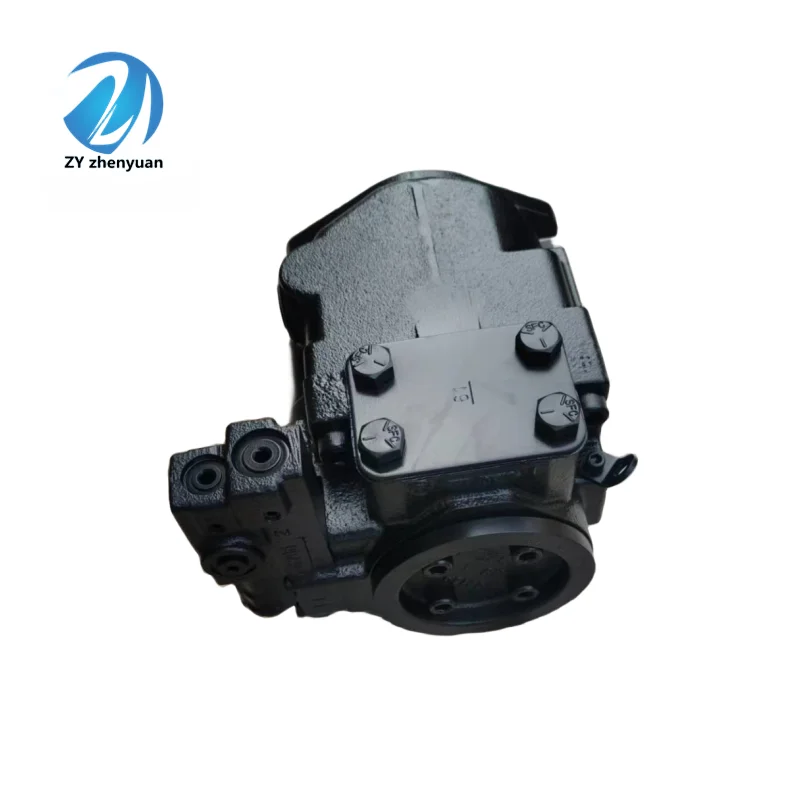


JRR060 JRR075 JRL045 JRL051 JRL060 JRL075 JRL JRR Open Circuit Axial Fixed Displacement Pump JRL060BLS252ONNN3C3N2A8NNNNNN
Core performance parameters
– Pump type: Axial variable piston pump, swash plate heavy-duty structure, right-rotating steering, suitable for high-pressure open/closed hydraulic circuits, supports stepless displacement adjustment, with built-in low-noise optimized design, providing high-pressure oil supply for medium and heavy-duty single/double actuators.
– Displacement and pressure parameters: Rated displacement 60 mL/r (marked with model “060”); Rated working pressure: 31.5 MPa, maximum allowable pressure: 35 MPa (for a duration of ≤10 seconds); Rated speed: 1500 r/min, maximum speed: 2000 r/min (short time ≤5 minutes).
– Flow and efficiency parameters: Maximum flow at rated speed is 90 L/min, and the variable range is continuously adjustable from 0 to 90 L/min. Volumetric efficiency ≥94%, total efficiency ≥86%; The rotational speed is within the range of 1000-1800 r/min, and the flow regulation accuracy is ±2%.
– Operating characteristics: Continuous operating oil temperature ≤85℃, rated working condition inlet vacuum degree ≤ 0.02MPa; The noise value is ≤78 dB (measured at 1 meter, it is 3-5 dB lower than that of ordinary pumps). The fault-free operating life is ≥ 15,000 hours (under rated conditions).
2. Structure and connection parameters
– Structural type: Swash plate axial piston structure, integrating the piston cylinder body, variable swash plate, return plate and built-in high-pressure relief valve; It adopts a combined control of constant power, constant voltage and load sensitivity, and supports remote proportional adjustment of displacement. Flange installation, equipped with high-efficiency oil suction filter screen, pressure compensation valve and low-noise unloading structure.
– Core material: The plunger is made of stainless steel 17-4PH (quenched and tempered, hardness HRC42-45); The cylinder block is made of alloy cast iron QT600-3 (aged treatment, hardness HB280-320). The swash plate is made of bearing steel GCr15 (quenched treatment, hardness HRC62-66). The sealing part is a combination of high-pressure resistant fluororubber and polytetrafluoroethylene (with a temperature resistance of ≤120℃).
– Connection specifications: The oil suction port (S) is a DN70 flange, and the oil outlet port (P) is a DN50 flange. The drive shaft is spline connected (specification: 10×38×42). Install flange bolts with a center distance of 190×130 mm. The weight of the pump body is approximately 120 kg, and its external dimensions (length × width × height) ≈550×320×360 mm.
3. Medium and Environmental requirements
– Medium requirements: L-HM 46/68 anti-wear hydraulic oil is suitable for normal temperature. L-HM 32 can be selected for low-temperature environment. The allowable medium viscosity is 25-400 mm²/s, with a moisture content of no more than 0.03% and an acid value of no more than 0.5 mgKOH/g. It is strictly prohibited to use media containing solid particles (particle size > 5 μm) or corrosive media.
– Cleanliness standard: The oil cleanliness must reach ISO 4406 15/12 grade. A 5 μm high-pressure fine filter must be placed in front of the oil suction port. The filter should be replaced immediately when the pressure difference of the filter is greater than 0.06 MPa.
– Environmental parameters: Operating environment temperature -25℃ to 90℃, relative humidity ≤95% (short-term condensation is allowed); With a protection grade of IP55, it is suitable for heavy-load and low-noise demand scenarios such as medium-sized construction machinery, industrial hydraulic stations, and mining equipment.Ii. Working Principle
This pump is a swashplate type axial variable piston pump. Its core achieves high-pressure and low-noise oil supply through the mechanism of “axial reciprocating volume change of the piston – swashplate Angle adjustment of the displacement – load sensitivity adaptation requirements”. The specific process is as follows:
1. Core process of oil suction and discharge
The drive shaft drives the cylinder block to rotate at high speed. Under the combined action of the spring force of the return disc and the hydraulic force, the plunger inside the cylinder block is always in close contact with the surface of the swash plate. When the plunger rotates with the cylinder block to the side of the swash plate that is farther from the center, the plunger extends outward, increasing the volume of the plunger chamber in the cylinder block and creating a negative pressure. Hydraulic oil is then drawn into the chamber through the suction port and the filter screen. When the plunger rotates to the side of the swash plate closer to the center, the inclined surface of the swash plate compresses the plunger to retract inward, causing a sharp reduction in volume. The oil is then discharged from the oil outlet under high pressure, completing the continuous oil suction and discharge cycle. Low-noise optimization eliminates trapped oil impact through arc-shaped unloading grooves and reduces transmission noise with silent bearings, achieving low-noise operation of ≤78 dB.
2. Variables and Safety Protection
– Stepless variable regulation: By combining a proportional electromagnet with a load-sensitive valve to control the variable mechanism, the tilt Angle of the swash plate (adjustable from 0 to 18°) is changed. An increase in the Angle leads to an increase in the plunger stroke and flow rate, while a decrease in the Angle results in a decrease in flow rate. The load sensitive system monitors the pressure demand of the actuator in real time, automatically matches the flow output, and achieves stepless adjustment from 0 to 90 L/min, with a response time of no more than 0.3 seconds.
– Safety Assurance: Equipped with a built-in high-pressure relief valve, it automatically unloads when the system pressure exceeds 33 MPa, and the overpressure oil flows back to the oil suction chamber. Constant power control automatically limits the maximum flow rate based on the power of the power source to avoid overload. The oil replenishment valve in the oil suction chamber prevents cavitation caused by excessive vacuum. The low-noise unloading tank simultaneously reduces pressure pulses, protecting pipelines and valve components.
Iii. Product Features and Advantages
– Medium displacement, high pressure and low noise compatibility: 31.5 MPa rated pressure combined with 60 mL/r displacement, maximum flow rate 90 L/min, compatible with equipment of 40-80 tons. The low-noise structure design ensures that the noise level is ≤78 dB, which is 3 to 5 dB lower than that of ordinary pumps. It is suitable for low-noise demand scenarios such as urban infrastructure and factory operations.
– Load sensitive, energy-saving and highly efficient: Load sensitive control can dynamically output flow according to the demand of the actuator. The non-working flow can be reduced to below 5 L/min, and the idle consumption is reduced by 40%. The flow regulation accuracy is ±2%, the pressure fluctuation under high-pressure conditions is ≤1%, and it is suitable for multi-action coordinated operation.
– Strong heavy-load impact resistance and reliability: The plunger is precisely ground with the cylinder block, with a fit clearance of ≤ 0.005mm and a volumetric efficiency of ≥94%. The core components are made of reinforced materials and undergo surface hardening treatment, featuring excellent resistance to impact loads. They can withstand a short-term high-pressure impact of 35 MPa and have a rated working condition fault-free life of ≥ 15,000 hours.
– Compact integration for easy installation: Integrates core components such as relief valves, load sensitive valves, and oil replenishment valves, eliminating the need for additional valve groups; Weighing only 120 kg, it is 30% lighter than the split system of the same displacement. The installation size is suitable for the limited space of medium-sized equipment and supports dual use of open and closed circuits.
– Intelligent control and easy operation and maintenance: Supports dual control of PLC and hydraulic pilot, and can be connected to the equipment intelligent monitoring system to provide real-time feedback on flow, pressure and operation status data. The external oil level mirror and pressure test port do not require disassembly of the pump body for operation and maintenance. The wear parts are highly universal, and the annual maintenance cost is 20% lower than that of similar products.
Iv. Usage Functions and Purposes
1. Core usage functions
High-pressure variable oil supply: It provides adjustable flow rates of 0-90 L/min for medium and heavy-duty systems, meeting the full working condition requirements from rapid action of the actuator (such as rapid mold closing of a hydraulic press), high-speed operation (such as rotation of an excavator) to high-pressure pressure holding (such as forging pressing), with low noise operation that does not interfere with the surrounding environment.
– Load sensitivity adaptation: Real-time monitoring of system load pressure, automatic adjustment of output flow to prevent excessive flow overflow loss, and adaptation to multi-action alternating or coordinated operation scenarios (such as excavator digging + rotation linkage, loader lifting + bucket flipping).
– Single-pump multi-loop drive: As the core power of the system, it distributes oil through multi-way valves, driving two heavy-duty actuators to act in coordination, enhancing system integration, reducing the number of pump body configurations, and lowering overall equipment noise.
2. Main application fields
In the medium-sized construction machinery field: 40-80 ton crawler excavators (main hydraulic circuit), 30-50 ton wheel loaders (lifting + bucket circuit), 100-200 ton truck cranes (telescopic boom + luffing circuit), suitable for low-noise demand scenarios such as urban infrastructure and factory operations.
– Industrial equipment field: 1000-2000 ton hydraulic press (main cylinder drive circuit), medium-sized machine tool hydraulic system (feed + clamping circuit), 1000-1500 ton heavy-duty injection molding machine (mold closing + injection circuit), suitable for precision operations in factories.
– Mining and special fields: Small and medium-sized mining crushing stations (hammer drive circuits), small tunnel boring machines (cutter head drive circuits), 20-40 ton cranes in ports (lifting + luffing circuits), suitable for scenarios with continuous heavy loads and certain noise control.
V. Applicable Machines and Scenarios
1. Adapt to the core machine
Medium-sized construction machinery: 40-80 ton crawler excavators, 30-50 ton wheel loaders, 100-200 ton truck cranes, medium-sized hydraulic crushing stations.
– Industrial equipment: 1000-2000 ton hydraulic press, medium-sized CNC lathe hydraulic system, 1000-1500 ton forging machine, 1000-1500 ton injection molding machine.
– Mining and special equipment: Small and medium-sized mining tunnel boring machines, small tunnel shield machines (main hydraulic systems), 20-40 ton gantry cranes for ports, medium-sized ship deck machinery.
2. Typical application scenarios
– Urban excavator operation scenario: As the main pump of a 60-ton excavator, it provides a high-pressure oil source of 31.5MPa in urban demolition projects. During excavation, it outputs a flow rate of 90 L/min to drive the bucket and boom linkage, with a noise level of ≤78 dB, meeting the urban operation standards. Compared with traditional pumps, it saves 35% energy.
– Factory hydraulic press forming scenario: For a 1500-ton factory hydraulic press, it outputs a flow rate of 90 L/min during rapid mold closing to enhance efficiency. When pressing precision parts, it reduces to a small flow rate of 25 L/min for pressure holding (pressure 31.5MPa, pressure holding accuracy ± 0.3MPa). It operates with low noise and does not affect the workshop environment.
– Mining area crushing scene: Equipped with small and medium-sized mining crushing stations, it provides 31.5MPa high-pressure oil for each crushing hammer. The flow rate is automatically adjusted according to the hardness of the rock (30-70 L/min). The impact-resistant structure is suitable for stone crushing operations, and the low-noise design improves the operating environment in the mining area.
Six. Similar models
1. Alternative models of the same series
– JRL040BLS252ONNN3C3N2A8NNNNNN: with small displacement low noise structure model, the rated capacity of 40 mL/r, 60 L/min, peak flow stress and noise parameters is consistent, adapter light overload (e.g., 30 tons loaders), low noise system costs 20% lower than the original model.
– JRL080BLS252ONNN3C3N2A8NNNNNN: with large displacement series low noise model, the rated capacity of 80 mL/r, maximum flow 120 L/min, the same pressure and noise parameters, fit medium low noise system (such as 80 tons of excavator), cost is 25% higher than the original model.
2. Cross-series alternative models
– JRL060BLS252ONNN3C3N2A8NNNNNN – L: left rotation to the low noise model, structure and parameter exactly, the power source of the adapter left-hand drive shaft (e.g., part of imported diesel engine), the cost and the original model.
– JRL060252ONNN3C3N2A8NNNNNN: base type of low noise design model, or less 85 dB noise and no noise requirements adaptation of the working condition of normal temperature, 30% lower cost than the original model.
– JRL060BLS252ONNN3C3N2A8NNNNNN – D: quantitative low noise model, fixed displacement 60 mL/r, pressure and noise parameters is consistent, stable adaptive traffic demand high pressure low noise system (such as fixed location hydraulic press), 15% lower cost than the original model.
Vii. Precautions for Use
1. Medium management
For normal temperature conditions, L-HM 46/68 anti-wear hydraulic oil should be selected. For low-temperature environments, L-HM 32 anti-wear hydraulic oil should be chosen. It is strictly prohibited to mix oils of different grades or use deteriorated oils. Before the new pump is used for the first time, the pump body and pipelines should be flushed with clean oil in a circulating manner for ≥20 minutes to ensure that the oil cleanliness meets ISO 4406 15/12 grade.
– Check the pressure difference of the oil suction filter weekly (replace the filter element immediately when the pressure difference is greater than 0.06 MPa), test the moisture content of the oil monthly (≤0.03%), and take samples to test the cleanliness of the oil quarterly. When emulsification, discoloration or presence of metal impurities in the oil is detected, immediately stop the machine to change the oil and disassemble and clean the pump body to prevent impurities from wearing down the silent structure.
2. Installation and commissioning
When installing, ensure that the coaxiality of the drive shaft and the motor shaft is ≤ 0.04mm (using an elastic coupling + positioning sleeve for positioning), and the flange connection bolts are evenly tightened with a torque of 600 N·m. The diameter of the oil suction pipeline should be no less than DN70, the length no more than 2.0m, and the number of pipeline elbows should not exceed 2 to avoid excessive oil suction resistance causing abnormal noise.
Before debugging, add hydraulic oil to the upper limit of the oil level gauge in the oil tank, and manually turn the wheel 3 to 5 times to confirm there is no jamming. Jog the motor to verify the rotation direction (right rotation), run it at low speed (1000 r/min) without load for 15 minutes, and then test the variable adjustment performance (no lag and stable pressure when adjusting from 0 to the maximum flow), while monitoring the noise value (≤78 dB is qualified).
The oil suction port should be at least 500mm lower than the oil level in the oil tank, and a 0-40MPa high-pressure pressure gauge should be installed at the oil outlet. When installing in low-noise scenarios, rubber shock-absorbing pads are added between the pump body and the base to further reduce vibration and noise. Install rain and dust covers outdoors to ensure that the protection level remains at IP55.
3. Operation and Maintenance
During operation, the pump body temperature (normal ≤80℃, maximum ≤90℃), outlet pressure and operating noise are monitored in real time. If a sudden temperature rise exceeding 15℃, pressure fluctuation greater than 1.2MPa, or abnormal noise increase (> 85dB) is detected, immediately stop the machine for inspection, with a focus on checking for oil contamination, blockage of the silent unloading tank, or wear of the bearings.
Regular maintenance should be carried out every 2000 hours: clean the oil suction filter screen and the built-in relief valve, check the fit clearance between the plunger and the cylinder block (replace the matching parts when the clearance is greater than 0.01mm), the wear condition of the silent bearing and the cleanliness of the unloading groove. Replace the high-pressure seals and hydraulic oil, and recalibrate the relief valve pressure to 33 MPa.
– It is strictly prohibited to run the engine without oil (idling for more than 3 seconds will cause sintering and damage to the plunger and cylinder block). It is strictly prohibited to operate at an excessive speed (> 2000 r/min) or under long-term overpressure (> 35 MPa) to avoid damaging the low-noise structure. When adjusting variables, avoid sudden changes in flow rate to prevent system shock and increased noise.
4. Storage protection
When stored for a long time, use special high-pressure plugs to block the oil suction port and the oil outlet, inject special anti-rust oil into the pump body, and apply high-temperature grease to the splined parts of the drive shaft. Store in a dry and well-ventilated warehouse with a temperature ranging from 0 to 45℃ and a humidity of no more than 60%. Avoid direct sunlight and heavy object compression. Manually turn the machine once a month to prevent component adhesion and protect the precision of the silent structure.
Before putting the pump into use after being idle for more than 18 months, thoroughly clean the inner cavity and oil passage of the pump body, and replace all high-pressure seals and silent bearings. After adding the corresponding working condition hydraulic oil, conduct a low-speed trial run for 2 hours to comprehensively test the variable performance, pressure stability and noise value. After confirming that there are no abnormalities, connect to the system.