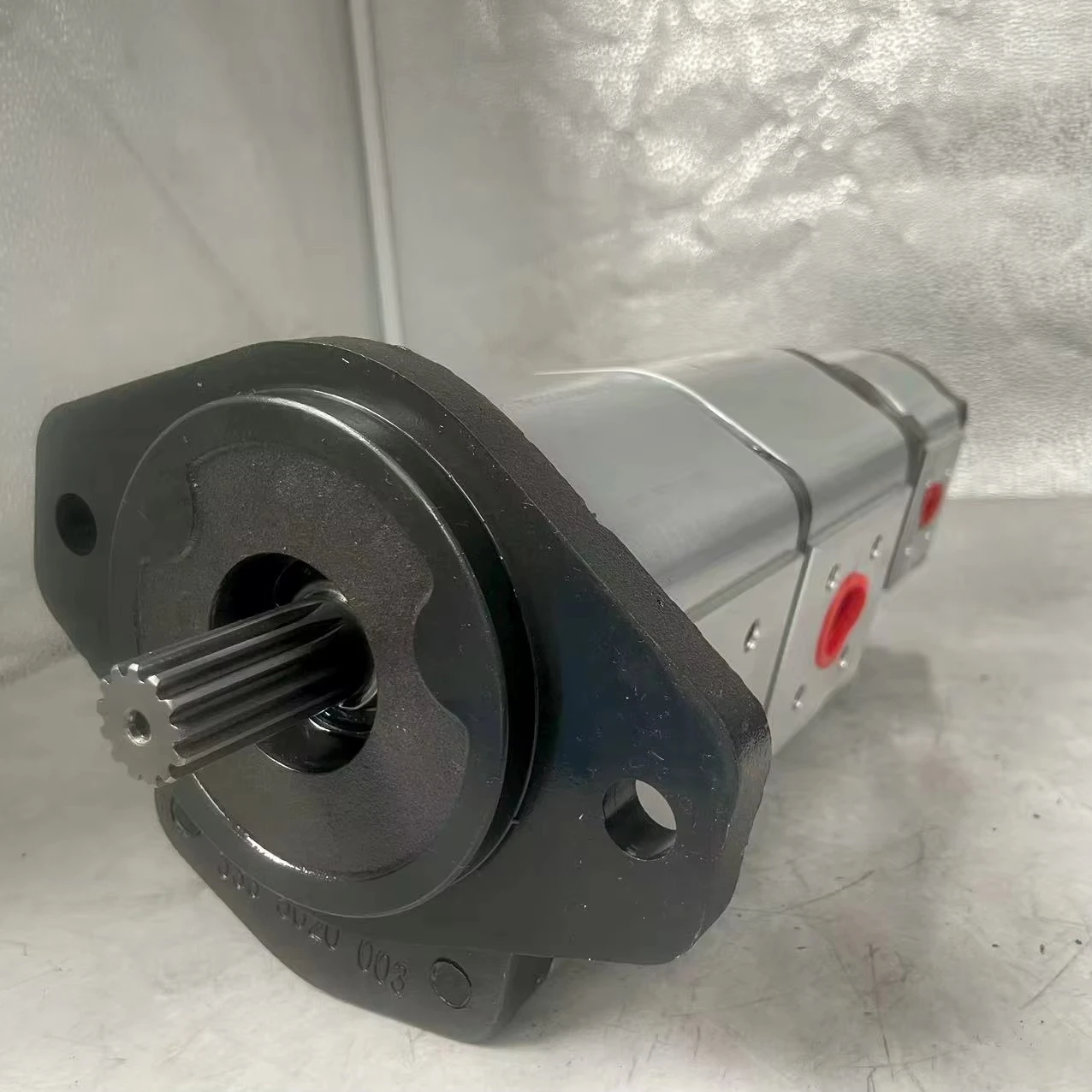
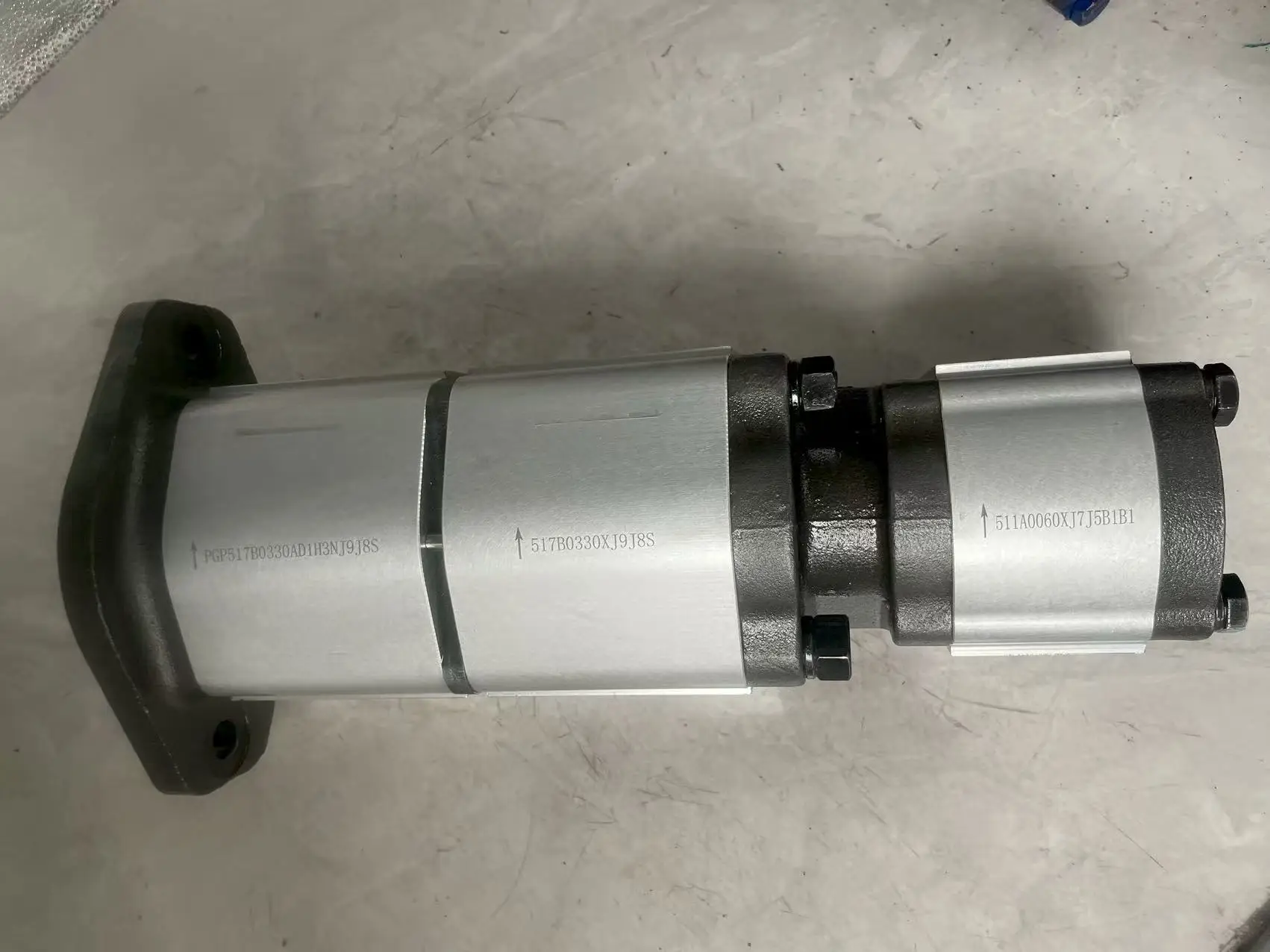
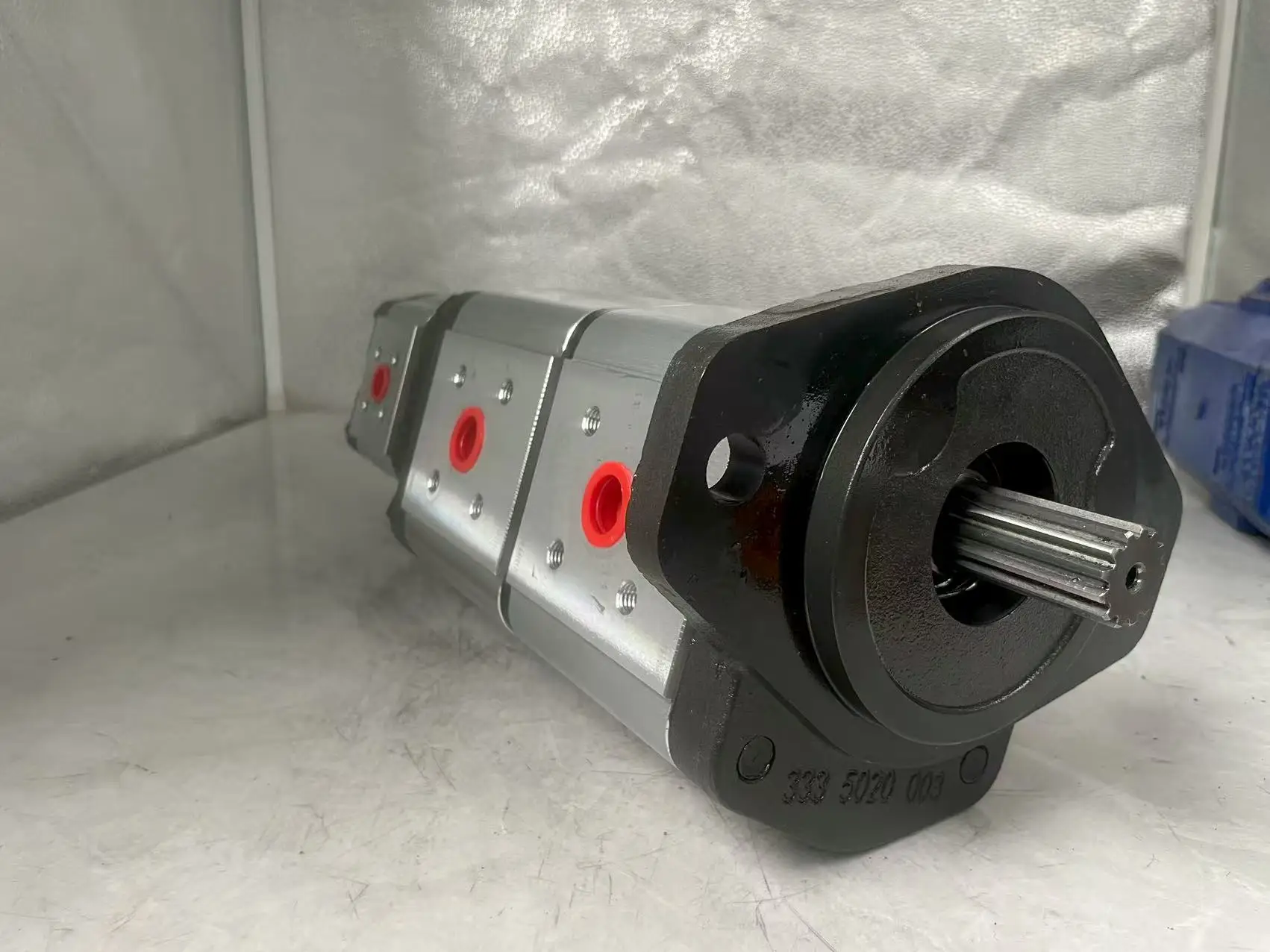
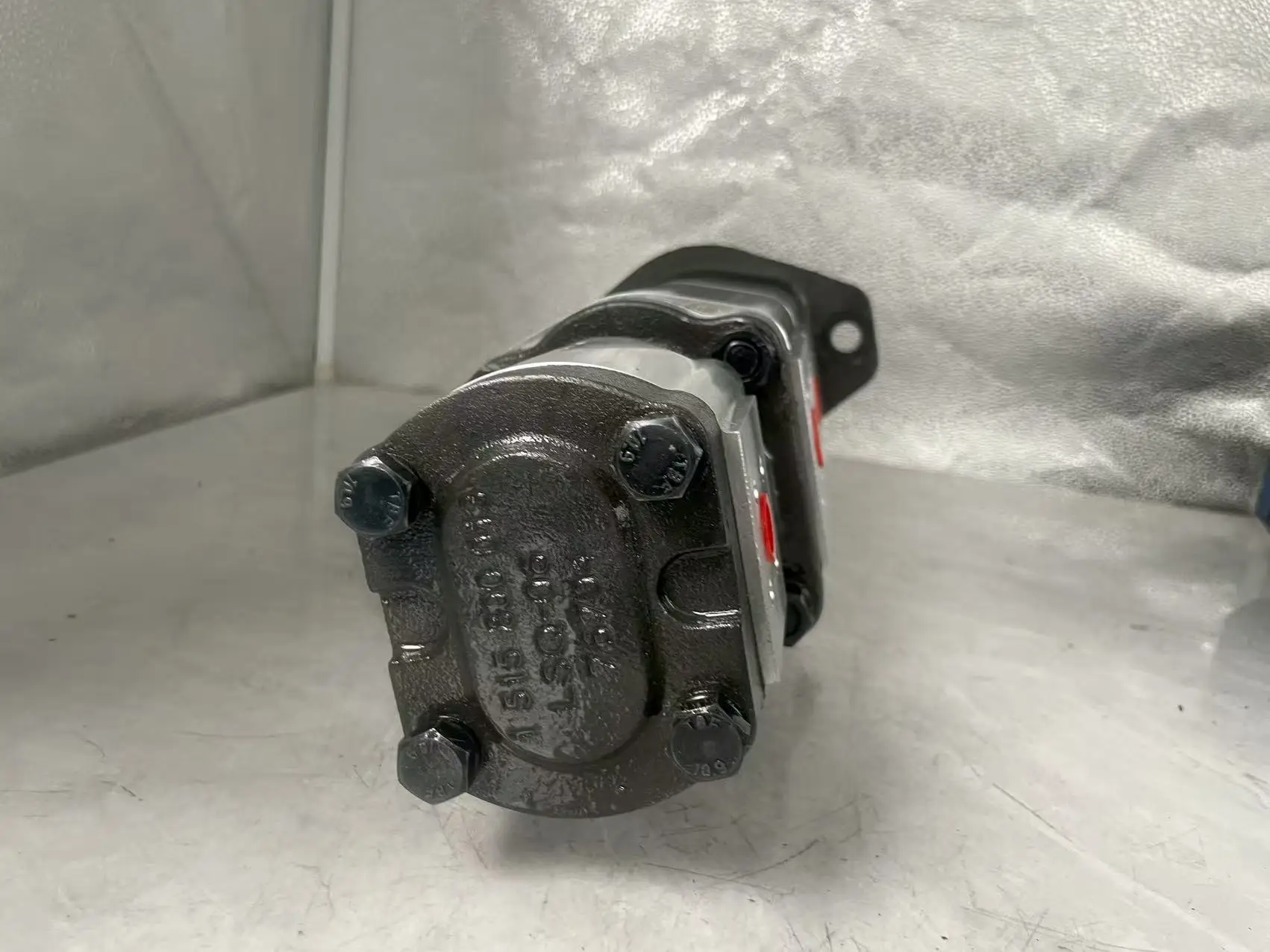
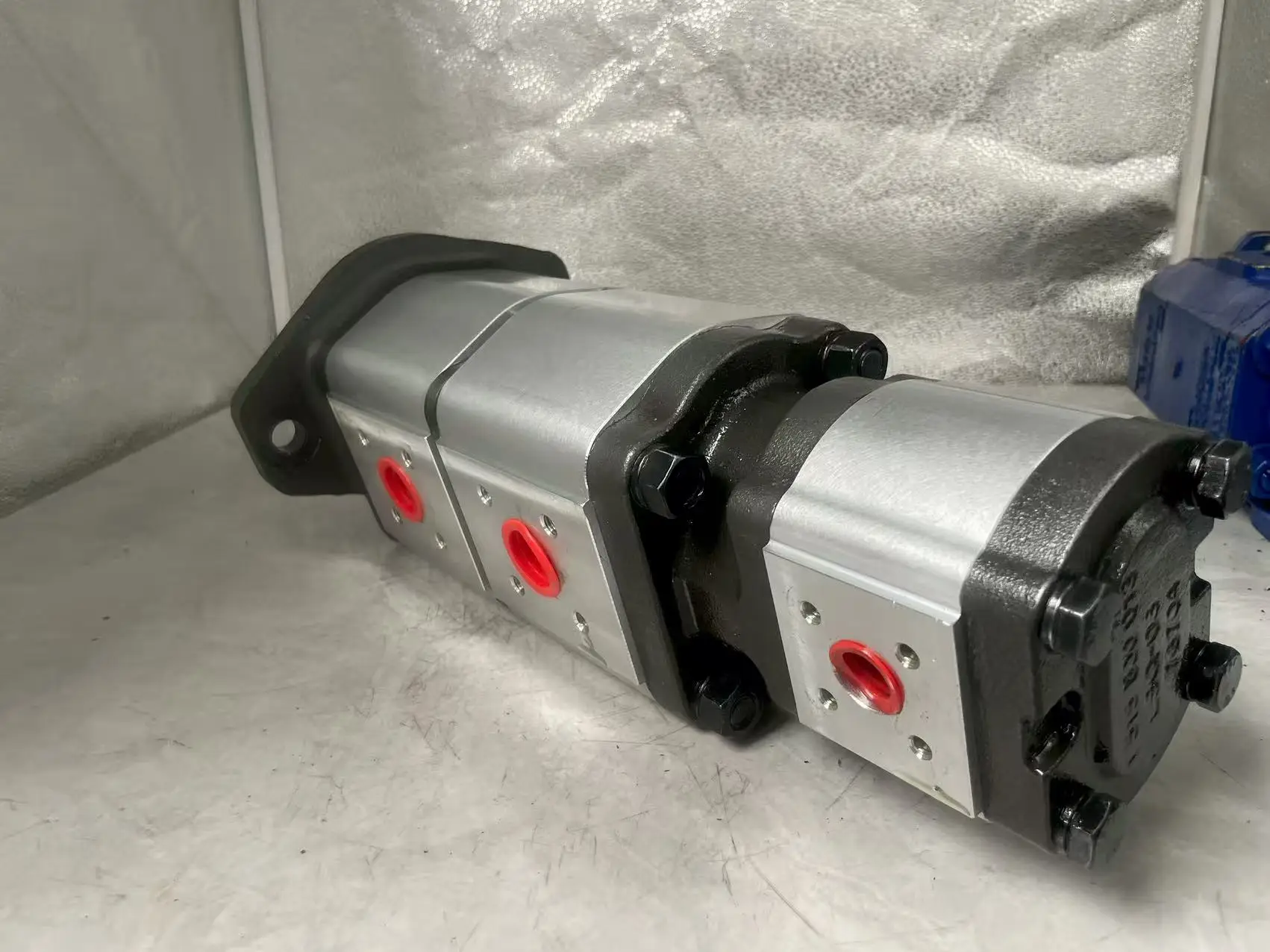
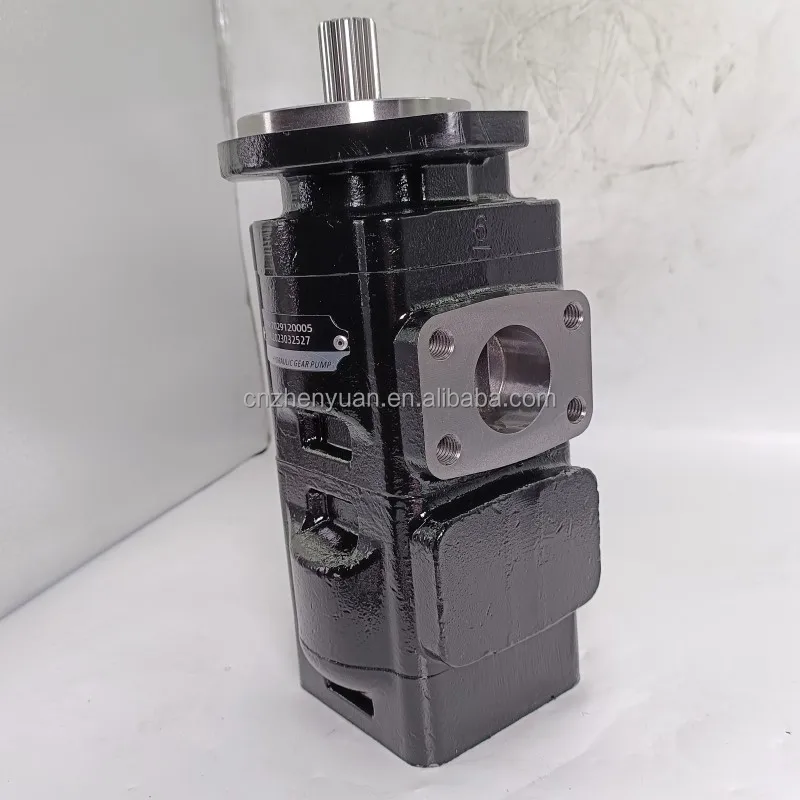
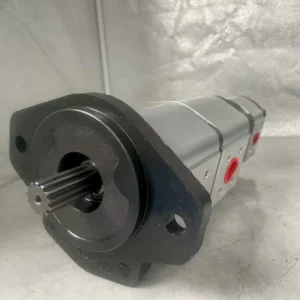
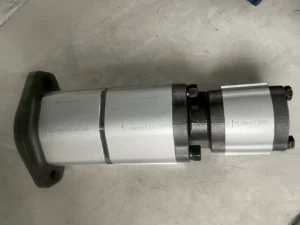
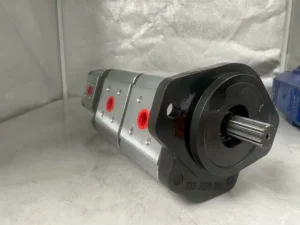
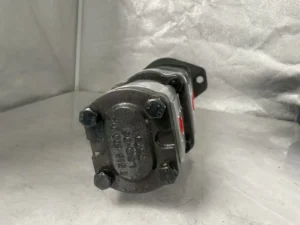
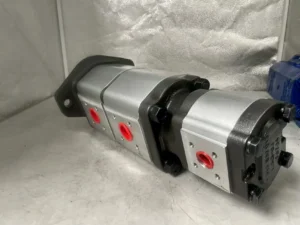
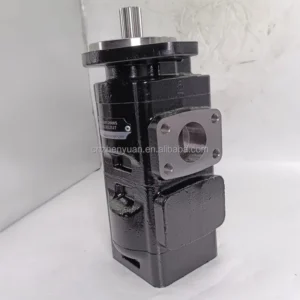
PGP517B0330AD1H3NJ9J8S-517B0330XJ9J8S-511A0060XJ7J5B1B1 Hydraulic Gear Pump PGP PGM PGP315 PGP517 PGP505 PGP511 Oil Pump
Basic specifications
Type: PGP series external meshing fixed displacement gear pump, three-pump structure (two 517 series + one 511 series pump units share one drive shaft)
Shell size: two PGP517 series + one PGP511 series, representing the size specification of the pump. The larger the number, the greater the displacement
Displacement
Main pump (517B0330) : approximately 33cc/rev (33ml/r), theoretical flow rate at 1500rpm is about 49.5L/min
Auxiliary pump (517B0330) : The same as the main pump, approximately 33cc/rev
Auxiliary pump (511A0060) : approximately 6cc/rev, with a theoretical flow rate of about 9L/min at 1500rpm
Rated working pressure: 25MPa (250bar), short-term peak pressure up to 27.5MPa (275bar)
Rated speed: 3000-3400rpm (slightly varying depending on the specific model), minimum stable speed ≥500rpm
Rotation direction: Standard clockwise (viewed from the shaft end), counterclockwise rotation can be achieved by replacing the pump unit
Drive mode: Through shaft drive, with one shaft simultaneously driving three pump units, saving space and installation costs
Working parameters
Volumetric efficiency: ≥92% (under rated conditions), with low energy conversion loss
Overall efficiency: ≥85%, with highly efficient comprehensive performance
Applicable medium: Anti-wear hydraulic oil, lubricating oil (viscosity index ≥90), L-HM46 or L-HV46 hydraulic oil is recommended
Medium viscosity: 10-300mm²/s, optimal working viscosity: 20-60mm²/s
Medium temperature: -15℃ to +80℃, recommended working temperature: 30-55℃
Oil cleanliness: ISO 4406 18/15 grade. A 10μm precision filter must be installed to protect the precision components
Weight: Approximately 38kg (excluding accessories), compact structure, high power densityIi. Working Principle
The core working mechanism of the external gear pump
Basic structure
Separated three-piece structure: Composed of the front pump cover, pump body and rear pump cover
The pump body is equipped with a pair of meshing gears (driving gear and driven gear), with 13 teeth for the PGP517 series and 12 teeth for the PGP511 series
The gear, the pump body and the end cover form a sealed working chamber, which is divided into the oil suction zone and the oil pressure zone by the meshing line
The three-pump structure connects three independent pump units through a common drive shaft, and each pump unit has independent oil inlet and outlet ports
Principle of fluid transportation
When the prime mover drives the driving gear to rotate, it meshes to drive the driven gear to rotate in the opposite direction
In the oil suction zone, the gears disengage, the sealed volume increases, and a local vacuum is formed. Under the action of atmospheric pressure, the oil in the oil tank is sucked in
The sucked oil fills the Spaces between the teeth and is carried to the oil pressure area as the gears rotate
In the oil pressure zone, the gears engage, the sealed volume decreases, and the oil is squeezed and discharged from the oil outlet
Due to the continuous rotation of the gears, the pump continuously sucks and discharges oil, outputting a stable flow rate
Mechanism of stress generation
The output pressure of the pump depends on the load resistance. When the load increases, the output pressure rises accordingly
The maximum pressure that the pump itself can withstand is determined by its structural strength and sealing performance (250bar for this model).
When the system pressure exceeds the rated value, the pressure should be limited through protective devices such as relief valves to prevent pump damage
Working characteristics of the three-pump:
Three pump units operate synchronously, and the flow rates can be superimposed (the total theoretical flow rate ≈96L/min).
Each pump unit can independently supply oil to different actuating elements, achieving a multi-loop system
Different displacement combinations can be configured to meet the flow and pressure requirements of different branches in the system
The shared drive shaft design reduces space occupation and the number of components, enhancing system reliability
Iii. Product Features and Advantages
1. High-pressure and high-efficiency performance
High-pressure working capacity: Continuous working pressure up to 250bar, short-term peak value 275bar, suitable for various high-pressure working conditions
High efficiency: The adoption of pressure-balanced floating bushing design reduces leakage and enhances volumetric efficiency (≥92%).
Low flow pulsation: The optimized tooth profile design (PGP517 has 13 teeth) minimizes flow and pressure pulsation, ensuring smooth operation
High power density: Large output power per unit volume, suitable for application scenarios with limited space
2. Structural and reliability advantages
High-strength materials: It adopts high-quality cast iron/aluminum alloy shell and high-strength gear materials, with strong anti-deformation ability
Large-diameter bearings: DU bearing design, strong load-bearing capacity, suitable for high-pressure operation, and extended service life
Automatic compensation function: The floating bushing can automatically compensate for wear and maintain long-term high-efficiency operation
Anti-pollution ability: It has a relatively low sensitivity to oil contamination and is suitable for harsh working environments
Easy maintenance: Modular design makes it easy to disassemble, assemble and repair, and the main components can be replaced separately
3. Advantages of the three-pump system
System simplification: One drive source drives three pumps, reducing components such as motors and couplings, and lowering costs and complexity
Multi-loop independent control: Three pumps can respectively supply oil to different actuating elements, achieving complex system functions
Flexible flow configuration: Different displacement combinations (33cc+33cc+6cc) meet the requirements of different branches in the system
Redundant design: When one pump unit fails, other pump units can still maintain the basic functions of the system, enhancing reliability
Space optimization: Compared with three independent pumps, it occupies less space and is convenient for installation and pipeline layout
4. Other features
Low-noise operation: The optimized tooth profile and structural design keep the operating noise below 80dB, improving the working environment
Good self-priming ability: No additional auxiliary pump is required, and the suction lift can reach 4 meters (depending on the viscosity of the medium)
The rotation direction is optional: clockwise, counterclockwise or bidirectional rotation versions are available to meet different installation requirements
Wide temperature adaptability: It can operate in an environment ranging from -15 ℃ to +80℃, adapting to different working conditions and regions
Iv. Usage Functions and Purposes
Core functions
Convert the mechanical energy of the prime mover into hydraulic energy to provide stable flow and pressure for the hydraulic system
The three-pump can simultaneously provide power for multiple actuating elements (such as hydraulic cylinders and hydraulic motors) to achieve complex mechanical movements
Precisely control the output flow to meet the requirements of different working mechanisms for speed and force
Main application fields
Construction machinery
Working devices and traveling systems of excavators, loaders, bulldozers, etc
It provides multiple hydraulic power sources to simultaneously drive the boom, bucket, bucket and traveling motor
It is particularly suitable for large-scale construction machinery that requires independent control of multiple circuits
Agricultural machinery
Hydraulic systems for tractors, harvesters, seeders, etc
It provides power for hydraulic steering, harvesting devices, material conveying, etc
It is suitable for the characteristics of large temperature differences and a lot of dust in the farmland operation environment
Mining machinery
Underground scraper conveyors, tunnel boring machines and other equipment
It provides reliable power in harsh environments and is suitable for damp and dusty conditions
The three-pump design can simultaneously drive the conveying, cutting and support systems
Industrial equipment
Industrial machinery such as injection molding machines, presses, and steel rolling equipment
Provide high-pressure stable flow to meet the requirements of different working conditions
The multi-pump design can simultaneously control multiple actions such as mold closing, injection, and ejection
Vehicle field
Hydraulic power steering systems for heavy-duty trucks and construction machinery vehicles
Provide auxiliary power for the braking system and lifting system
The three-pump can simultaneously drive the steering, lifting and braking systems
V. Applicable Machines and Scenarios
1. Typical applicable machines
Hydraulic system of large excavators
It is particularly suitable for 20-30 ton excavators, such as the PC200 and ZX230 models of a certain brand
Three-pump configuration: The main pump drives the working device (boom, bucket rod, bucket), the auxiliary pump drives the rotary and traveling systems, and the auxiliary pump provides pilot control pressure
When performing compound actions, the three pumps work in coordination, increasing the overall efficiency of the machine by 15-20%
Adapt to the frequent start-stop, reversing and load changes in excavation operations
Injection molding equipment
It is suitable for large injection molding machines with a clamping force of 1,000 to 2,000 tons
The main pump provides high pressure and large flow for mold closing and injection, the auxiliary pump provides pressure holding and ejection power, and the auxiliary pump is used in the hydraulic control circuit
The three-pump design enables the injection molding machine to achieve precise flow and pressure control at different working stages (mold closing, injection, pressure holding, cooling, and ejection)
Reduce system heat generation, improve energy utilization efficiency and production efficiency
Mine scraper conveyor
It is applicable to large-scale conveying equipment in coal mines, metal mines, etc
The main pump drives the scraper chain to operate, the auxiliary pump drives the tensioning device, and the auxiliary pump provides pressure for the control system
Provide stable power in harsh environments (damp, dusty, vibrating) to ensure continuous production
The three-pump configuration enhances system reliability and reduces maintenance frequency
2. Characteristics of applicable scenarios
Complex hydraulic systems that require independent control of multiple circuits, such as construction machinery and injection molding machines
Applications in high-pressure and high-flow working environments, with an output pressure stabilized at 20-25 mpa and a flow requirement of 50-100L/min
In situations where space is limited but multiple pumps are needed for oil supply, such as in vehicle and ship hydraulic systems
Industrial applications that require high efficiency and low energy consumption, such as precision processing equipment
Mining, metallurgy, construction and other industries with harsh working environments (high temperature, humidity, dust)
For production equipment that requires continuous and stable operation, the three-pump design provides redundant backup to enhance system reliability
Six. Similar models
1. Different specifications and models of the same series
PGP517A0330: It is basically the same as 517B0330, with the main differences lying in the housing material or bearing configuration. The A series usually has a cast iron housing, while the B series has an aluminum alloy housing
PGP517B0280/0360/0380: Different displacement versions, approximately 28cc/rev, 36cc/rev, and 38cc/rev respectively, suitable for various flow requirements
PGP511A0040/0080:511 series with different displacement versions, approximately 4cc/rev and 8cc/rev respectively, can be used as auxiliary pumps
PGP505 series: Smaller specifications (displacement 3-12cc/rev), suitable for small hydraulic systems
2. Different series models of the same type
PGP503 series: The smallest specification (displacement 0.8-7.9cc/rev), suitable for precise control and low-flow applications
PGP523 Series: Larger specifications (displacement 50-70cc/rev), suitable for super-large construction machinery and Marine hydraulic systems
PGM series: Similar in structure to the PGP series, but the PGM series is a motor that can convert hydraulic energy into mechanical energy
3. Similar products from other brands
Rexroth Rexroth 1PF2G series: High-pressure aluminum alloy gear pumps, with displacement and pressure parameters similar to those of the PGP series, can be interchanged under certain conditions
Kracht KP series: High-pressure gear pumps, with performance parameters similar to those of the PGP series, are particularly suitable for high-precision applications
Marzocchi ALP Series: Aluminum alloy gear pumps, with excellent cost performance, are suitable for general industrial applications
Domestic YUKEN oil research series: Similar performance, more economical price, suitable for domestic market maintenance and matching
Vii. Precautions for Use
1. Installation points
Direction confirmation
It must be installed in the specified direction (standard clockwise). The oil inlet and return ports must not be connected in reverse; otherwise, the internal seal and bearings will be damaged
The oil inlet and outlet ports of each pump unit should be correctly connected. Incorrect connection is not allowed to cause system failure
Fixation and connection
The installation plane must be flat (flatness < 0.1mm), and the fixing bolts should be evenly tightened to prevent the shell from deforming and affecting the gear meshing
The drive shaft and the prime mover must be connected by an elastic coupling. Rigid connection is strictly prohibited, and the coaxiality error should be less than 0.05mm
The installation bracket of the three-pump must have sufficient rigidity to prevent vibration and displacement during operation
Pipeline configuration
The inlet pipe diameter is ≥38mm (for the main pump) to ensure smooth oil suction, reduce oil suction resistance and prevent cavitation
The outlet pipe diameter should be no less than 32mm, and the return pipe diameter no less than 25mm to ensure smooth oil return and a back pressure of less than 0.5MPa
The drain pipes of each pump unit must be led back to the oil tank separately and not connected to back pressure to ensure the smooth discharge of the leaked oil inside
All pipelines must be firmly fixed to prevent vibration and wear
2. Startup and Operation management
Startup program
Check the oil level in the fuel tank (≥300mm above the suction port) and the oil temperature (≥-10℃)
Manually turn the wheel 2 to 3 times to ensure there is no jamming
Loosen the exhaust plug, jog the start motor to exhaust, and then tighten it after continuous oil output
Start the machine without load and run it for 5 to 10 minutes to observe if there are any abnormal noises or leaks
Gradually load (each time ≤25% of the rated pressure, with an interval of ≥3 minutes). It is strictly prohibited to directly load the cold machine to full capacity
Operation monitoring
Oil temperature: Normal operating temperature is 30-55℃. If the temperature exceeds 70℃, the machine should be shut down to check the cooling system
Pressure: Not exceeding the rated value (250bar), peak not exceeding 275bar and cumulative time < 10 minutes per hour
Noise: Smooth operation <85dB. Abnormal noise (>90dB) indicates possible wear or cavitation, and the machine should be stopped immediately
Leakage: Slight seepage (<15 drops per minute) is allowed. If the leakage increases, timely maintenance is required
The working status of each pump: Regularly inspect the working condition of each pump unit to ensure there is no abnormal vibration or overheating
3. Maintenance and care
Daily inspection
Check the oil level, temperature, noise and leakage conditions every shift, and record the operating parameters
Check if the connecting bolts are loose and tighten them in time
Clean the surface of the pump body to prevent the accumulation of oil stains from affecting heat dissipation
Check the pressure difference of the filter to ensure the filtration effect
Regular maintenance
Every 250 hours: Check the pressure difference of the filter (<0.15MPa), and replace the filter element if necessary
Every 500 hours: Check the contamination level of the oil (≤ISO 4406 18/15 grade), and take samples for testing if necessary
Every 1000 hours: Change the hydraulic oil and clean the oil tank and filter at the same time
Every 2000 hours: Conduct a comprehensive disassembly and inspection, measure the fit clearances of key components such as gears and bushings, and replace worn parts
Oil Product management
Anti-wear hydraulic oil that meets the requirements must be used. Hydraulic oils of different brands are strictly prohibited from being mixed
In cold regions, low-viscosity hydraulic oil (such as L-HV series) should be used to ensure low-temperature starting performance
Regularly test the viscosity and acid value of the oil to ensure they meet the usage requirements
The cleanliness of the oil is of vital importance and the filter must be inspected and replaced regularly
4. Special Precautions
Prevent dry running
It is strictly prohibited to start the pump without oil. Even short-term dry operation will cause severe wear of gears and bearings
After a long period of inactivity, when restarting the pump, clean hydraulic oil should be filled into it
Before starting, it is necessary to confirm that the fuel supply system is working properly
Prevent cavitation
Ensure that the oil suction pipeline is well sealed to prevent air from entering the system and forming bubbles
The oil suction height should be less than 500mm, and it is recommended to be less than 300mm to reduce the oil suction resistance
When the oil temperature is too low (<10℃), run it no-load for 20 minutes first to increase the oil temperature before loading
Avoid operating when the oil viscosity is abnormal to prevent difficulty in oil suction
Load matching
It is strictly prohibited to operate beyond the rated pressure and speed; otherwise, the service life will be significantly shortened
Avoid frequent overload impacts to protect gears and bearings
Theoretically, it is not allowed for the maximum pressure and maximum rotational speed to occur simultaneously to avoid overload
The working loads of each pump unit should be as balanced as possible to avoid one pump unit being under high load for a long time while others are under light load
Shutdown protection
Before shutting down, the oil should be unloaded to a low pressure (<20bar) and run for 5 to 10 minutes. Only when the oil temperature drops below 60℃ should the power be cut off
If the equipment is not in use for a long time, it should be pumped back in