
What Is a Hydraulic System?
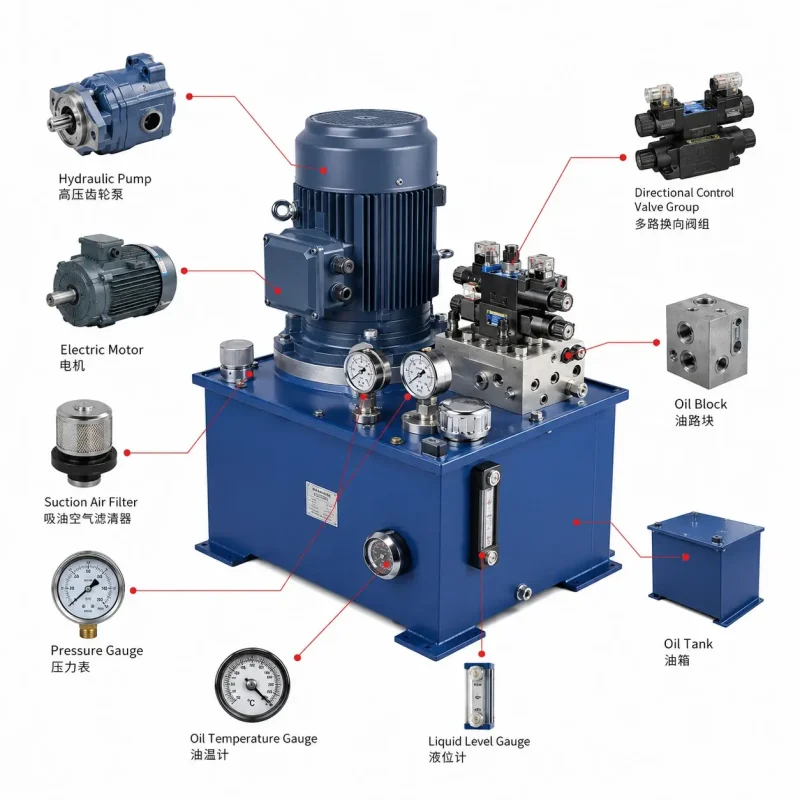
A hydraulic system is a power transmission system that uses incompressible fluid, usually hydraulic oil, to transfer energy from a pump to an actuator.
A basic hydraulic system includes:
- Hydraulic pump
- Reservoir
- Valves
- Hydraulic cylinders or motors
- Hoses, pipes, and fittings
- Filters
- Pressure relief devices
- Coolers or heat exchangers
In most industrial systems, operating pressures commonly range from 70 bar to 350 bar. Heavy-duty mobile and hydrostatic systems may operate above this range depending on the pump, motor, and circuit design.
Main Types of Hydraulic Systems
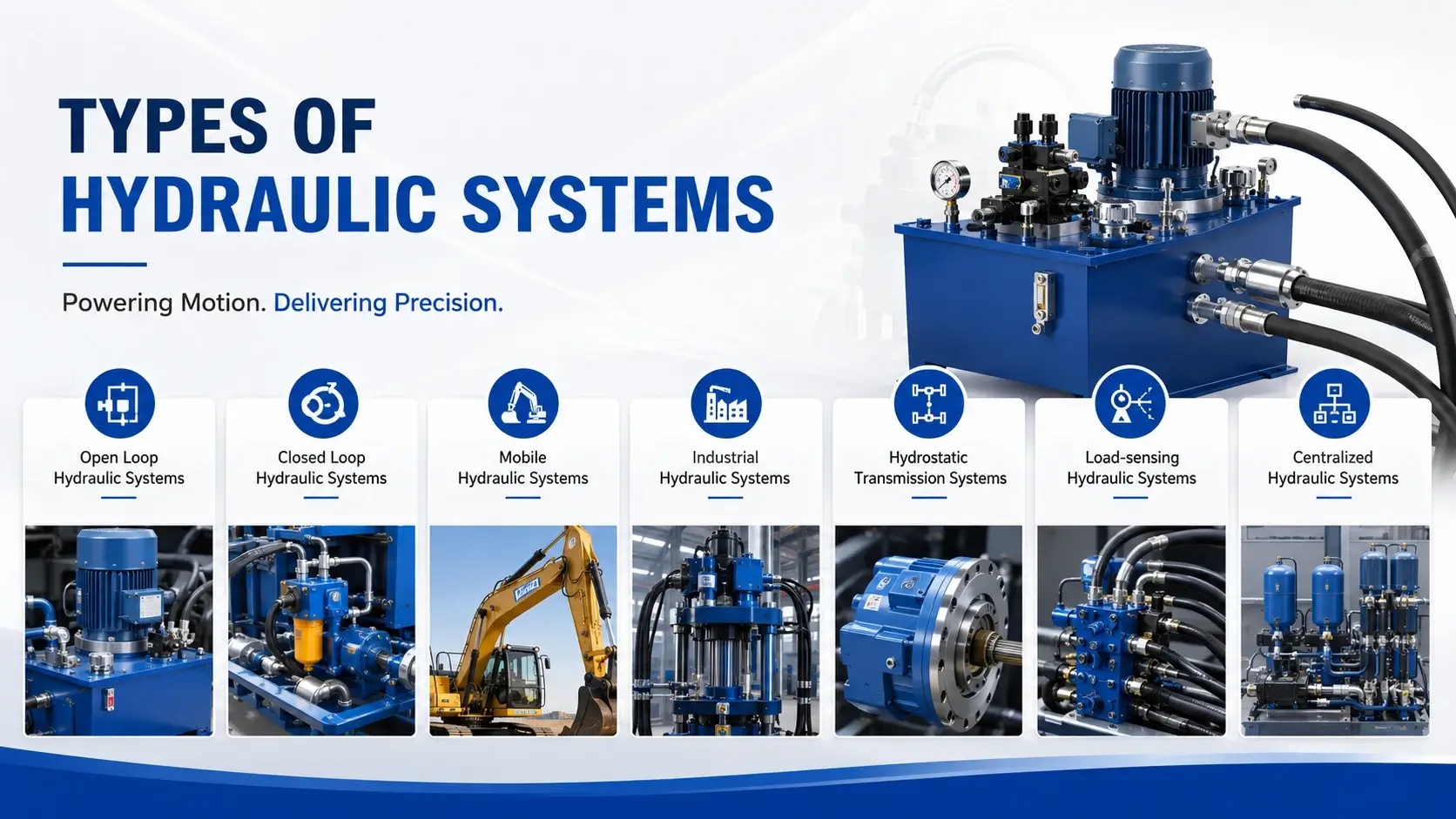
The main types of hydraulic systems include:
- Open loop hydraulic systems
- Closed loop hydraulic systems
- Mobile hydraulic systems
- Industrial hydraulic systems
- Hydrostatic transmission systems
- Load-sensing hydraulic systems
- Centralized hydraulic systems
Each type has different advantages depending on load, speed control, duty cycle, efficiency, heat generation, and maintenance requirements.
Open Loop Hydraulic Systems
How It Works
In an open loop circuit:
1.The pump draws oil from the tank.
2.Pressurized oil flows through valves.
3.The valve directs oil to a cylinder or motor.
4.Return oil flows back to the tank.
5.The reservoir helps with cooling, deaeration, and contamination settling.
Common Applications
Open loop systems are widely used in:
1.Hydraulic presses
2.Lift tables
3.Dump trucks
4.Machine tools
5.Agricultural implements
6.Industrial cylinders
7.Material handling equipment
Advantages
1.Simple design
2.Easier cooling through the reservoir
3.Lower initial cost
4.Easier filtration and maintenance
5.Suitable for cylinder-driven equipment
Limitations
1.Less efficient for continuous rotary drive
2.Larger reservoir may be required
3.More heat generation in some valve-controlled systems
4.Less compact than closed loop systems
Open loop systems are often preferred when the application needs linear motion, moderate control precision, and reliable serviceability.
Closed Loop Hydraulic Systems
How It Works
In a closed loop circuit:
1.A variable displacement pump sends oil directly to a hydraulic motor.
2.The return flow from the motor goes back to the pump inlet.
3.A charge pump supplies makeup oil to replace leakage.
4.Direction and speed are controlled by changing pump displacement.
Common Applications
Closed loop systems are used in:
1.Excavator travel drives
2.Skid steer loaders
3.Combine harvesters
4.Road rollers
5.Concrete mixers
6.Winches
7.Marine propulsion systems
Advantages
1.High efficiency for rotary motion
2.Compact circuit layout
3.Excellent speed and direction control
4.Suitable for continuous drive applications
5.Fast response
Limitations
1.More complex than open loop systems
2.Requires charge pressure control
3.More sensitive to contamination
4.Heat management must be carefully designed
5.Troubleshooting requires higher technical skill
Closed loop systems are best suited for equipment that needs continuous rotation, variable speed, and reversible motion.
Mobile Hydraulic Systems
Common Applications
1.Excavators
2.Wheel loaders
3.Forklifts
4.Cranes
5.Tractors
6.Drilling rigs
7.Mining equipment
8.Forestry machinery
Key Features
Mobile hydraulic systems often use:
1.Gear pumps for simple auxiliary functions
2.Piston pumps for high-pressure variable flow
4.Sectional or monoblock control valves
5.Load-sensing circuits
6.Hydraulic cylinders
7.Hydraulic motors
8.Compact oil tanks
Mobile systems are usually designed for high power density because space and weight are limited.
Industrial Hydraulic Systems
Common Applications
1.Hydraulic presses
2.Plastic injection molding machines
3.Metal forming equipment
4.Steel mill machinery
5.Paper machinery
6.Test benches
7.Die casting machines
8.Industrial clamping systems
Key Features
Industrial hydraulic systems often include:
1.Hydraulic power units
2.Large oil reservoirs
3.Pressure control valves
4.Proportional or servo valves
5.Accumulators
6.Heat exchangers
7.Fine filtration systems
Compared with mobile hydraulics, industrial systems often have more space for cooling, filtration, and noise control.
Hydrostatic Transmission Systems
Common Applications
1.Construction equipment travel drives
2.Agricultural harvesters
3.Turf equipment
4.Mining machines
5.Road construction machines
6.Industrial drive systems
Advantages
– Smooth speed control
– Easy forward and reverse operation
– High torque at low speed
– Compact mechanical layout
– Good controllability under variable load
Hydrostatic transmissions are especially useful when mechanical gear transmission would be bulky or less flexible.
Load-Sensing Hydraulic Systems
Benefits
1.Improved energy efficiency
2.Reduced heat generation
3.Better multi-function control
4.Lower fuel consumption in mobile machinery
5.Longer component life when properly maintained
Typical Applications
1.Excavators
2.Cranes
3.Telehandlers
4.Agricultural machinery
5.Advanced industrial machines
Load-sensing systems usually use variable displacement piston pumps and load-sensing control valves.
Centralized Hydraulic Systems
A centralized hydraulic system uses one hydraulic power unit to supply multiple machines, actuators, or workstations.
Common Applications
1.Factory production lines
2.Steel plants
3.Automated machinery
4.Hydraulic testing facilities
5.Large industrial presses
Advantages
1.Centralized maintenance
2.Shared filtration and cooling
3.Reduced number of individual power units
4.Easier system monitoring
Limitations
1.Higher installation complexity
2.Longer pipe runs
3.Potential system-wide downtime if not designed with redundancy
4.Requires careful pressure and flow management
Centralized systems are useful when several hydraulic functions operate within the same facility and can share a common power source.
Hydraulic System Types Comparison
| Hydraulic System Type | Best For | Main Advantage | Main Limitation |
|---|---|---|---|
Open loop |
Cylinders, presses, lifting |
Simple and easy to maintain |
Less efficient for continuous rotary drive |
Closed loop |
Hydraulic motors, travel drives |
Compact and efficient |
More complex troubleshooting |
Mobile hydraulic |
Off-road equipment |
High power density |
Harsh operating conditions |
Industrial hydraulic |
Stationary machinery |
Stable, repeatable force |
Larger footprint |
Hydrostatic transmission |
Variable speed drive |
Smooth speed and direction control |
Requires clean oil and correct charge pressure |
Load-sensing |
Multi-function machinery |
Energy efficiency |
Higher component cost |
Centralized hydraulic |
Multiple machines |
Centralized control and maintenance |
Complex installation |
Main Components of Hydraulic Systems
Hydraulic Pump
The pump converts mechanical power into hydraulic flow. Common pump types include:
1.Gear pumps
2.Vane pumps
3.Axial piston pumps
4.Radial piston pumps
Gear pumps are simple and cost-effective. Piston pumps are better for high-pressure, variable-flow, and high-efficiency applications.
Hydraulic Actuators
ctuators convert hydraulic energy into mechanical movement.
Common types include:
1.Hydraulic cylinders for linear motion
2.Hydraulic motors for rotary motion
Control Valves
Valves control pressure, flow, and direction.
Common valve types include:
1.Directional control valves
2.Pressure relief valves
3.Flow control valves
4.Check valves
5.Proportional valves
6.Servo valves
Reservoir
The reservoir stores hydraulic oil and helps with cooling, air separation, and contamination settling.
Filters
Advantages of Hydraulic Systems
1.High force output from compact components
2.Smooth and precise motion control
3.Easy overload protection
4.Flexible power transmission
5.High power density
6.Reliable operation in heavy-duty environments
A hydraulic cylinder can generate very high force from a relatively compact package, which is why hydraulics are common in presses, excavators, and lifting machinery.
Disadvantages of Hydraulic Systems
1.Oil leakage risk
2.Heat generation
3.Contamination sensitivity
4.Noise from pumps and flow restriction
5.Regular maintenance requirements
6.Efficiency losses through valves, hoses, and fittings
The system design must account for cooling, filtration, seal compatibility, and proper oil viscosity
How to Choose the Right Hydraulic System
| Requirement | Recommended System Type |
|---|---|
Simple lifting or pressing |
Open loop hydraulic system |
Continuous rotary drive |
Closed loop or hydrostatic system |
Off-road vehicle functions |
Mobile hydraulic system |
Factory machinery |
Industrial hydraulic system |
Multiple machine supply |
Centralized hydraulic system |
Energy-efficient multi-function control |
Load-sensing hydraulic system |
High-pressure variable flow |
Piston pump-based system |
Key Selection Factors
When selecting a hydraulic system, evaluate:
– Required pressure
– Required flow rate
– Load type
– Duty cycle
– Speed control requirements
– Space limitations
– Cooling capacity
– Contamination control
– Maintenance access
– Component availability
– Total cost of ownership
For example, a hydraulic press may work well with an open loop system and fixed displacement pump. A wheel loader travel drive usually needs a closed loop hydrostatic transmission with a variable displacement piston pump.
Common Hydraulic System Problems
Common problems include:
– Low pressure
– Slow actuator movement
– Excessive oil temperature
– Pump noise
– Internal leakage
– Cylinder drift
– Valve sticking
– Contaminated oil
– Cavitation
– Aeration
Many hydraulic failures are caused by contamination, incorrect oil viscosity, poor suction conditions, or overheating.
Troubleshooting Guide
| Symptom | Possible Cause | Recommended Check |
|---|---|---|
Low pressure |
Relief valve setting, pump wear, internal leakage |
Check pressure at pump outlet and actuator |
Slow movement |
Low flow, blocked filter, valve restriction |
Measure flow and inspect filters |
Overheating |
Excessive bypass flow, undersized cooler, high pressure drop |
Check oil temperature and pressure losses |
Pump noise |
Cavitation, aeration, blocked suction line |
Inspect suction filter, oil level, inlet hose |
Cylinder drift |
Worn piston seal or leaking valve |
Perform leakage test |
Erratic operation |
Air in oil or contamination |
Bleed system and test oil cleanliness |
Maintenance Tips
To extend hydraulic system life:
– Keep hydraulic oil clean and dry
– Replace filters according to operating conditions
– Monitor oil temperature
– Check hoses and fittings for leakage
– Avoid cavitation at the pump inlet
– Use the correct oil viscosity grade
– Inspect seals and cylinders regularly
– Test pressure settings after major service
– Keep breathers and tank openings clean
– Use oil analysis for critical equipment
Good maintenance is especially important for piston pumps, servo valves, proportional valves, and hydrostatic transmissions because they have tighter internal clearances.
FAQs
What are the main types of hydraulic systems?
What is the difference between open-loop and closed-loop hydraulic systems?
Which hydraulic system is best for construction equipment?
Which hydraulic system is best for hydraulic cylinders?
What type of hydraulic pump is used in high-pressure systems?
Are hydraulic systems better than pneumatic systems?
Authority Sources
- ISO hydraulic fluid power standards
- NFPA fluid power technical resources
- Bosch Rexroth hydraulic system documentation
- Parker Hannifin hydraulic technology guides
- Eaton hydraulic system application guides