
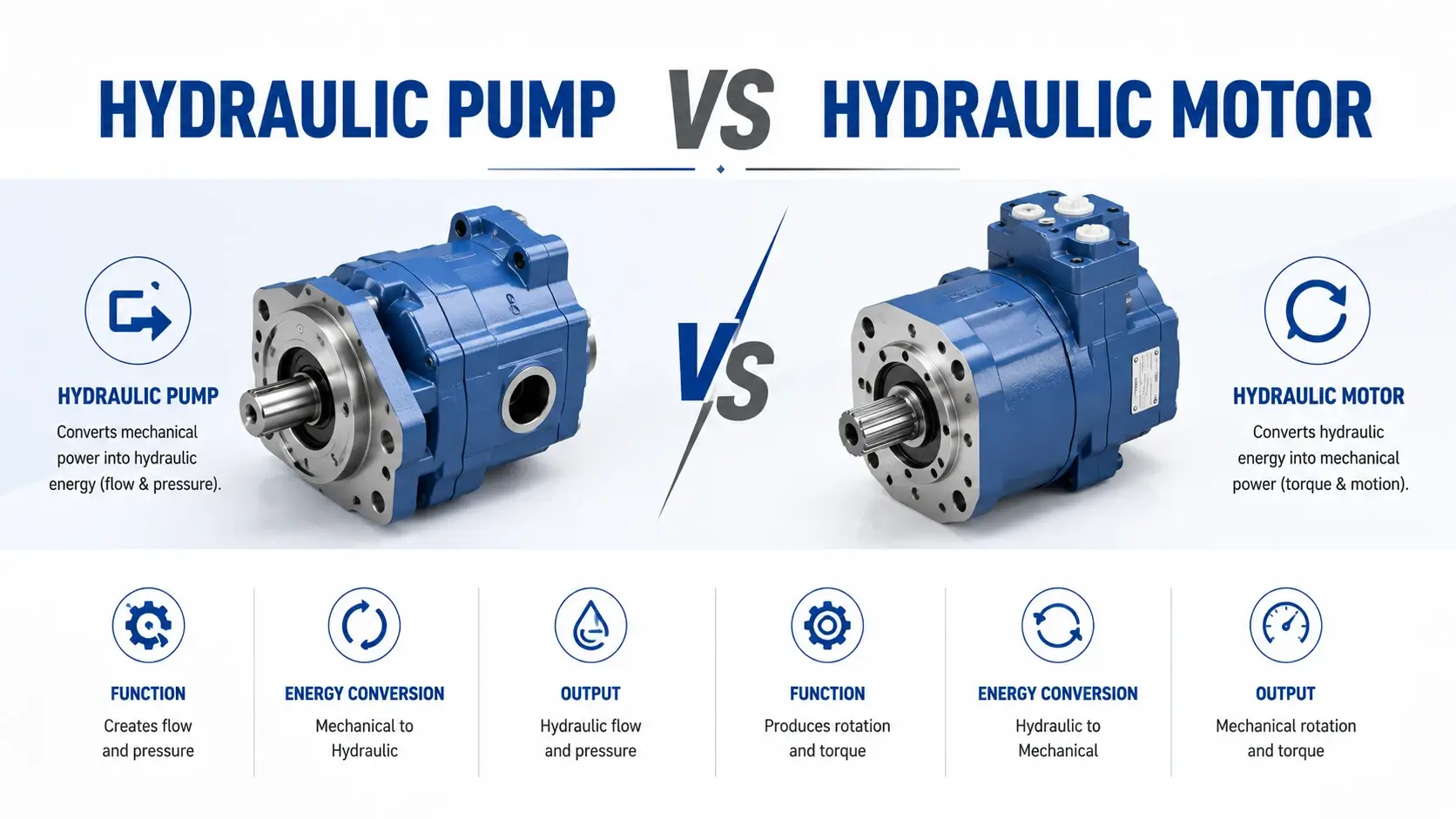
Quick Comparison
| Item | Hydraulic Pump | Hydraulic Motor |
|---|---|---|
Main function |
Generates hydraulic flow |
Produces rotary motion |
Energy conversion |
Mechanical to hydraulic |
Hydraulic to mechanical |
Input |
Shaft rotation from engine or electric motor |
Pressurized hydraulic oil |
Output |
Flow and pressure |
Torque and speed |
Common units |
L/min, GPM, bar, PSI |
Nm, rpm, kW, HP |
Gear, vane, axial piston, radial piston |
Gear, vane, orbital, axial piston, radial piston |
Gear, vane, orbital, axial piston, radial piston |
Used for |
Supplying a hydraulic system |
Driving wheels, winches, conveyors, mixers, fans |
What Is a Hydraulic Pump?
What Is a Hydraulic Motor?
How Pumps and Motors Work Together
A basic hydraulic drive circuit works like this:
- An electric motor or diesel engine rotates the hydraulic pump.
- The pump sends oil through valves, filters, and hoses.
- Directional or proportional valves control flow direction and speed.
- Pressurized oil enters the hydraulic motor.
- The motor turns a shaft connected to the machine load.
- Return oil flows back to the reservoir or charge circuit.
In an open-loop system, the pump draws oil from a tank and return oil goes back to the tank. In a closed-loop hydrostatic drive, oil circulates directly between a pump and motor, usually with a charge pump to maintain loop pressure and cooling flow.
Can a Hydraulic Pump Be Used as a Hydraulic Motor?
Main Engineering Differences
| Factor | Pump Design Priority | Motor Design Priority |
|---|---|---|
Inlet condition |
Avoid cavitation under suction |
Accept pressurized inlet flow |
Outlet condition |
Deliver stable flow |
Return oil with controlled backpressure |
Shaft load |
Driven by prime mover |
Drives external load |
Efficiency focus |
Volumetric flow delivery |
Torque output and mechanical efficiency |
Case drain |
Critical for piston pumps |
Critical for piston motors |
Failure risk |
Cavitation, wear, leakage |
overpressure, bearing load, overheating |
Common Applications
Hydraulic pumps are used in:
- Hydraulic power units
- Presses and forming machines
- Excavators and loaders
- Injection molding machines
- Machine tools
- Marine and offshore systems
- Industrial lifting systems
Hydraulic motors are used in:
- Wheel and track drives
- Winches and hoists
- Conveyor systems
- Mixers and augers
- Forestry equipment
- Drilling equipment
- Cooling fan drives
Common Problems and Troubleshooting
| Symptom | Possible Pump Cause | Possible Motor Cause |
|---|---|---|
Slow movement |
Low pump flow, worn pump, clogged suction filter |
Internal leakage, excessive load |
Noise |
Cavitation, air in oil, misalignment |
Bearing wear, pressure ripple |
Overheating |
Excessive bypass flow, wrong viscosity |
High case drain flow, overload |
Weak torque |
Pump cannot maintain pressure |
Worn motor, low displacement |
Seal leakage |
High case pressure, shaft misalignment |
High return pressure, worn shaft seal |
Selection Guide
Choose a hydraulic pump based on:
- Required system flow rate
- Maximum pressure
- Duty cycle
- Fixed or variable displacement
- Noise requirements
- Fluid viscosity and cleanliness
- Prime mover speed and power
- Open-loop or closed-loop circuit design
Choose a hydraulic motor based on:
- Required output torque
- Required speed range
- Starting torque demand
- Continuous and peak pressure
- Displacement
- Side load and shaft load limits
- Brake requirements
- Case drain and cooling requirements
For example, a conveyor may use a low-speed high-torque orbital motor. A closed-loop mobile drive may need an axial piston pump and axial piston motor. A heavy rotary table may require a radial piston motor because starting torque matters more than high speed.
Maintenance Tips
FAQ
Q1:What is the main difference between a hydraulic pump and a hydraulic motor?
A hydraulic pump converts mechanical energy into hydraulic energy. A hydraulic motor converts hydraulic energy into mechanical rotary energy.
Q2:Does a hydraulic pump create pressure or flow?
Q3:Can a hydraulic motor work as a pump?
Q4:Which is more important for a hydraulic motor: pressure or flow?
Q5:Which pump type is best for high-pressure hydraulic systems?
Q6:Why does a hydraulic motor lose torque?
Authority Sources
- ISO 4413 hydraulic fluid power safety requirements
- National Fluid Power Association
- Bosch Rexroth hydraulic pumps
- Bosch Rexroth hydraulic motors
- Parker Hydraulic Pump and Motor Division FAQ