
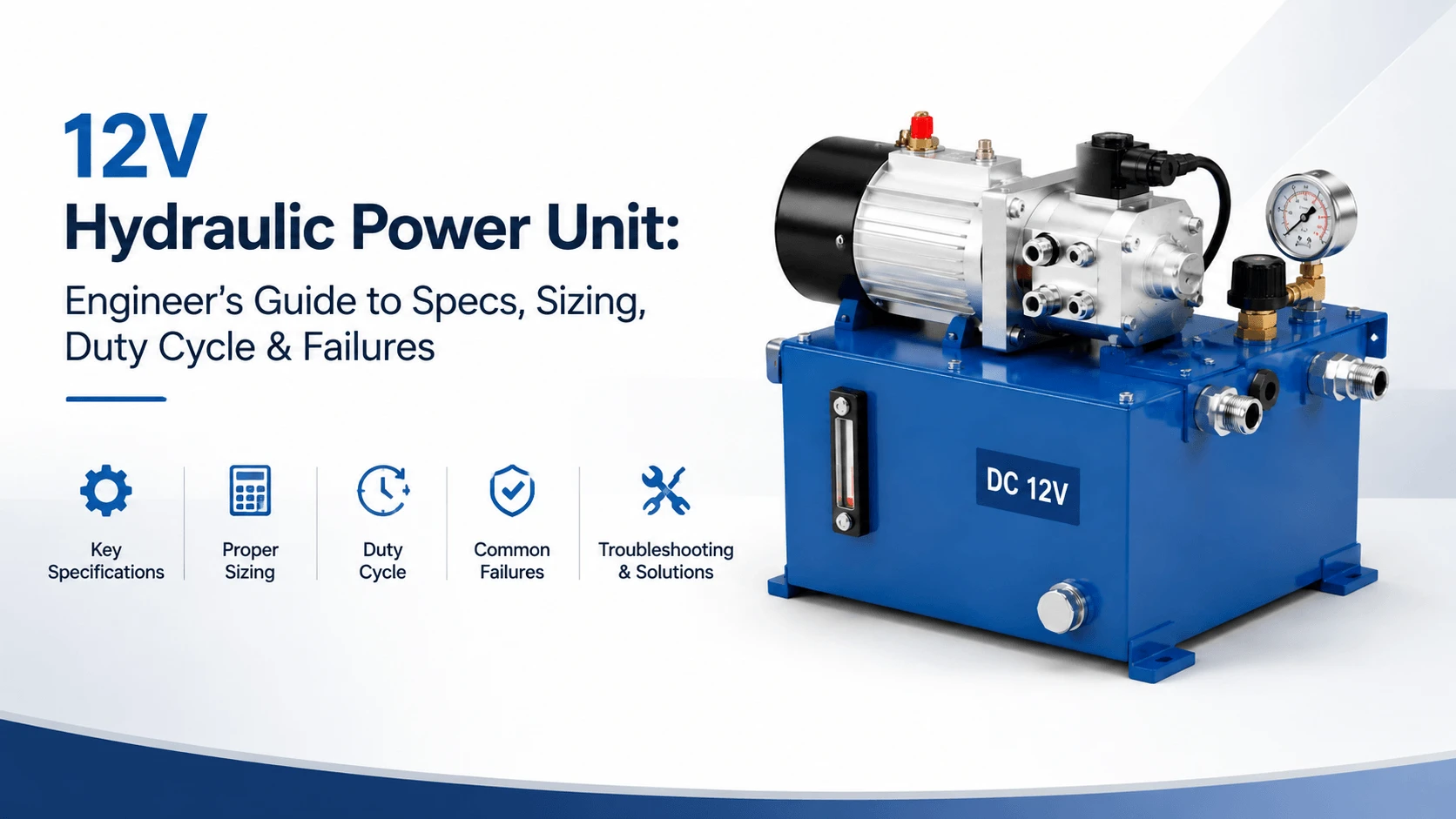
What is a 12V Hydraulic Power Unit?
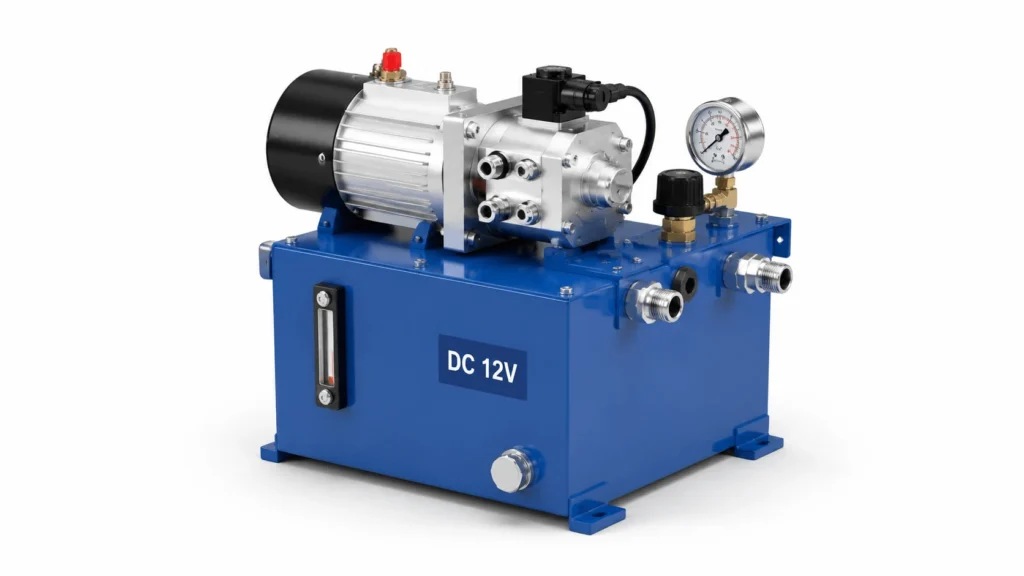
How a 12V Hydraulic Power Unit Works
Main Components
DC Motor (PMDC)
Gear Pump
Reservoir
Directional Valve and Relief
Manual Release and Check Valve
Key Specifications
| Spec | Typical range | Notes |
|---|---|---|
Voltage |
12V DC nominal (10.5–14.5V operating) |
battery sag under load matters |
Motor power |
0.8–3 kW |
PMDC, brush type |
Pump displacement |
0.5–3.5 cc/rev |
external gear, fixed |
Max pressure |
100–210 bar |
relief setting |
Flow at pressure |
0.5–8 L/min |
falls as pressure rises |
Reservoir |
0.5–10 L |
matches cylinder volume |
Duty cycle |
S2 intermittent |
30 s on / 2–3 min off typical |
Port standard |
SAE J1926 / ISO 6149 / BSPP |
varies by region |
Oil grade |
ISO VG 32 or 46 |
VG 32 for cold, VG 46 for warm |
12V vs 24V vs AC Hydraulic Power Units
| Feature | 12V DC HPU | 24V DC HPU | 115/230V AC HPU |
|---|---|---|---|
Power source |
vehicle or trailer battery |
truck or heavy equipment battery |
wall power |
Current at 2 kW |
~167 A |
~83 A |
~9–17 A |
Wire gauge needed |
2 AWG typical |
6 AWG typical |
14 AWG |
Duty cycle |
intermittent (S2) |
intermittent to semi-continuous |
continuous |
Best use |
trailers, light mobile |
heavy trucks, marine |
stationary lifts, docks |
Sizing a 12V Hydraulic Power Unit
Duty Cycle and Thermal Limits
Common Applications
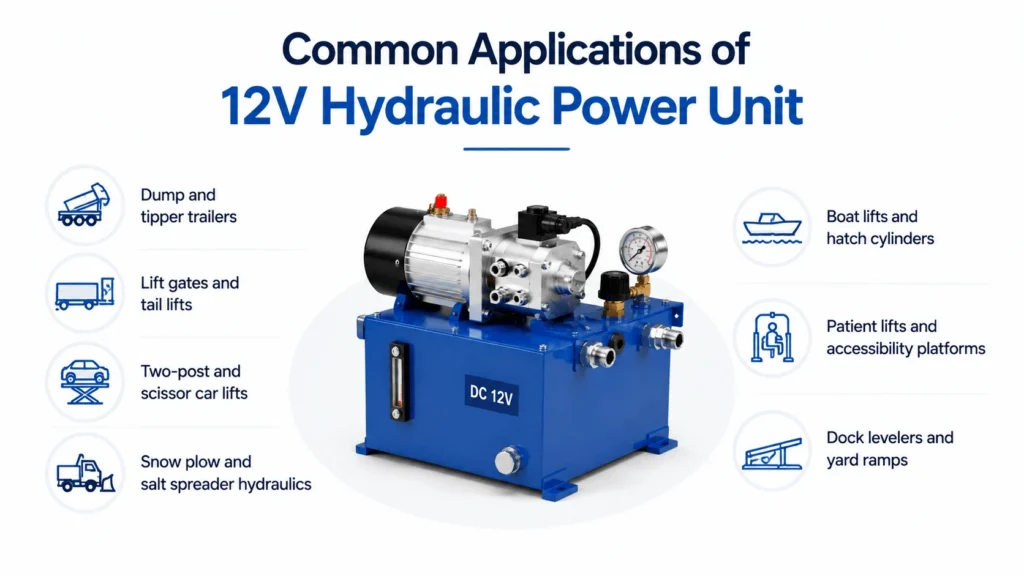
- Dump and tipper trailers — single-acting telescopic cylinder, manual lower
- Lift gates and tail lifts — double-acting cylinder, solenoid lower
- Two-post and scissor car lifts — high flow for fast rise, load held by check valve
- Snow plow and salt spreader hydraulics — frequent cycling, cold oil
- Boat lifts and hatch cylinders — marine-grade reservoir and plated hardware
- Patient lifts and accessibility platforms — low-noise, low-flow units
- Dock levelers and yard ramps — intermittent heavy lifts
Common Failures
Slow or no lift usually traces to low voltage, a worn pump, or a relief valve stuck open. Check the battery state of charge and voltage at the motor terminals under load first. A unit that reads 12.6 V open-circuit but sags to 10.0 V under load has a connection or battery problem, not a pump problem.
Motor brush wear is the leading wear-out mode. Brushes typically last 200 to 800 hours, depending on load. You will hear sparking through the housing before failure. Replace brushes before they reach 6 mm.
Solenoid coil burnout comes from holding the valve energized too long or from low voltage that spikes the current. A chattering solenoid usually means dirty oil or low voltage. Clean the oil and check the ground path.
Pump cavitation shows as groaning and foamy oil. Causes include cold oil, a clogged suction strainer, the wrong viscosity, or excessive suction lift. ISO VG 32 handles cold starts; VG 46 suits warm climates.
Troubleshooting Guide
| Symptom | Likely cause | First check |
|---|---|---|
Motor won’t run |
no power, blown fuse, bad ground |
voltage at motor terminal |
Motor runs, no lift |
low oil, relief bypassing, cavitation |
oil level and suction strainer |
Slow lift |
low voltage, worn pump, cold oil |
voltage under load |
Won’t hold load |
check valve leaking, cylinder seal bypass |
lower cylinder with load, watch drift |
Overheating trips |
duty cycle exceeded, low oil |
runtime and oil temperature |
Foamy oil |
cavitation, water ingress |
suction strainer and oil sample |
Selection Checklist
- Required cylinder force sets bore and pressure.
- Required speed sets the flow at pressure.
- Duty profile sets the duty-cycle rating.
- Cylinder volume sets reservoir size.
- Single- or double-acting sets valve configuration.
- Power source sets 12V, 24V, or AC.
- The environment sets the reservoir finish and port standard.
- Safety code sets the manual release and thermal overload.
Maintenance Best Practices
- Check oil level weekly; top up with ISO VG 32 or 46 to the maker’s spec.
- Replace the suction strainer every 500 hours or annually.
- Sample oil for ISO 4406 cleanliness; target 20/18/15 or better.
- Inspect motor brushes at 200 hours; replace those below 6 mm.
- Keep battery terminals clean; voltage drop kills more units than wear.
- Verify the relief setting with a gauge during annual service.
FAQ
What is a 12V hydraulic power unit used for?
A 12V HPU powers hydraulic cylinders and motors where only a 12V battery is available. Common uses include dump trailers, lift gates, snow plows, car lifts, and boat lifts. The unit combines motor, pump, valve, reservoir, and relief in one housing.
How does a 12V hydraulic power unit work?
A 12V DC motor drives a gear pump that pulls oil from the reservoir and feeds a directional valve. The valve routes oil to extend or retract a cylinder. A relief valve caps pressure, and a check valve holds the load when the motor stops.
How long can a 12V hydraulic power unit run continuously?
Most 12V HPUs run on S2 short-time duty, typically 30 seconds on followed by 2 to 3 minutes off. Some heavy models allow 1 to 3 minutes of continuous run. Exceeding the duty cycle overheats the motor, shortens brush life, and trips the thermal overload.
12V or 24V hydraulic power unit — which do I need?
Choose 12V for light trailers and equipment on a single battery. Choose 24V when power exceeds about 2 kW, because the current halves and you can use thinner wire. Trucks, marine systems, and heavy mobile equipment almost always use 24V.
What oil goes in a 12V hydraulic power unit?
Use a clean hydraulic oil at ISO VG 32 for cold climates or VG 46 for warm climates. Keep cleanliness at ISO 4406 20/18/15 or better. Never mix grades, and never run with water-contaminated or foamy oil.
Why is my 12V hydraulic power unit slow or weak?
The usual cause is low voltage at the motor under load, not pump wear. Check the battery state of charge, ground connection, and cable gauge first. If the voltage holds above 11 V and the lift is still slow, inspect the pump and relief valve.
How do I size a 12V hydraulic power unit?
Match three things: pressure to cylinder force, flow to required cylinder speed, and reservoir to cylinder volume. Then confirm the duty cycle covers your longest lift. Use P = F / A for pressure and speed = Q / A for flow.
Conclusion
A 12V hydraulic power unit trades continuous-duty runtime for portability. Get the spec right — pressure for force, flow for speed, duty cycle for runtime — and the unit outlasts the trailer it sits on. Get it wrong, and you replace brushes, pumps, and solenoids every season.
Before you buy, do one check: measure voltage at the motor terminals under full load. If that number holds, almost everything else follows. If it sags, no pump or relief upgrade will save you — fix the battery, cables, and ground first, then size the unit.
Whether you are specifying a dump-trailer power pack, replacing a burned-out lift-gate unit, or diagnosing a slow snow-plow pump, the components, ratings, and sizing math above take you from “which 12V HPU?” to a fully specified, duty-cycle-matched unit without guesswork.