
Walk into any hydraulic hose shop, and you will see walls of adapters. Dozens of hydraulic fitting types exist because no single design wins on pressure, cost, vibration resistance, and ease of assembly at the same time. Pick the wrong one, and you get leaks, galling, or a burst line at the worst moment.
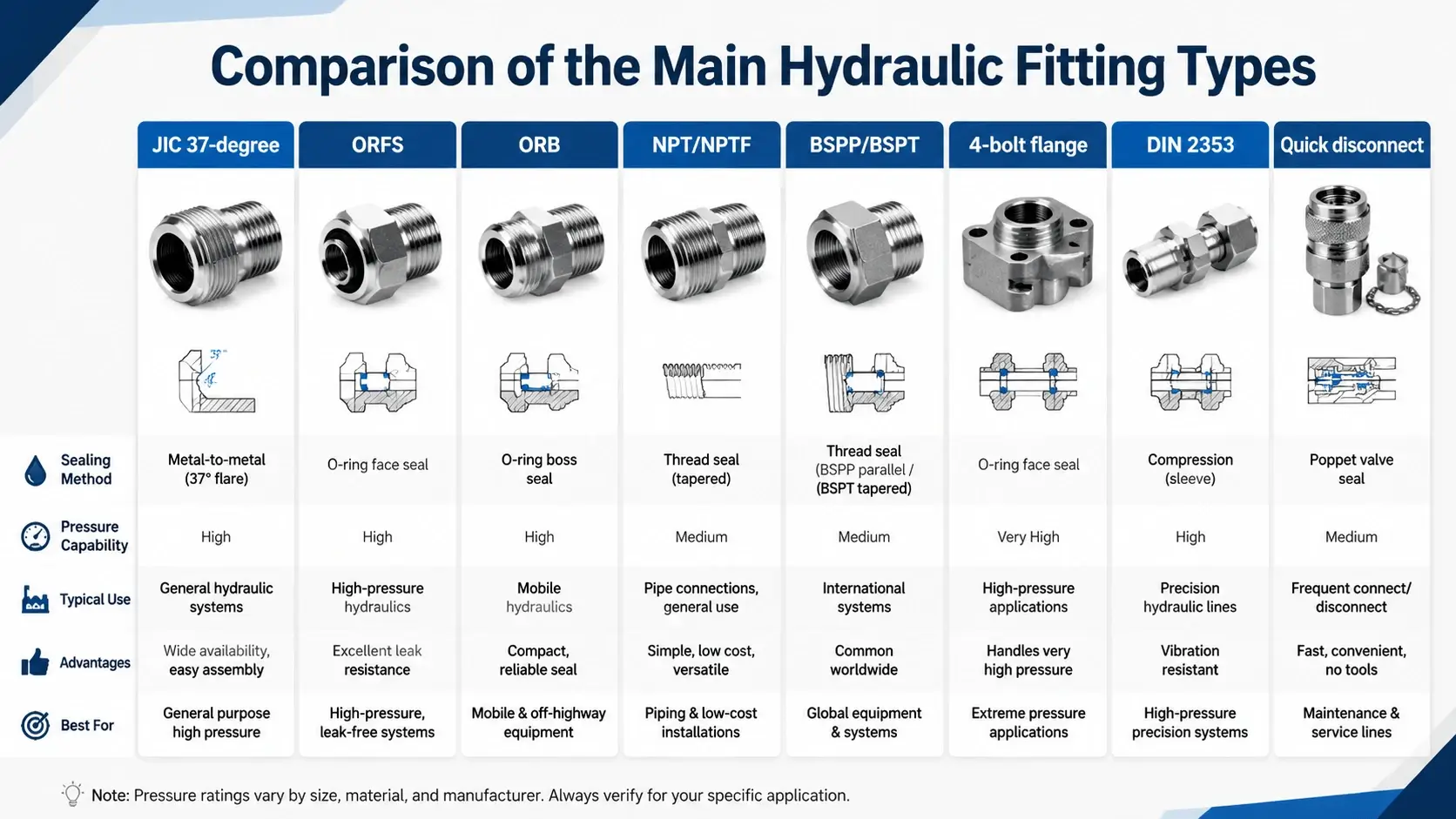
This guide covers the eight fitting families you will meet most often. For each one, you get the sealing method, pressure range, governing standard, and the applications where it makes sense. A comparison table and an identification procedure follow at the end.
Why Hydraulic Fitting Types Matter
A fitting does two jobs. It holds pressure, and it seals against leaks. How it seals determines almost everything else: torque requirements, reusability, vibration tolerance, and failure behavior.
The main hydraulic fitting types fall into five sealing categories:
- Metal-to-metal flare seat (JIC)
- O-ring face seal (ORFS)
- O-ring boss thread (ORB)
- Tapered thread interference (NPT, BSPT)
- Mechanical bite or clamping (DIN 2353, flange, quick disconnect)
Each category suits a different pressure class and service environment. The sections below break them down one by one.
JIC 37-Degree Flare (SAE J514)
Pressure and Size Range
Where JIC Works Best
Watch Out For
ORFS O-Ring Face Seal (ISO 8434-3 / SAE J1453)
Pressure and Performance
Strengths and Limits
ORB O-Ring Boss (SAE J1926 / ISO 6149)
How It Seals
Application Notes
NPT and NPTF Tapered Pipe Thread
Why Engineers Limit NPT
Practical Limits
BSPP and BSPT (ISO 228-1 / ISO 7-1)
Identification Trap
Ratings
SAE 4-Bolt Flange (Code 61 / Code 62)
Code 61 vs Code 62
Where Flanges Win
DIN 2353 Compression Fitting (ISO 8434-1)
Series and Ratings
Assembly Discipline
Quick Disconnect Couplings
Poppet vs Flat Face
Selection Notes
Comparison of the Main Hydraulic Fitting Types
| Fitting Type | Standard | Seal Method | Typical Max Pressure | Best Use |
|---|---|---|---|---|
JIC 37-degree |
SAE J514 |
Metal flare |
420 bar (small sizes) |
Mobile equipment, general tubing |
ORFS |
ISO 8434-3 |
O-ring face |
414 bar |
High-pressure, high-vibration lines |
ORB |
SAE J1926 |
O-ring boss |
420 bar (port) |
Pump and valve ports |
NPT/NPTF |
ASME B1.20.1 |
Thread interference |
210 bar |
Low-pressure plumbing only |
BSPP/BSPT |
ISO 228 / ISO 7 |
Bonded seal or thread |
210-400 bar |
European and Asian equipment |
4-bolt flange |
SAE J518 |
O-ring face |
350-420 bar |
Large lines, pumps, motors |
DIN 2353 |
ISO 8434-1 |
Cutting ring |
630 bar (Series S) |
Industrial steel tube systems |
Quick disconnect |
ISO 16028 |
Poppet or flat face |
350 bar |
Tool and attachment changeover |
How to Identify an Unknown Fitting
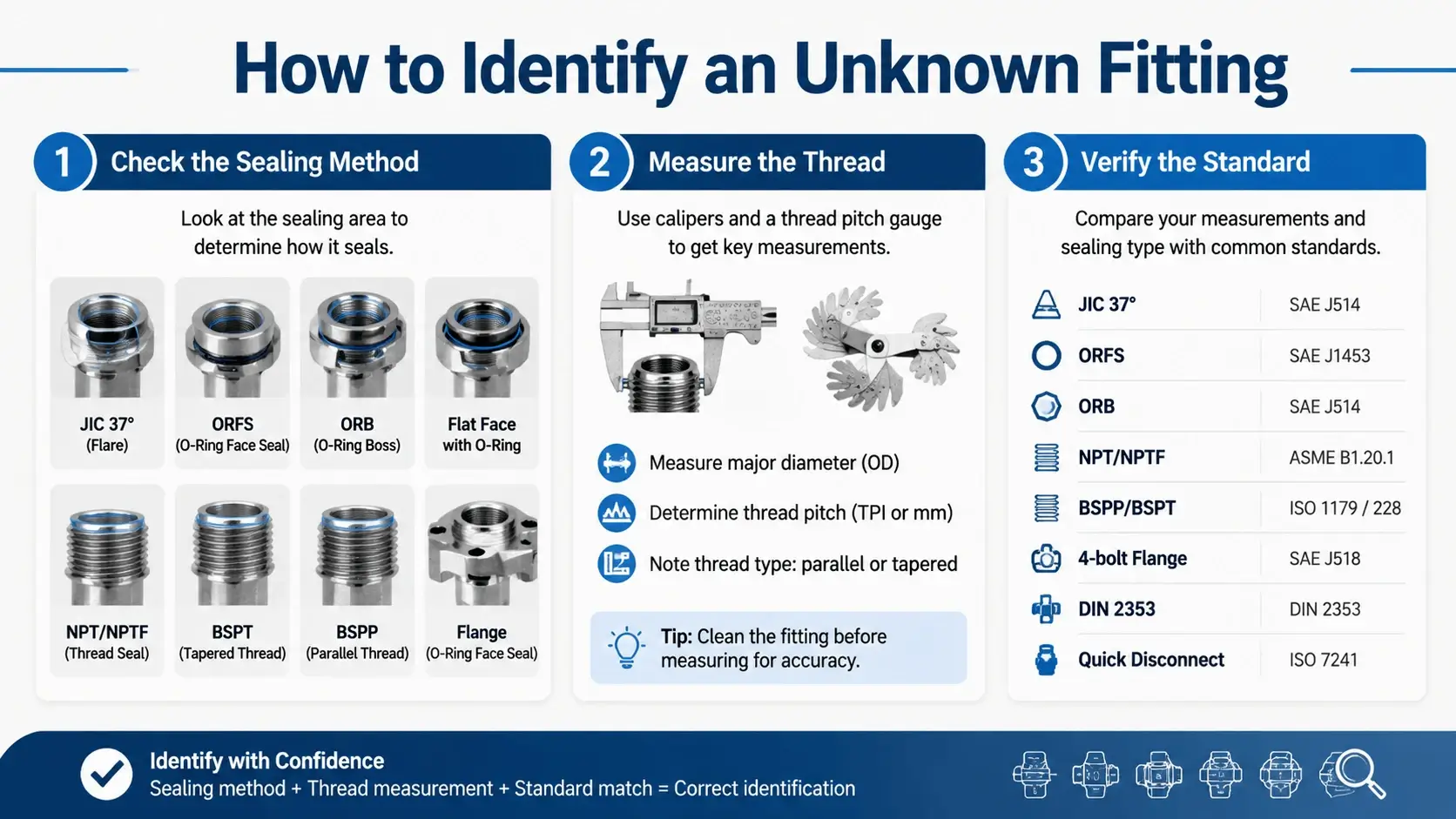
Step 1: Check the Sealing Method
Step 2: Measure the Thread
Step 3: Verify the Standard
Common Failure Modes
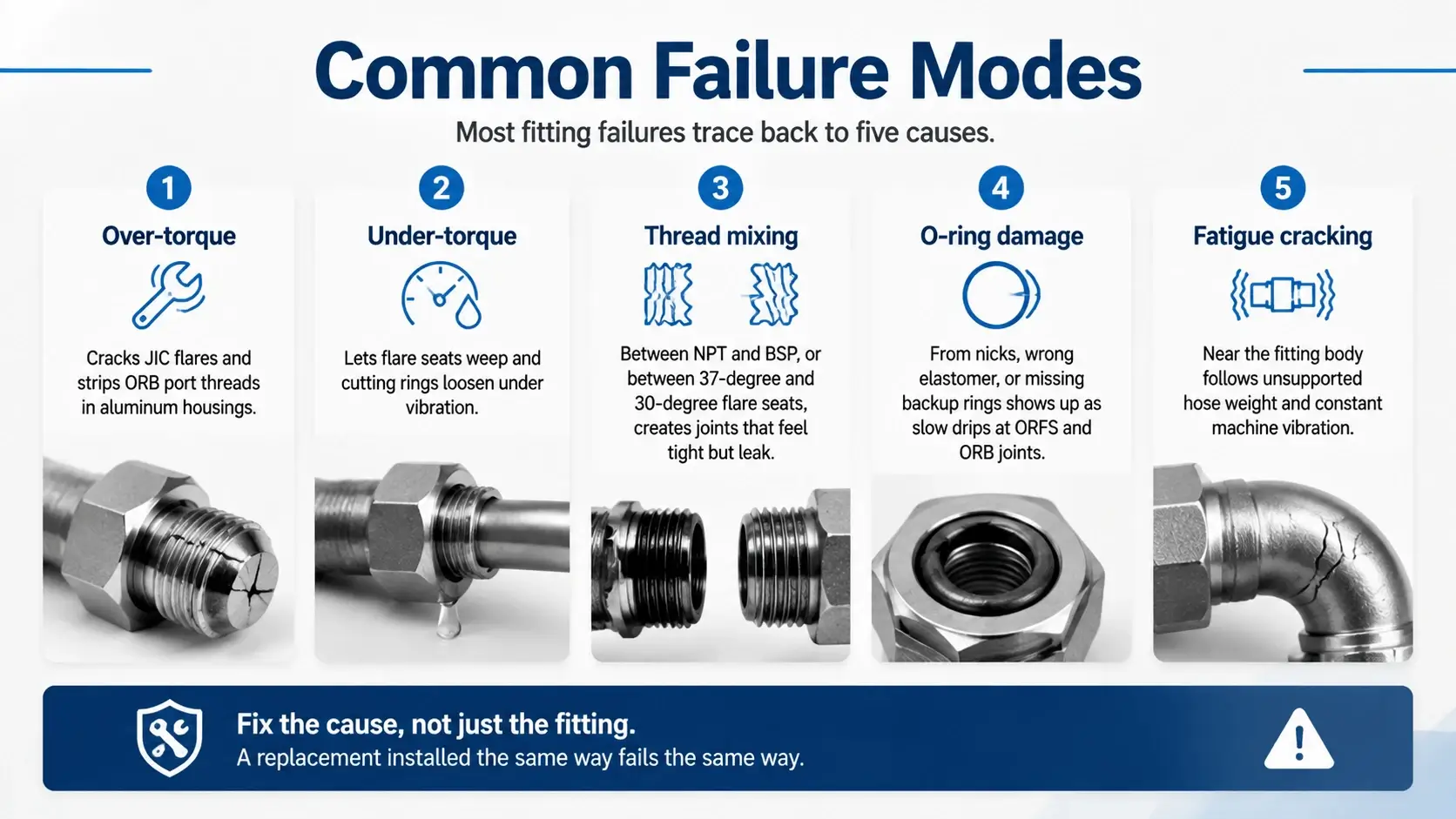
Most fitting failures trace back to five causes.
- Over-torque cracks JIC flares and strips ORB port threads in aluminum housings.
- Under-torque lets flare seats weep and cutting rings loosen under vibration.
- Thread mixing between NPT and BSP, or between 37-degree and 30-degree flare seats, creates joints that feel tight but leak.
- O-ring damage from nicks, wrong elastomer, or missing backup rings shows up as slow drips at ORFS and ORB joints.
- Fatigue cracking near the fitting body follows unsupported hose weight and constant machine vibration.
Fix the cause, not just the fitting. A replacement installed the same way fails the same way.
Selection Guide for New Systems
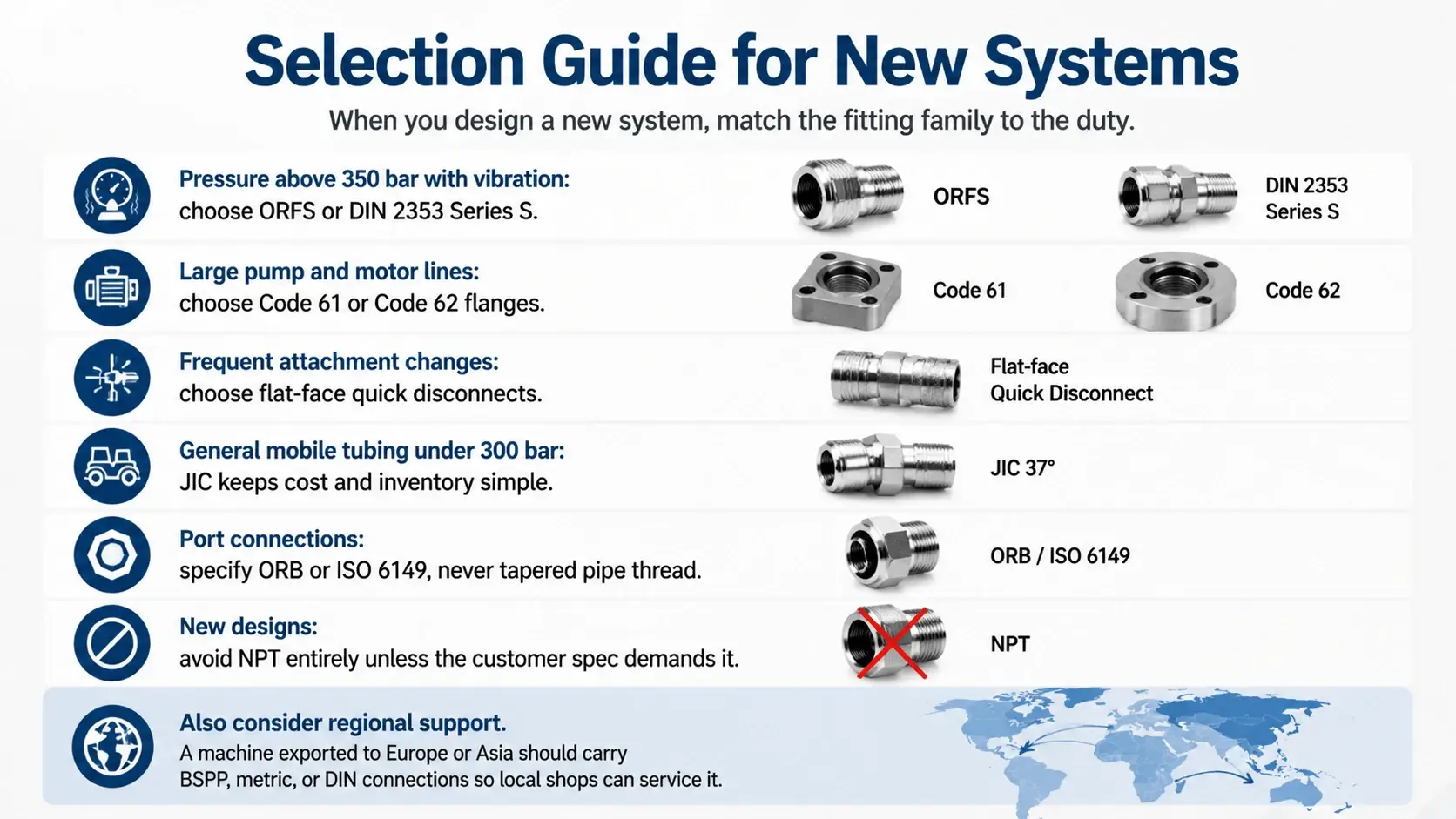
When you design a new system, match the fitting family to the duty.
- Pressure above 350 bar with vibration: choose ORFS or DIN 2353 Series S.
- Large pump and motor lines: choose Code 61 or Code 62 flanges.
- Frequent attachment changes: choose flat-face quick disconnects.
- General mobile tubing under 300 bar: JIC keeps cost and inventory simple.
- Port connections: specify ORB or ISO 6149, never tapered pipe thread.
- New designs: avoid NPT entirely unless the customer spec demands it.
Also consider regional support. A machine exported to Europe or Asia should carry BSPP, metric, or DIN connections so local shops can service it.
FAQ
What is the most common hydraulic fitting type?
JIC 37-degree flare is the most common in North America. It appears on most mobile equipment, hose assemblies, and adapters. In Europe and Asia, DIN 2353 compression fittings and BSPP threads share the top spot. ORFS grows fast on new high-pressure machines because it seals better under vibration.
Can I connect NPT and BSP fittings together?
No. NPT uses a 60-degree thread angle and BSP uses 55 degrees, and the pitches differ on most sizes. Some small sizes will start threading together, which makes the trap worse. The joint binds, feels tight, and then leaks or cracks the port. Use a proper NPT-to-BSP adapter instead.
How tight should a JIC fitting be?
Use the flats-from-wrench-resistance method. Tighten the nut by hand until the flare seats. Then mark the nut and turn it the number of hex flats given on the datasheet, usually one to two flats for most sizes. This method beats a torque wrench on flared fittings because friction varies with plating and lubrication.
Which hydraulic fitting types handle the highest pressure?
DIN 2353 Series S compression fittings reach 630 bar, the highest rating of the common families. SAE Code 62 flanges and ORFS follow at 420 and 414 bar. JIC reaches 420 bar only in small sizes. Tapered pipe threads sit at the bottom, limited to about 210 bar in hydraulic service.
How many times can I reuse a hydraulic fitting?
It depends on the seal method. ORFS fittings reassemble almost indefinitely if you install a fresh O-ring each time. JIC flares survive ten to twenty careful reassemblies before the flare work-hardens. DIN 2353 cutting rings bite once, so reuse requires a new ring and a fresh tube end. NPT degrades with every cycle because the threads deform.
Conclusion
The eight hydraulic fitting types covered here handle nearly every connection you will build or repair. The selection logic stays simple: match the seal method to the pressure, vibration, and service access of the circuit. ORFS and DIN 2353 own the high-pressure end. JIC owns general mobile work. Flanges own big lines. NPT belongs in the past.
When you replace a fitting, identify the thread by measurement, not by eye. When you design a system, pick one or two families and standardize your inventory around them. Both habits cut leak calls and downtime more than any premium component upgrade.
Need help cross-referencing an unidentified fitting or sourcing adapters for a mixed-standard fleet? Contact our engineering team with photos and thread measurements. We stock JIC, ORFS, ORB, BSP, flange, and DIN 2353 fittings in carbon steel and stainless, and we can quote custom hose assemblies built to your pressure and cleanliness requirements.