
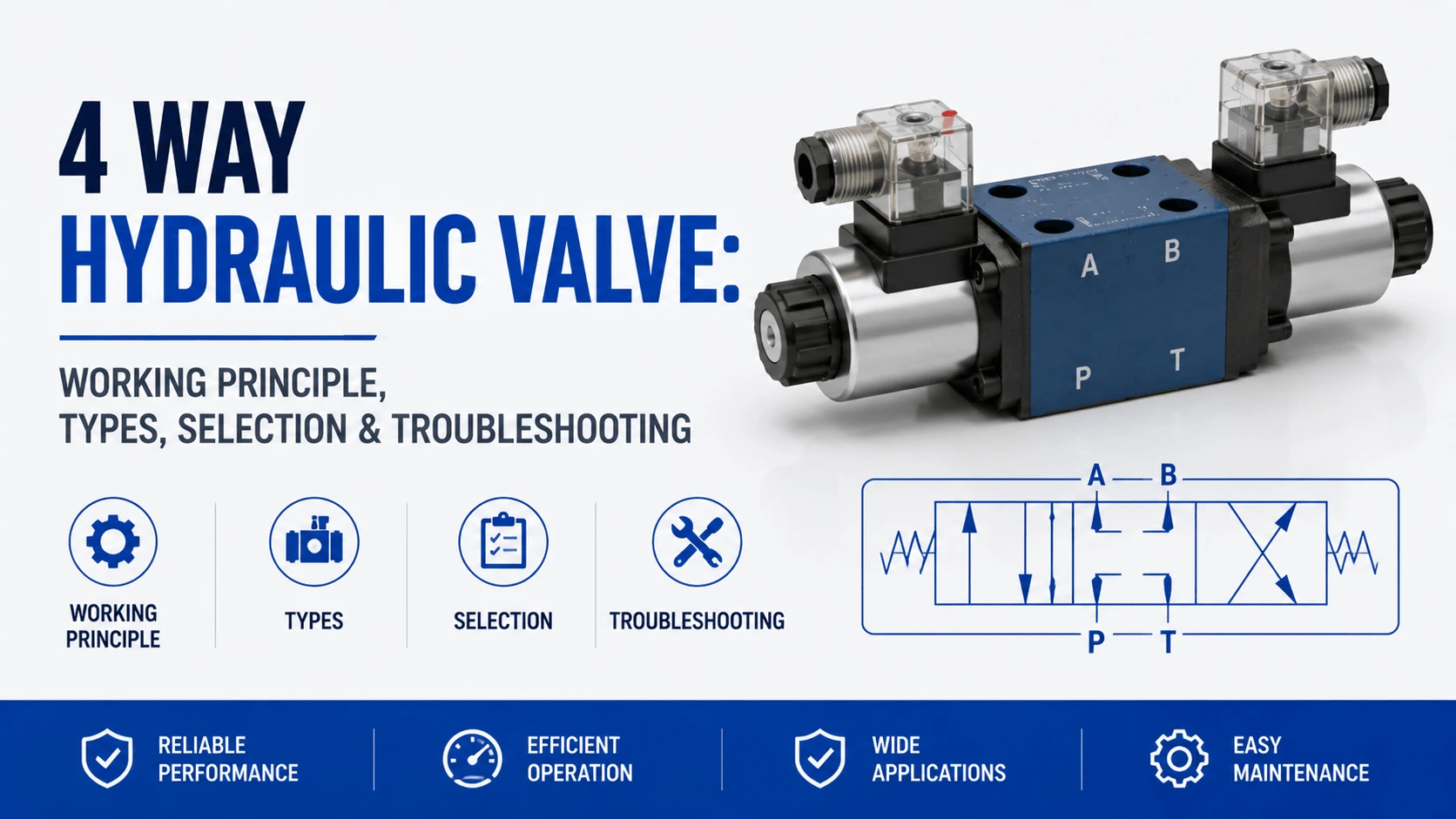
Introduction
What Is a 4 Way Hydraulic Valve?
| Port | Function |
|---|---|
P |
Pressure inlet from pump |
T |
Tank or return line |
A |
Work port to actuator |
B |
Work port to actuator |
How a 4 Way Hydraulic Valve Works
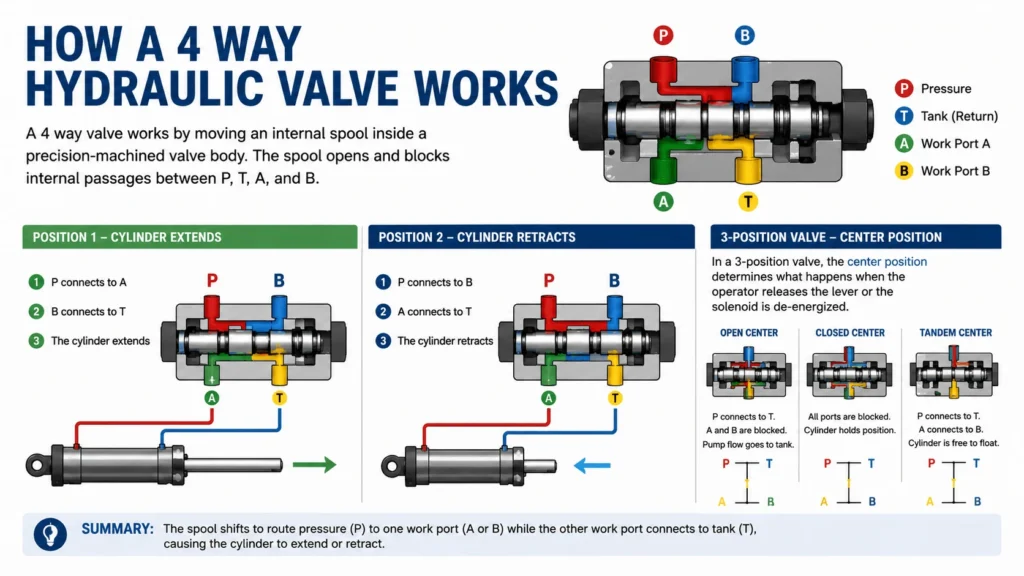
A 4 way valve works by moving an internal spool inside a precision-machined valve body. The spool opens and blocks internal passages between P, T, A, and B.
In one shifted position:
- P connects to A
- B connects to T
- The cylinder extends
In the opposite shifted position:
- P connects to B
- A connects to T
- The cylinder retracts
In a 3-position valve, the center position determines what happens when the operator releases the lever or the solenoid is de-energized.
4/2 vs 4/3 Hydraulic Valves
| Valve Type | Meaning | Typical Use |
|---|---|---|
4/2 valve |
4 ports, 2 positions |
Simple extend/retract control |
4/3 valve |
4 ports, 3 positions |
Extend/neutral/retract control |
4/3 closed center |
All ports blocked in neutral |
Holding actuator position |
4/3 tandem center |
P connected to T, A/B blocked |
Unloading pump while holding actuator |
4/3 float center |
A/B connected to T |
Allowing actuator to float |
Main Components
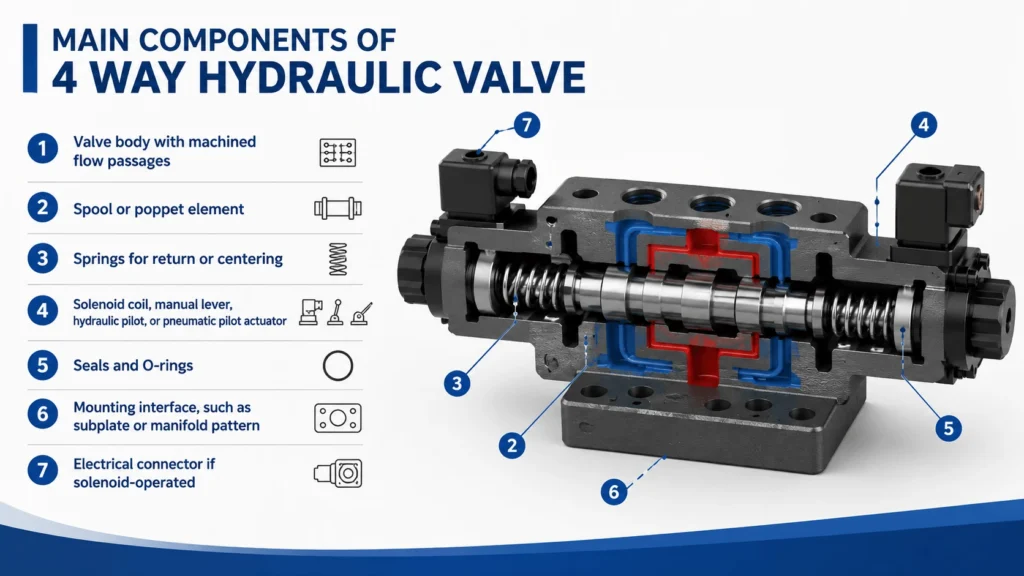
A standard 4 way hydraulic valve usually includes:
- Valve body with machined flow passages
- Spool or poppet element
- Springs for return or centering
- Solenoid coil, manual lever, hydraulic pilot, or pneumatic pilot actuator
- Seals and O-rings
- Mounting interface, such as subplate or manifold pattern
- Electrical connector if solenoid-operated
Direct-operated valves are common in smaller flow applications. Pilot-operated valves are used when higher flow requires more shifting force than a solenoid can provide directly.
Advantages
A 4 way hydraulic valve offers several practical benefits:
- Simple control of double-acting cylinders
- Reversible control for hydraulic motors
- Multiple spool options for different neutral behavior
- Easy integration into manifolds and subplates
- Available in manual, solenoid, proportional, and pilot-operated designs
- Suitable for automation and mobile equipment
Limitations
The main limitations are usually related to sizing and operating conditions:
- Undersized valves create pressure drop and heat
- Contamination can cause spool sticking
- Incorrect center type can create unsafe actuator movement
- High-flow circuits may require pilot-operated valves
- Internal leakage may prevent precise load holding
- Solenoid valves may shift slowly or fail under low voltage
A 4 way valve should not be treated as a load-holding safety device unless the circuit is specifically designed for that purpose. Counterbalance valves, pilot-operated check valves, or mechanical locks may be needed.
Industrial Applications
4 way hydraulic valves are widely used in:
- Injection molding machines
- Hydraulic presses
- CNC machine tool clamping systems
- Agricultural equipment
- Construction machinery
- Material handling systems
- Marine hydraulic systems
- Hydraulic power units
- Winches and reversible motor drives
- Lift tables and scissor lifts
In a press application, for example, the valve may extend the cylinder for pressing, hold or unload in neutral, then reverse flow for cylinder return.
Common Problems
| Problem | Likely Cause | Practical Check |
|---|---|---|
Cylinder does not move |
No pressure, stuck spool, failed solenoid |
Check pressure, coil voltage, manual override |
Cylinder moves slowly |
Low flow, pressure drop, blocked filter |
Check pump flow and valve flow rating |
Valve coil overheats |
Wrong voltage, continuous-duty mismatch |
Confirm coil voltage and duty cycle |
Spool sticks |
Contamination, varnish, damaged bore |
Inspect oil cleanliness and filter condition |
Actuator drifts |
Internal leakage or wrong center type |
Test leakage and review spool code |
Harsh shifting |
High flow, no damping, wrong spool |
Consider soft-shift or proportional control |
Excessive heat |
Valve too small or high pressure drop |
Compare flow rate with valve curves |
Troubleshooting Guide
- Confirm the hydraulic schematic. Check whether the valve is 4/2 or 4/3, and verify the center condition. Many field problems come from installing the wrong spool type.
- Check electrical actuation. For solenoid valves, measure voltage at the coil under load. A valve rated for 24 VDC may fail to shift reliably if the actual voltage drops too far during operation.
- Check pressure and flow. Install gauges at P, A, and B ports where possible. If pressure rises but the actuator does not move, the issue may be mechanical binding, blocked flow, or incorrect plumbing.
- Inspect contamination. Directional spool valves depend on tight clearances. Dirty oil, degraded seals, metal particles, or varnish can cause slow shifting or sticking.
- Review valve sizing. A valve that appears correct by port size may still be too small by rated flow. Always compare required flow with the manufacturer’s pressure drop curve.
Selection Guide
When selecting a 4 way hydraulic valve, specify:
| Selection Factor | What to Confirm |
|---|---|
Flow rate |
Required L/min or GPM at acceptable pressure drop |
Pressure rating |
Maximum system and shock pressure |
Spool configuration |
4/2, 4/3, closed center, tandem, float, etc. |
Actuation method |
Manual, solenoid, hydraulic pilot, pneumatic pilot |
Voltage |
12 VDC, 24 VDC, 110 VAC, 220 VAC, etc. |
Mounting style |
Inline, subplate, manifold, cartridge |
Fluid compatibility |
Mineral oil, biodegradable fluid, fire-resistant fluid |
Leakage tolerance |
Standard spool leakage vs poppet-style sealing |
Environment |
Temperature, vibration, outdoor exposure, hazardous area |
Standards/interface |
ISO, CETOP, NFPA mounting patterns where applicable |
As a general engineering practice, do not size the valve only for maximum flow. Also check pressure drop, heat generation, response time, and whether the actuator must hold position safely in neutral.
Maintenance Tips
- Keep hydraulic oil clean and within the viscosity range
- Replace filters before bypass conditions occur
- Avoid over-tightening coils or connectors
- Check mounting bolts for correct torque
- Inspect O-rings during valve replacement
- Flush manifolds after pump or cylinder failure
- Verify coil voltage before replacing the valve body
- Record spool codes and center conditions for future maintenance
FAQ
What is a 4 way hydraulic valve?
A 4 way hydraulic valve is a directional control valve with four ports: pressure, tank, and two work ports. It is commonly used to control double-acting cylinders or reversible hydraulic motors.
What is the difference between a 4/2 and a 4/3 hydraulic valve?
A 4/2 valve has four ports and two spool positions. A 4/3 valve has four ports and three spool positions, usually extend, neutral, and retract.
Can a 4 way valve hold a cylinder in position?
It can help hold position if the correct center spool is used, but spool valves normally have some internal leakage. For critical load holding, use a counterbalance valve, pilot-operated check valve, or mechanical lock.
Why does a 4 way hydraulic valve get stuck?
Common causes include contaminated oil, varnish, damaged spool surfaces, incorrect fluid viscosity, excessive side loading from poor mounting, or debris after component failure.
How do I choose the right 4 way valve?
Match the valve to system pressure, flow rate, spool configuration, actuation method, voltage, mounting pattern, fluid type, and required neutral behavior. Always check the pressure drop curve, not only port size.
Authority Sources
Need help selecting a 4 way hydraulic valve for your equipment? Share your system pressure, flow rate, actuator type, voltage, and spool requirement with our hydraulic engineering team. We can help match the correct valve configuration, mounting interface, and replacement model for your application.