
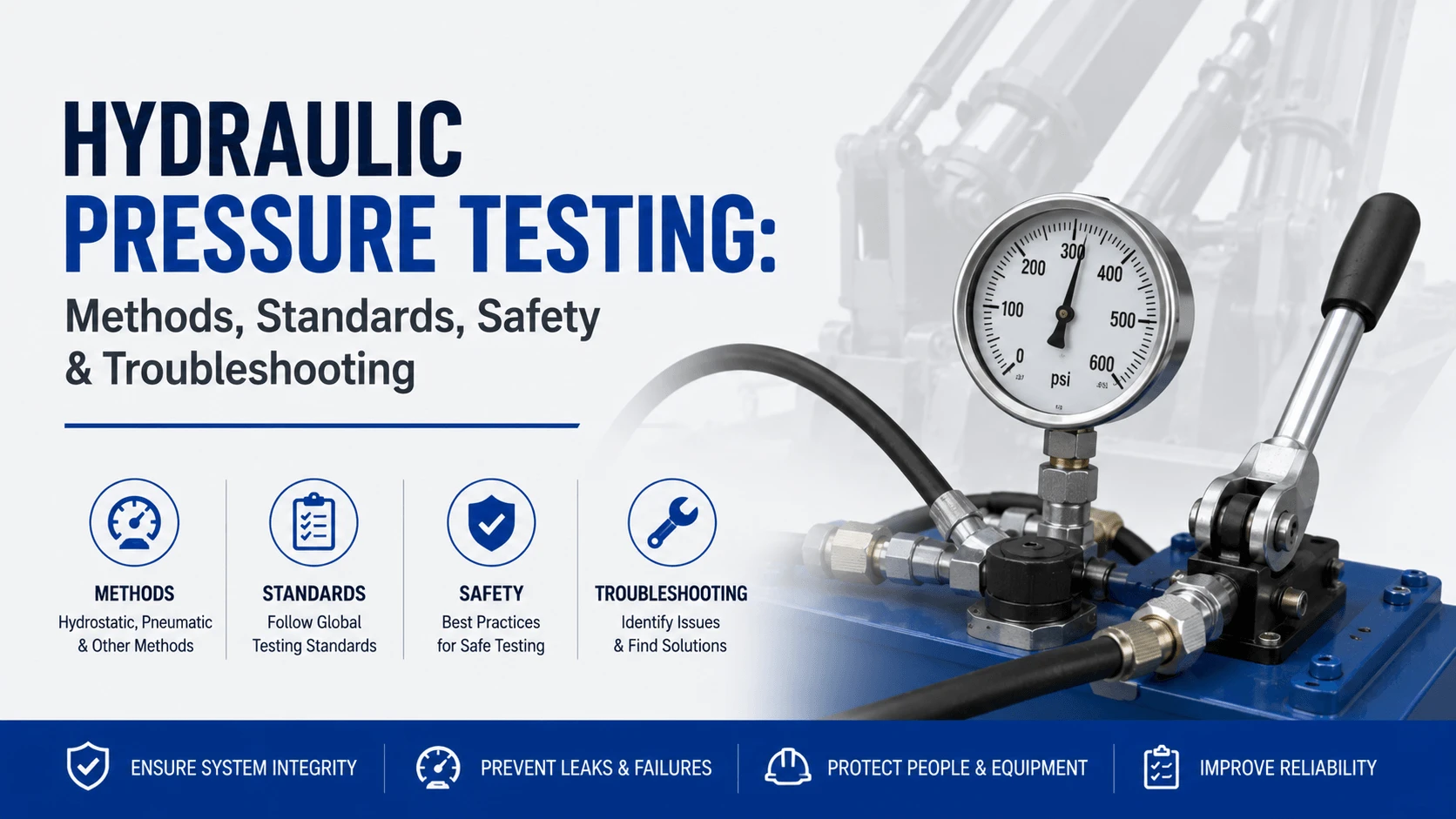
Hydraulic pressure testing verifies whether a hydraulic component or system can safely hold pressure without leakage, deformation, or performance loss. It is used on hose assemblies, cylinders, manifolds, valves, pumps, accumulators, pipework, and complete hydraulic circuits before commissioning or after repair.
In industrial equipment, a small leak is not just a housekeeping issue. It can reduce actuator force, cause overheating, contaminate the work area, create fire risk near ignition sources, and expose workers to high-pressure fluid injection hazards.
What is Hydraulic Pressure Testing?
Hydraulic pressure testing is the controlled pressurization of a component or system using hydraulic oil, water, or another approved test fluid. The goal is to confirm pressure integrity under specified conditions.
A good test normally checks:
- Whether the assembly holds the required pressure
- Whether fittings, seals, welds, hoses, or threaded joints leak
- Whether the component deforms, expands, bulges, or fails
- Whether pressure remains stable during the hold period
- Whether the component performs correctly after depressurization
For example, a repaired hydraulic cylinder may be tested at rated working pressure to confirm seal integrity, then cycled under load to check rod movement and internal bypass leakage.
Main Types of Hydraulic Pressure Testing
| Test Type | Purpose | Typical Use |
|---|---|---|
Leak test |
Finds visible leakage or pressure drop |
Hoses, fittings, manifolds, cylinders |
Proof test |
Confirms the component can withstand pressure above normal working pressure |
Hose assemblies, cylinders, pressure vessels, pipework |
Burst test |
Determines failure pressure under controlled laboratory conditions |
Hose validation, product development |
Impulse test |
Simulates repeated pressure spikes and fatigue cycles |
Hydraulic hoses and assemblies |
Functional pressure test |
Confirms operation under load |
Cylinders, valves, pumps, power units |
How Hydraulic Pressure Testing Works
A standard hydraulic pressure test usually follows these steps:
- Inspect the component before testing.
- Confirm the rated working pressure and applicable test specification.
- Select compatible test fluid and calibrated gauges or sensors.
- Remove trapped air where practical.
- Increase pressure gradually.
- Hold the specified test pressure for the required time.
- Inspect for leakage, bulging, deformation, pressure drop, or abnormal noise.
- Depressurize safely.
- Record pressure, duration, fluid, temperature, component ID, and result.
Pressure should be increased gradually. Rapid pressurization can shock seals, disturb fittings, and hide small leaks that only appear during a stable hold period.
Common Components Tested
Hydraulic pressure testing is commonly used for:
- Hydraulic hose assemblies
- Hydraulic cylinders
- Valve blocks and manifolds
- Tube and pipe assemblies
- Pumps and motors
- Accumulators
- Power units
- Quick couplings and adapters
- Welded reservoirs or pressure-related housings
Each component requires a different test method. A hose assembly may need proof and impulse testing, while a cylinder may need pressure hold, stroke cycling, and internal leakage checks.
Typical Pressure Ranges
Hydraulic systems vary widely by industry. Many industrial and mobile hydraulic systems operate between 1,500 and 5,000 psi. Heavy equipment, presses, and specialized systems may run higher.
Common reference points:
| Application | Typical Working Pressure |
|---|---|
Light industrial hydraulic units |
1,000-2,500 psi |
Mobile equipment |
2,500-5,000 psi |
High-pressure hydraulic tools |
10,000 psi or higher |
Hose proof testing |
Often above rated working pressure, depending on hose standard and customer specification |
Hose burst testing |
Often several times working pressure, depending on hose type and standard |
Do not select test pressure by guesswork. Use the component datasheet, drawing, purchase specification, and applicable standard.
Safety Precautions
Hydraulic pressure testing must be treated as a high-energy operation. Use guarding, remote pressurization where possible, rated fittings, calibrated gauges, and a controlled test area.
Key precautions:
- Never use your hands to check for leaks.
- Depressurize before tightening fittings.
- Use test hoses and adapters rated above the test pressure.
- Keep personnel away from the line of failure.
- Avoid pneumatic testing unless specifically engineered and approved.
- Use pressure relief devices.
- Bleed trapped air where practical.
- Wear appropriate eye, face, and hand protection.
- Record and label failed components so they are not returned to service.
High-pressure fluid injection can look minor at first, but it may require urgent surgery. The UK HSE warns that hydraulic fluid released under pressure can penetrate skin and cause severe injury, including amputation risk.
Common Failures Found During Testing
| Failure Symptom | Likely Cause | Corrective Action |
|---|---|---|
Pressure drops during hold |
External leak, internal bypass, trapped air, faulty gauge |
Inspect joints, reseal, retest after bleeding air |
Hose bulges |
Reinforcement damage, wrong hose rating, poor crimp |
Reject assembly |
Fitting leaks |
Incorrect torque, damaged thread, wrong seal type |
Replace seal or fitting, verify torque |
Cylinder drifts |
Piston seal bypass, valve leakage |
Isolate cylinder and test ports separately |
Pump cannot reach pressure |
Worn pump, relief valve setting too low, internal leakage |
Check relief valve, flow, and pump condition |
Sudden rupture |
Incorrect rating, material defect, overpressure |
Quarantine batch and review specification |
Hydraulic Hose Pressure Testing
Hydraulic hose assemblies are among the most common items tested. A hose assembly includes the hose, fittings, ferrules, and crimp quality. The complete assembly matters because a correctly rated hose can still fail if the fitting is mismatched or the crimp dimension is wrong.
Typical hose pressure tests include:
- Proof pressure test
- Leakage test
- Burst pressure test
- Impulse test
- Change-in-length measurement
- Visual inspection after testing
ISO 6605 covers uniform test methods for hydraulic hoses and hose assemblies, while SAE J1273 provides guidance for selection, routing, installation, replacement, and maintenance of hydraulic hose assemblies.
Hydraulic Cylinder Pressure Testing
Hydraulic cylinders are usually tested for both external leakage and internal bypass. A practical cylinder test may include:
- Port plug pressure hold
- Full stroke cycling
- Rod seal leakage inspection
- Piston seal bypass check
- Cushion function check
- Rod drift under load
For double-acting cylinders, both extend and retract sides should be tested. Rod scratches, bore wear, piston seal damage, and incorrect seal material are common causes of test failure.
How to Choose a Hydraulic Pressure Testing Supplier
Choose a supplier that can document the test, not just “pressurize and see.”
Ask for:
- Calibrated pressure gauges or digital sensors
- Written test procedure
- Test certificate with serial number or batch number
- Maximum working pressure and test pressure record
- Fluid compatibility control
- Safety guarding or remote test capability
- Experience with your component type
- Traceability for hoses, fittings, seals, and materials
For OEM or export projects, documentation is often as important as the test itself. Buyers may need test reports for quality audits, warranty claims, CE-related technical files, or customer acceptance.
Maintenance Tips After Pressure Testing
- Clean and cap ports after testing.
- Replace protective plugs before storage.
- Mark tested components clearly.
- Store hoses away from UV, ozone, heat, and sharp bends.
- Keep test records by serial number or batch.
- Recheck torque after pressure cycling where the procedure requires it.
- Do not reuse failed hose assemblies.
- Investigate repeated failures instead of increasing test pressure blindly.
FAQs
What is hydraulic pressure testing?
What fluid is used for hydraulic pressure testing?
Is hydraulic pressure testing dangerous?
What is the difference between proof pressure and burst pressure?
How often should hydraulic hoses be pressure tested?
Can compressed air be used for hydraulic pressure testing?
Authority Sources
- ISO 4413:2010 hydraulic fluid power safety requirements
- ISO 6605:2017 test methods for hydraulic hoses and hose assemblies
- SAE J1273 hydraulic hose assembly recommended practices
- HSE high-pressure fluid injection hazards
- OSHA Hydraulic Systems Preventive Maintenance Bulletin
Need hydraulic components tested, documented, or supplied for your equipment? Contact our engineering team for hydraulic hose assemblies, cylinders, manifolds, and pressure-tested hydraulic solutions built to your working pressure, fluid, and application requirements.