
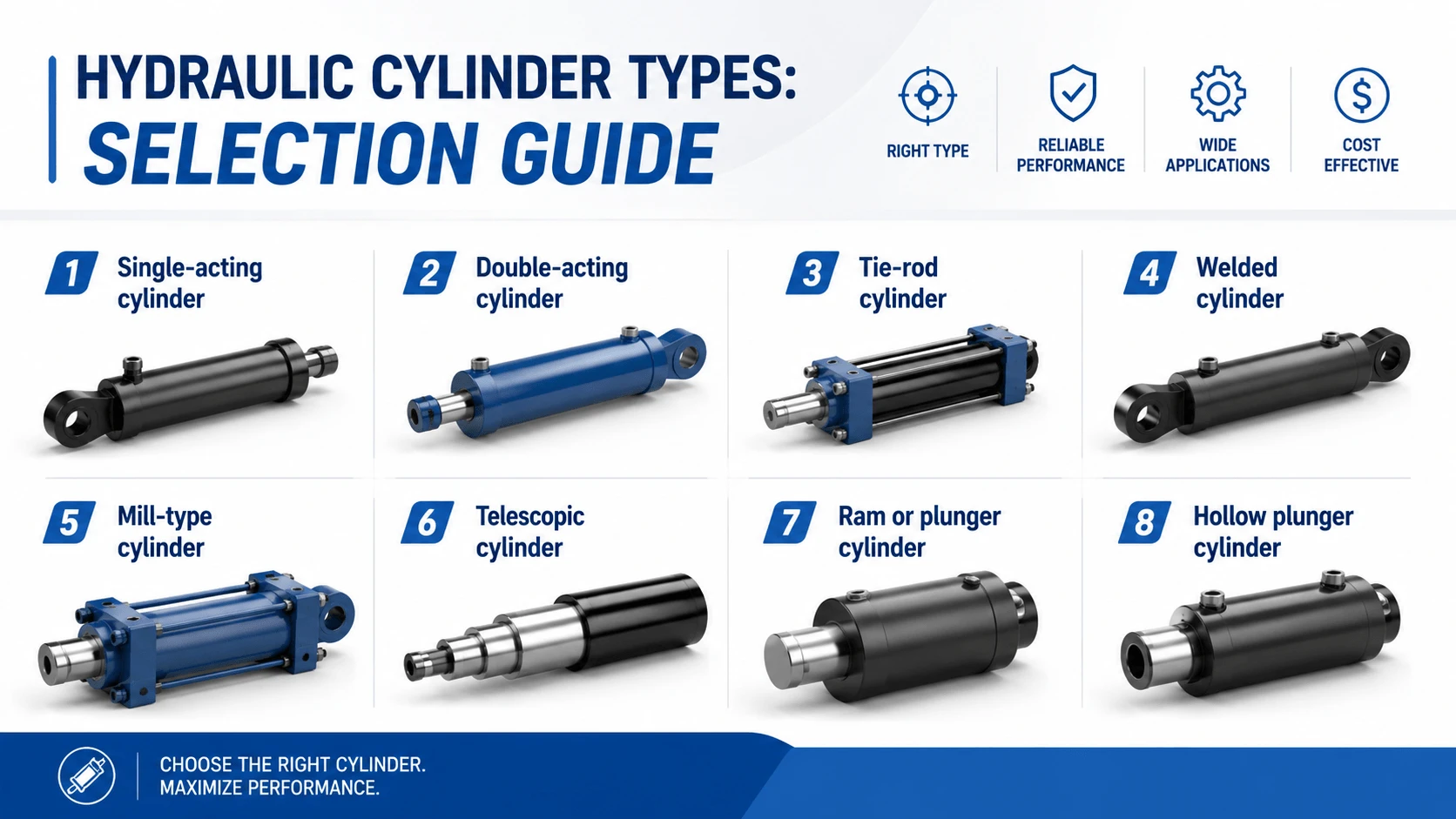
Choosing the wrong hydraulic cylinder type usually causes problems later: seal leakage, slow cycle time, rod bending, poor alignment, or premature wear. The best choice depends on force, stroke, speed, mounting style, duty cycle, pressure, and the working environment.
A hydraulic cylinder is a linear actuator that converts hydraulic pressure and oil flow into straight-line force and motion. In simple terms, force equals pressure multiplied by piston area, while cylinder speed depends on oil flow and effective piston area.
Main Hydraulic Cylinder Types
| Cylinder Type | Best Used For | Key Advantage | Main Limitation |
|---|---|---|---|
Single-acting cylinder |
Lifting, pressing, clamping |
Simple and cost-effective |
Force in one direction only |
Double-acting cylinder |
Controlled extend and retract motion |
Better control and faster return |
Requires two hydraulic lines |
Tie-rod cylinder |
Industrial machinery, presses, automation |
Easy to service and standardize |
Less ideal for severe shock or dirty mobile use |
Welded cylinder |
Mobile equipment, agriculture, construction |
Compact and rugged |
Harder to rebuild than tie-rod designs |
Mill-type cylinder |
Steel mills, presses, mining, heavy industry |
Strong body and high shock resistance |
Larger, heavier, higher cost |
Telescopic cylinder |
Dump trucks, trailers, compactors |
Long stroke from short retracted length |
Sensitive to side load and misalignment |
Ram or plunger cylinder |
Heavy lifting and pushing |
Handles high loads simply |
Needs external guidance |
Hollow plunger cylinder |
Pulling, tensioning, bearing removal |
Can push and pull through the center hole |
Specialized use case |
Single-Acting vs Double-Acting Cylinders
A single-acting hydraulic cylinder uses hydraulic pressure to move in one direction. Return movement is handled by gravity, spring force, or an external load. It is common in lifting tables, jacks, dump bodies, and simple pressing systems.
A double-acting hydraulic cylinder uses hydraulic pressure for both extension and retraction. It has two ports, giving better control over speed, force, and positioning. This is the standard choice for machine tools, industrial presses, injection molding machines, and mobile equipment where controlled movement is required both ways.
Construction Types
Tie-rod cylinders use external rods to clamp the end caps and barrel together. They are common in factory equipment because they are serviceable and often available in standard NFPA or ISO mounting patterns.
Welded cylinders use a welded body construction, making them compact and strong for mobile machinery. They are often selected for excavators, loaders, agricultural machines, and material handling equipment.
Mill-type cylinders are built for high-load, high-shock environments. They usually use heavy-duty heads, flanges, bolts, and thick barrel construction. These are common in steel production, forging presses, mining equipment, and large industrial systems.
Telescopic cylinders use multiple nested stages to achieve a long stroke from a short closed length. They are useful where space is limited, but they need careful guidance because side loading can damage stages and seals.
Main Components
A hydraulic cylinder typically includes the barrel, piston, piston rod, rod gland, head, cap, ports, seals, wear rings, cushions, and mounting hardware. The seals control leakage, the wear rings manage side load, and the rod surface finish strongly affects service life.
Advantages
Hydraulic cylinders offer high force density, compact size, rugged construction, and reliable linear motion. With the right valves and feedback devices, they can also provide accurate speed and position control.
Disadvantages
They require clean hydraulic oil, proper filtration, leak control, and careful alignment. High pressure also creates safety risks if hoses, fittings, mounts, or locking valves are incorrectly specified.
Industrial Applications
Hydraulic cylinders are used in presses, injection molding machines, construction equipment, agricultural machinery, mining machines, steel mills, marine systems, lifting equipment, compactors, and material handling systems.
Common Problems
Typical hydraulic cylinder failures include external leakage, internal bypass, rod scoring, seal extrusion, cylinder drift, slow movement, overheating, bent rods, damaged threads, and uneven motion. In many cases, the root cause is not the cylinder itself but contamination, pressure spikes, side load, incorrect mounting, or poor system design.
Troubleshooting Guide
| Problem | Likely Cause | Practical Check |
|---|---|---|
Cylinder drifts under load |
Internal seal bypass or valve leakage |
Isolate cylinder and pressure test |
Rod seal leaks |
Rod damage, contamination, worn seal |
Inspect rod finish and wiper condition |
Slow movement |
Low flow, restriction, undersized hose |
Check pump flow and pressure drop |
Jerky motion |
Air in system, contamination, stick-slip |
Bleed system and inspect fluid condition |
Bent rod |
Side load or wrong mounting |
Check alignment and rod buckling load |
Seal extrusion |
Pressure spikes or wrong seal material |
Verify pressure rating and relief valve setting |
Selection Guide
To choose the right hydraulic cylinder type, start with required force, available system pressure, stroke length, speed, mounting style, rod buckling risk, side load, duty cycle, temperature, fluid type, corrosion exposure, and serviceability needs.
For procurement, specify bore, stroke, rod diameter, mounting style, working pressure, test pressure, port size, seal material, rod coating, cushion requirement, position sensing, and applicable standards.
Maintenance Tips
Keep hydraulic oil clean, inspect rod surfaces regularly, protect rods from weld spatter and impact, check mount alignment, monitor pressure spikes, replace worn wipers early, and avoid using the cylinder as a structural guide unless it was designed for side load.
FAQs
What are the main types of hydraulic cylinders?
The main types are single-acting, double-acting, tie-rod, welded, mill-type, telescopic, ram, and hollow plunger cylinders.
Which cylinder type is best for heavy-duty applications?
Mill-type cylinders are usually preferred for heavy-duty industrial applications with shock loads, high force, and continuous operation.
What is the difference between tie-rod and welded cylinders?
Tie-rod cylinders are easier to service and standardize. Welded cylinders are more compact and rugged for mobile equipment.
When should I use a telescopic cylinder?
Use a telescopic cylinder when the application needs a long stroke but has limited retracted space, such as dump trucks or trailers.
How do I size a hydraulic cylinder?
Calculate the required force, divide by the available pressure to estimate piston area, then select bore size, rod diameter, stroke, and mounting based on load and buckling conditions.
Authority Sources
Need help choosing the right hydraulic cylinder type for your equipment? Contact our engineering team with your pressure, bore, stroke, load, and mounting requirements, and we can recommend a cylinder configuration for your application.