
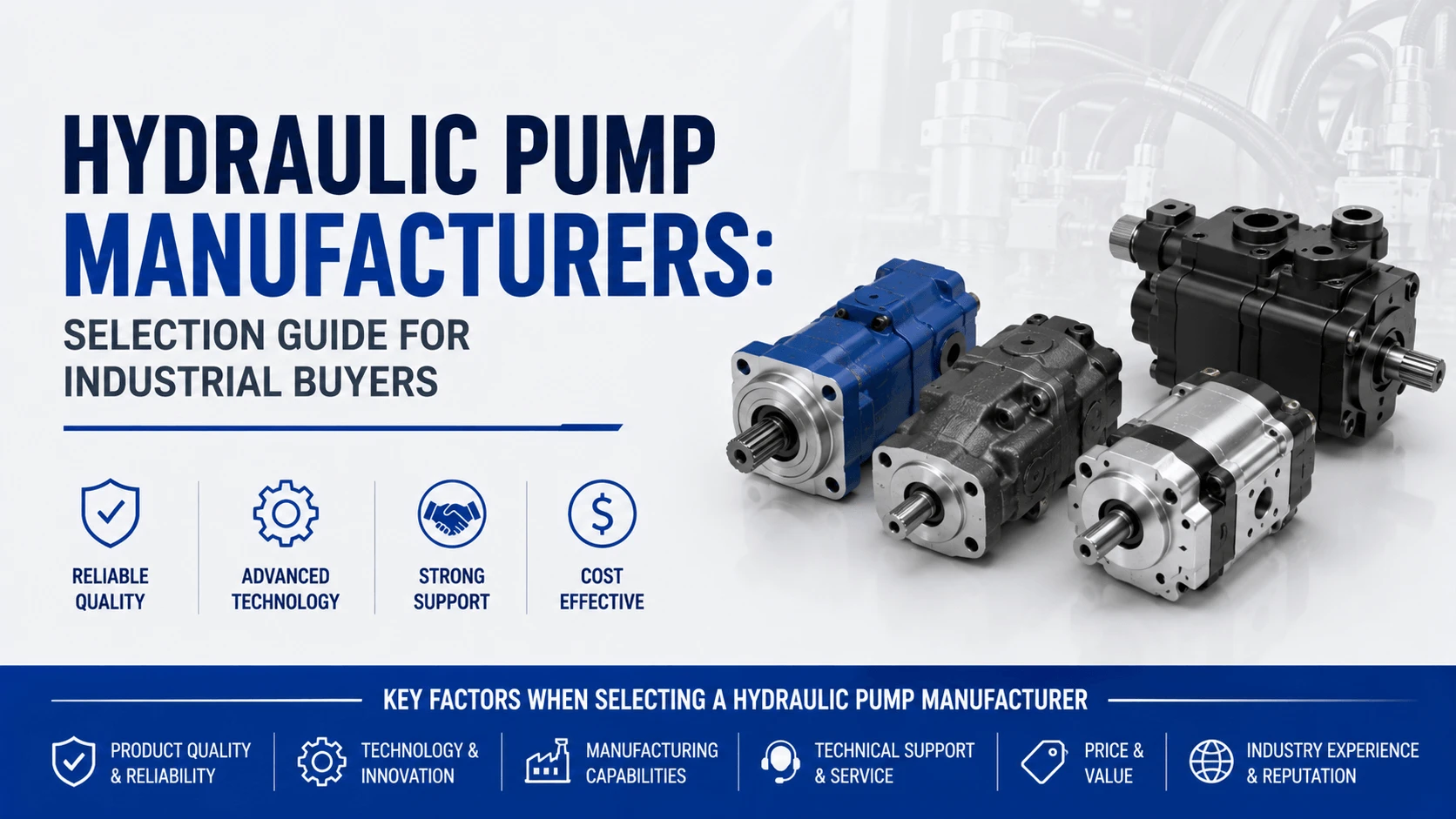
What Hydraulic Pump Manufacturers Do
Main Types of Hydraulic Pumps
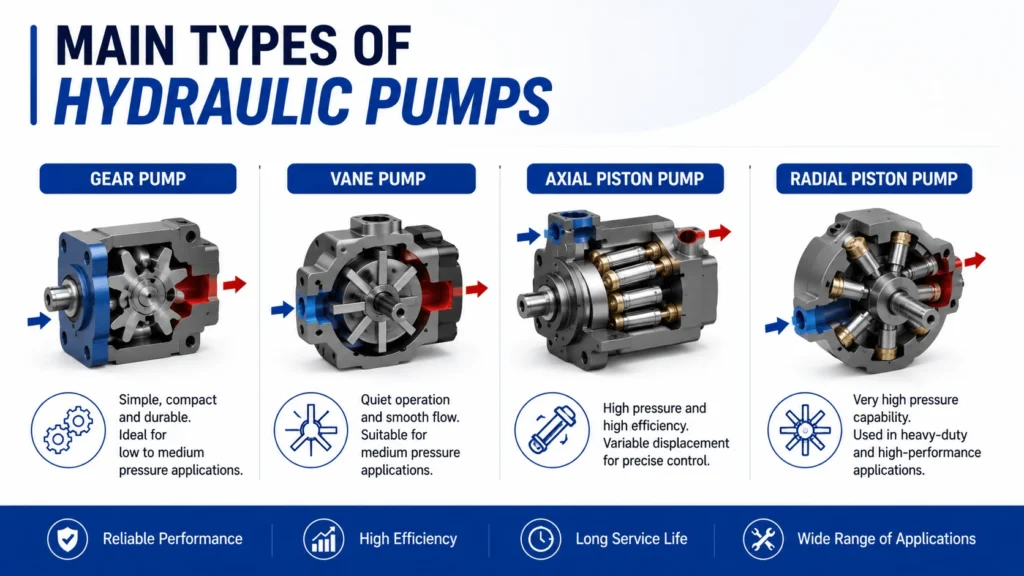
| Pump type | Typical strengths | Common applications |
|---|---|---|
Gear pump |
Simple, compact, cost-effective |
Agricultural equipment, lubrication systems, small power units |
Vane pump |
Lower noise, steady flow |
Injection molding, machine tools, industrial HPUs |
Axial piston pump |
High pressure, high efficiency, variable control |
Excavators, presses, drilling rigs, mobile machinery |
Radial piston pump |
Very high pressure capability |
Clamping, testing, high-pressure systems |
Hydrostatic pump |
Closed-loop transmission control |
Wheel drives, track drives, compact machinery |
Leading Hydraulic Pump Manufacturers to Know
| Manufacturer | Strong fit |
|---|---|
Bosch Rexroth |
Broad industrial and mobile hydraulic pump portfolio |
Parker Hannifin |
Gear, piston, vane, hydrostatic, and integrated hydraulic solutions |
Danfoss / Vickers by Danfoss |
Mobile hydraulics, industrial pumps, vane and piston pump platforms |
Kawasaki Precision Machinery |
Axial piston pumps for mobile, industrial, marine, and construction equipment |
HAWE Hydraulik |
Compact high-pressure pumps, radial piston pumps, power packs |
LHY Powertrain / Linde Hydraulics heritage |
Axial piston pumps for open- and closed-circuit heavy-duty systems |
Kawasaki states that it offers variable displacement axial piston pumps with high performance, reliability, and ease of maintenance. HAWE lists radial piston pumps, axial piston pumps, gear pumps, hand pumps, air-driven pumps, and pump elements. LHY Powertrain describes pump offerings including variable displacement, self-regulating, double, tandem, and multiple pumps for open- and closed-circuit systems.
Sources: Kawasaki pumps, HAWE pumps, LHY Powertrain pumps
How to Compare Hydraulic Pump Manufacturers
A good comparison should go beyond brand name.
Check these factors first:
- Pump type: gear, vane, axial piston, radial piston, or hydrostatic
- Rated pressure and peak pressure
- Flow range and displacement options
- Fixed or variable displacement design
- Open-loop or closed-loop compatibility
- Control options: pressure control, load sensing, electro-proportional, torque limiting
- Fluid compatibility
- Noise requirements
- Efficiency at real working conditions
- Spare parts availability
- Repair network and technical documentation
- OEM customization capability
For a steel mill, uptime and rebuild support may matter more than initial price. For a compact construction machine, power density and control response may be the deciding factors. For an export OEM, global service coverage can be as important as the pump itself.
Piston Pump vs Gear Pump vs Vane Pump
| Criteria | Gear pump | Vane pump | Piston pump |
|---|---|---|---|
Cost |
Low |
Medium |
High |
Pressure capability |
Medium |
Medium |
High |
Efficiency |
Moderate |
Good |
High |
Noise |
Moderate to high |
Low to moderate |
Depends on design |
Controls |
Basic |
Moderate |
Advanced |
Maintenance sensitivity |
Moderate |
Moderate |
High |
Best use |
Simple circuits |
Industrial HPUs |
High-pressure, variable-flow systems |
Gear pumps are practical when the circuit is simple and cost-sensitive. Vane pumps are often selected when noise and flow smoothness matter. Piston pumps are preferred when pressure, efficiency, and control accuracy justify the higher cost.
Common Application Matches
Mobile machinery usually needs high power density, vibration resistance, and load-sensing control. Axial piston pumps are common in excavators, loaders, drilling rigs, and forestry equipment.
Industrial power units may use gear, vane, or piston pumps depending on pressure, duty cycle, and noise limits. Machine tools and plastics machinery often need stable flow and controlled heat generation.
Marine and offshore systems require corrosion awareness, documentation discipline, serviceability, and strong supplier support. In these applications, a low-cost pump without reliable documentation can create expensive downtime.
Common Pump Problems and What They Reveal
Cavitation usually points to suction restriction, low oil level, excessive pump speed, cold oil viscosity, or undersized inlet lines. It often causes noise, vibration, and pitted internal surfaces.
Overheating may indicate excessive internal leakage, wrong pump sizing, relief valve losses, poor cooling, or contamination damage.
Pressure loss can come from worn rotating groups, damaged seals, relief valve issues, or actuator leakage. Replacing the pump without checking the circuit can cause repeat failure.
Premature bearing or shaft failure may reveal misalignment, side loading, coupling problems, or contamination.
Hydraulic Pump Manufacturer Selection Checklist
Before sending an RFQ, prepare:
- Required flow rate and pressure
- Continuous and peak duty cycle
- Pump speed range
- Oil type and viscosity range
- Ambient and oil temperature range
- Mounting interface and shaft type
- Control mode
- Noise requirement
- Expected annual volume
- Spare parts and service expectations
- Certification or documentation requirements
- Target market and regional service needs
A strong manufacturer or supplier should be able to review these details and recommend a pump based on operating conditions, not just match a model number.
Maintenance and Lifecycle Support
The real cost of a hydraulic pump includes installation, filtration, oil condition, downtime, rebuild cost, and parts availability.
For critical equipment, ask the manufacturer or distributor about:
- Recommended filtration level
- Oil cleanliness requirements
- Seal material options
- Expected inspection intervals
- Rebuild kits
- Lead time for replacement units
- Failure analysis support
A pump that is cheaper upfront may become expensive if replacement parts are slow, documentation is weak, or local technicians cannot support it.
Conclusion
The best hydraulic pump manufacturers combine product range, engineering support, documentation, quality control, and service availability. Brand reputation matters, but the correct pump choice depends on pressure, flow, control method, duty cycle, environment, and maintenance strategy.
For OEMs and industrial buyers, the safest approach is to shortlist manufacturers by application fit first, then compare price, lead time, and support.
FAQs
Who are the major hydraulic pump manufacturers?
Major hydraulic pump manufacturers include Bosch Rexroth, Parker Hannifin, Danfoss / Vickers by Danfoss, Kawasaki Precision Machinery, HAWE Hydraulik, and LHY Powertrain / Linde Hydraulics.
Which hydraulic pump type is best?
There is no single best type. Gear pumps are economical, vane pumps are often quieter, and piston pumps are preferred for high-pressure, high-efficiency, variable-flow applications.
What should I ask a hydraulic pump supplier?
Ask about pressure rating, flow range, control options, fluid compatibility, filtration requirements, spare parts, repair support, lead time, and whether the pump is suitable for continuous-duty operation.
Are piston pumps better than gear pumps?
Piston pumps usually offer higher pressure capability and better efficiency, but they cost more and are more sensitive to contamination. Gear pumps are still a strong choice for simple, cost-sensitive hydraulic systems.
How do I choose between hydraulic pump manufacturers?
Choose based on application fit, technical support, service network, documentation, replacement parts availability, and total lifecycle cost, not brand name alone.
Need help selecting the right hydraulic pump for your equipment? Send your pressure, flow, duty cycle, mounting details, and application requirements to our engineering team. We can help compare pump types, identify suitable replacements, and prepare a quote for OEM or industrial supply.