
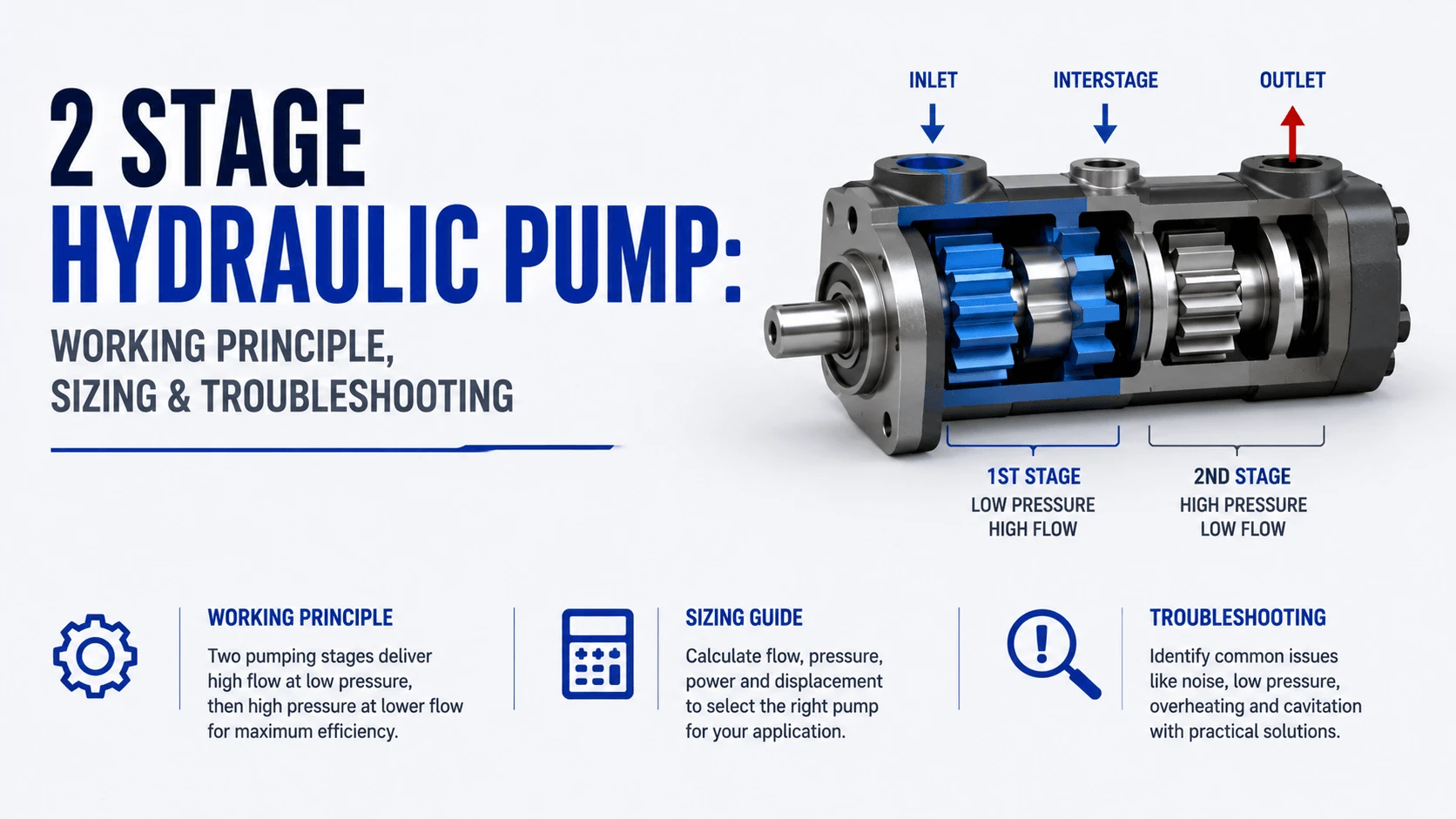
What is a 2 Stage Hydraulic Pump?
| Operating Mode | Flow | Pressure | Purpose |
|---|---|---|---|
Stage 1 |
High flow |
Low pressure |
Fast cylinder travel |
Stage 2 |
Low flow |
High pressure |
High force under load |
How Does a 2 Stage Hydraulic Pump Work?
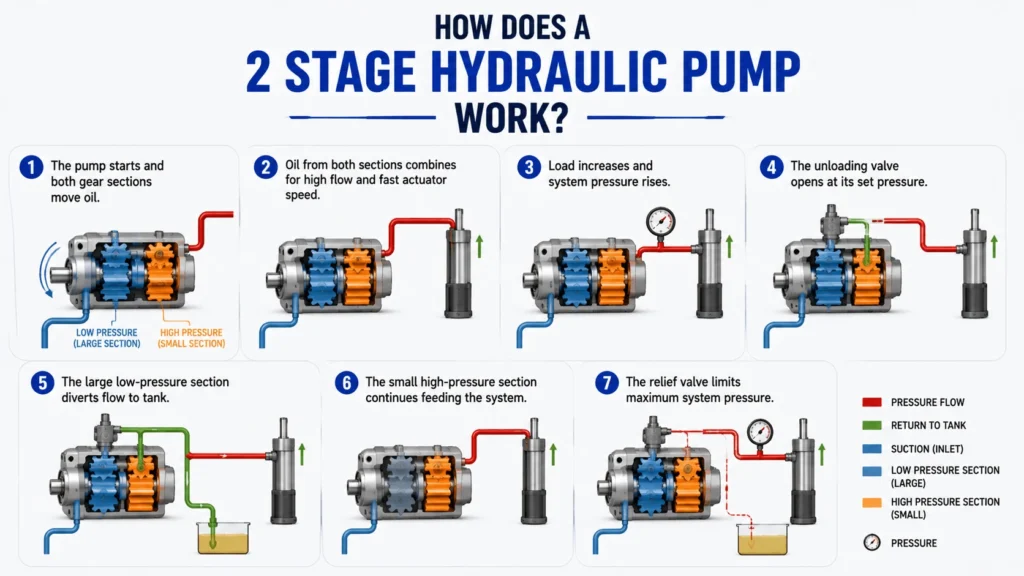
A 2 stage hydraulic pump works by combining the flow from a large pump section and a small pump section at low pressure. When pressure reaches the unloading valve setting, usually around 500 to 900 psi on many splitter-style pumps, the large section unloads back to the tank. The smaller section then continues to build pressure, often up to 2,500 to 3,500 psi, depending on pump and system rating.
The basic sequence is:
- The pump starts, and both gear sections move oil.
- Oil from both sections combines for high flow and fast actuator speed.
- Load increases and system pressure rise.
- The unloading valve opens at its set pressure.
- The large low-pressure section diverts flow to the tank.
- The small high-pressure section continues feeding the system.
- The relief valve limits maximum system pressure.
This arrangement reduces horsepower demand. If the full flow had to be delivered at maximum pressure, the engine or electric motor would need to be much larger.
Hydraulic horsepower can be estimated with:
HP = (GPM x PSI) / (1714 x efficiency)
For example, a pump delivering 16 GPM at 650 psi needs far less power than 16 GPM at 3,000 psi. This is the main reason two stage pumps are effective in small hydraulic systems.
Main Components of a 2 Stage Hydraulic Pump
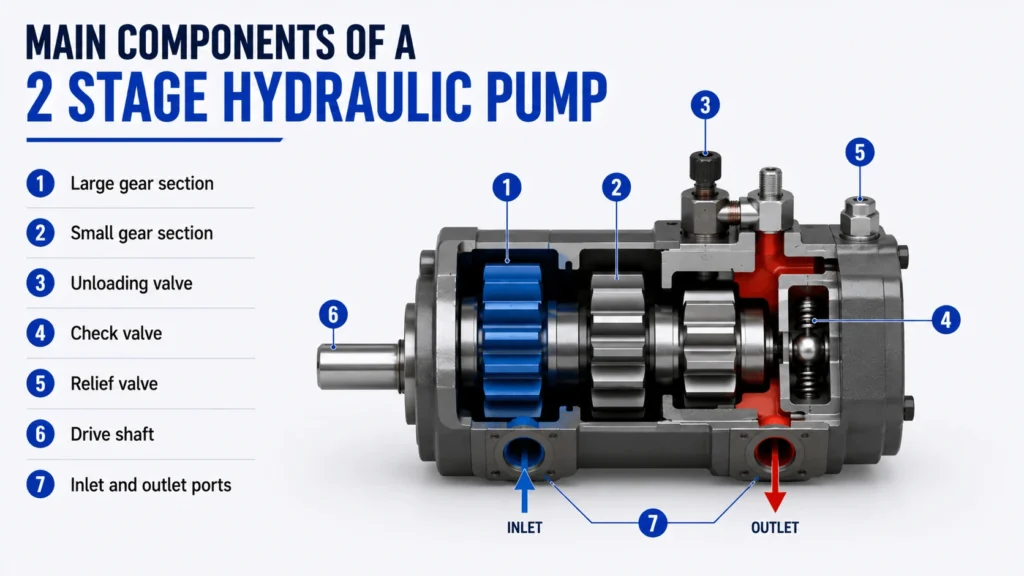
| Component | Function |
|---|---|
Large gear section |
Provides high flow at low pressure |
Small gear section |
Provides lower flow at high pressure |
Unloading valve |
Diverts the large section when pressure rises |
Check valve |
Prevents high-pressure oil from flowing backward |
Relief valve |
Protects the system from excessive pressure |
Drive shaft |
Transfers mechanical power from engine or motor |
Inlet and outlet ports |
Connect the pump to reservoir and hydraulic circuit |
The unloading valve is the key component. If it sticks, leaks, or is adjusted incorrectly, the pump may fail to shift stages, lose speed, or never reach full pressure.
Advantages of a 2 Stage Hydraulic Pump
The main advantage is better cycle speed without oversizing the power source.
Key benefits include:
- Faster cylinder movement during low-load travel
- High force when load increases
- Lower required engine or motor horsepower
- Compact design compared with separate pump circuits
- Good value for intermittent-duty equipment
- Simple hydraulic layout for log splitters and small presses
For equipment that spends part of the cycle moving freely and part of the cycle working under heavy load, this design is efficient and cost-effective.
Disadvantages and Limitations
A 2 stage hydraulic pump is not the best choice for every hydraulic system.
Limitations include:
- Flow drops sharply after the pump shifts to high-pressure mode
- Not ideal for applications needing high flow at high pressure continuously
- More sensitive to unloading valve issues than a simple single-stage pump
- Can create noticeable actuator speed changes
- Usually limited to gear pump efficiency and pressure capability
- Requires correct reservoir, suction line, and oil viscosity to prevent cavitation
For continuous industrial duty, a pressure-compensated piston pump or variable displacement pump may be a better engineering choice.
Industrial Applications
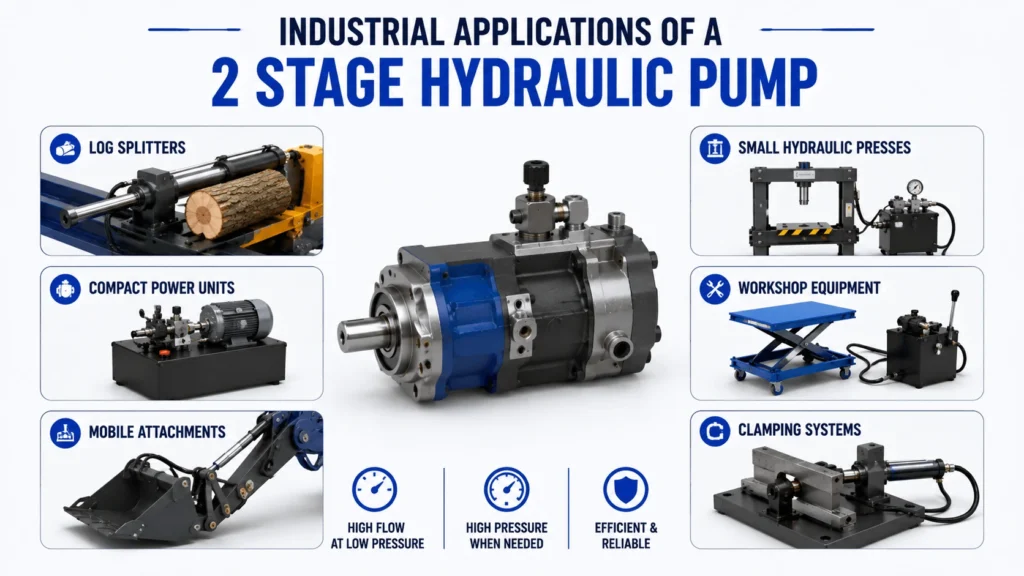
| Application | Why Two Stage Works |
|---|---|
Log splitters |
Fast ram travel, high splitting force |
Small hydraulic presses |
Fast approach, high pressing force |
Compact power units |
Good performance with smaller motors |
Workshop equipment |
Lower cost and simple maintenance |
Mobile attachments |
Useful where engine horsepower is limited |
Clamping systems |
Fast clamp movement before high holding force |
Common Problems with 2 Stage Hydraulic Pumps
| Symptom | Likely Cause |
|---|---|
Pump is slow all the time |
Low engine RPM, worn pump, restricted suction, wrong oil |
Pump will not build pressure |
Relief valve open, worn gears, internal leakage, bad check valve |
Pump does not shift stages |
Stuck unloading valve or incorrect unloading setting |
Pump gets hot |
Excessive bypassing, undersized reservoir, high duty cycle |
Pump is noisy |
Cavitation, air leak, clogged suction strainer, oil too thick |
Shaft seal leaks |
Wrong rotation, pressure spike, worn seal, blocked case drain if applicable |
Troubleshooting Guide
| Step | Check | What to Look For |
|---|---|---|
1 |
Oil level |
Low oil causes aeration and erratic movement |
2 |
Oil viscosity |
Oil too thick can starve the pump, especially cold |
3 |
Suction line |
Collapsed hose, undersized hose, clogged strainer |
4 |
Rotation |
Wrong rotation can damage seals and prevent output |
5 |
Engine or motor RPM |
Low RPM reduces flow directly |
6 |
Relief valve |
Stuck open or set too low |
7 |
Unloading valve |
Stuck, contaminated, or misadjusted |
8 |
Pressure test |
Compare low-stage shift pressure and max pressure |
9 |
Flow test |
Confirms internal leakage or worn gear sections |
Selection Guide: How to Choose a 2 Stage Hydraulic Pump
| Selection Factor | Engineering Consideration |
|---|---|
Total flow |
Determines low-pressure actuator speed |
High-pressure flow |
Determines working speed under load |
Maximum pressure |
Must meet cylinder force requirement |
Unloading pressure |
Affects when speed changes to force mode |
RPM rating |
Must match engine or motor speed |
Rotation |
Clockwise or counterclockwise must match drive |
Shaft type |
Coupling compatibility matters |
Port size |
Suction port must support inlet flow |
Oil viscosity |
Must stay within pump manufacturer range |
Duty cycle |
Intermittent vs continuous operation |
For cylinder force:
Force = Pressure x Cylinder Area
For cylinder speed:
Speed = Flow / Cylinder Area
A larger pump may improve approach speed, but it also increases heat, inlet flow demand, and horsepower requirement. Oversizing the pump without checking the engine or motor is a common mistake.
Maintenance Tips
To extend service life:
- Keep hydraulic oil clean and at the correct viscosity.
- Replace or clean suction strainers according to schedule.
- Avoid restrictive suction fittings and long inlet hoses.
- Warm oil before heavy loading in cold environments.
- Confirm pump rotation before startup.
- Keep relief valve pressure within rated limits.
- Inspect coupling alignment and shaft wear.
- Check for aeration, foaming, or milky oil.
- Use pressure gauges during commissioning and service.
For procurement teams, request the pump curve or data sheet before ordering. Confirm flow ratings, max pressure, unloading pressure, rotation, RPM, shaft type, inlet size, outlet size, and recommended fluid.
FAQ
What is a 2 stage hydraulic pump?
A 2 stage hydraulic pump is a pump with two pumping sections. It delivers high flow at low pressure for fast movement, then switches to low flow at high pressure when load increases.
How does a 2 stage hydraulic pump work?
It combines flow from two pump sections during low-pressure operation. When pressure reaches the unloading valve setting, the larger section unloads to tank while the smaller section continues producing high pressure.
What pressure does a 2 stage hydraulic pump switch at?
Many log splitter-style two stage pumps switch around 500 to 900 psi, with 650 psi being common in many small hydraulic systems. The exact value depends on the pump model and unloading valve setting.
Is a 2 stage hydraulic pump the same as a gear pump?
Most two stage hydraulic pumps used in log splitters and compact power units are gear pumps, but “two stage” describes the operating arrangement, not only the gear design.
Why is my 2 stage hydraulic pump slow?
Common causes include low engine RPM, low oil level, suction restriction, oil that is too thick, a stuck unloading valve, a worn pump, or a relief valve bypassing oil.
Can a 2 stage hydraulic pump run continuously?
It can run in intermittent-duty systems, but it is usually not the best choice for continuous high-pressure, high-flow industrial operation. For that duty, a piston pump or variable displacement pump may be more suitable.
Authority Sources
Need help selecting a 2-stage hydraulic pump for your equipment? Contact our hydraulic engineering team with your required flow, pressure, cylinder size, duty cycle, engine or motor rating, and port requirements. We can help match the correct pump specification, quote compatible hydraulic components, and support OEM or replacement applications.