
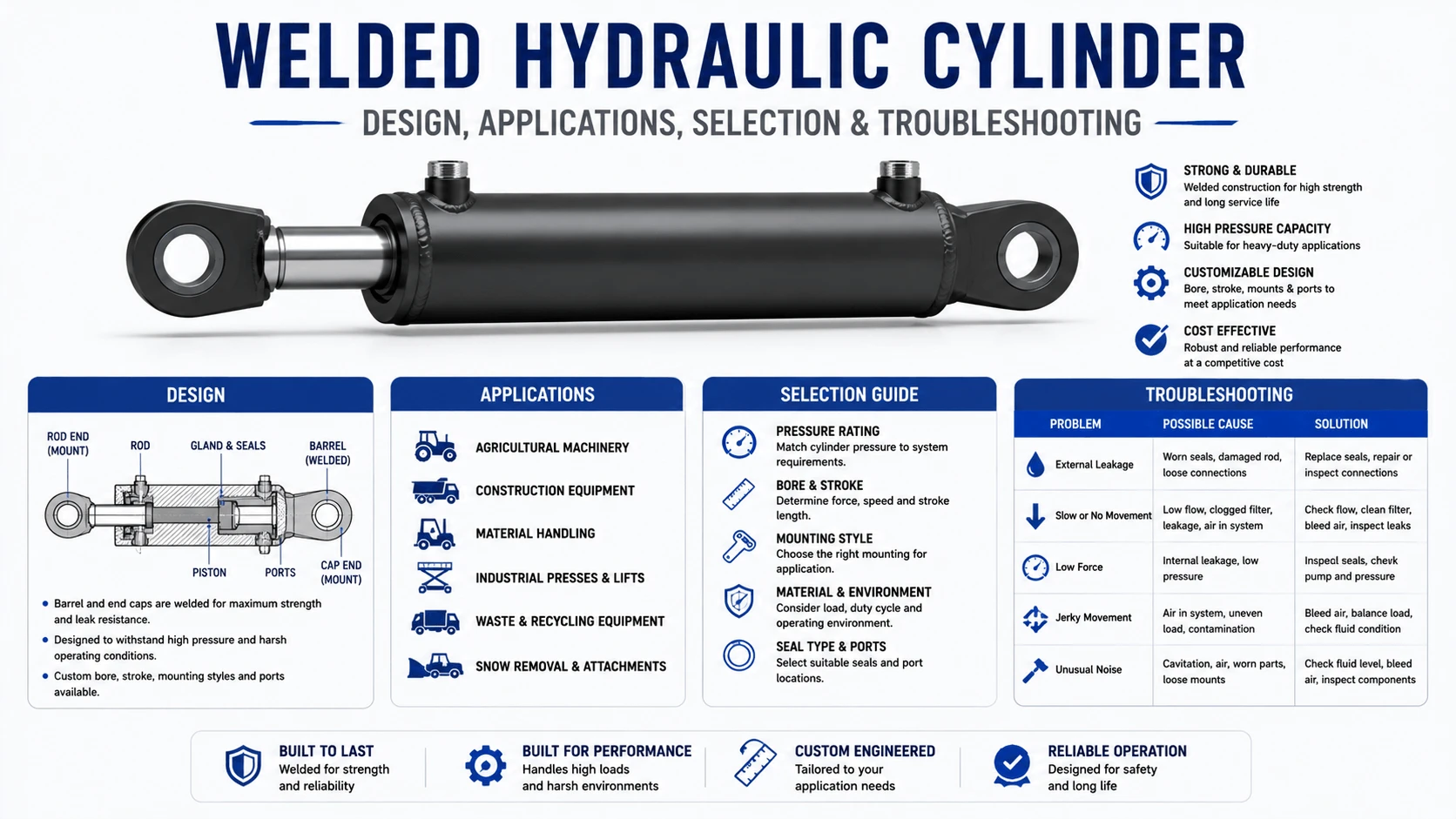
What is a Welded Hydraulic Cylinder?
How a Welded Hydraulic Cylinder Works
Main Components of a Welded Hydraulic Cylinder
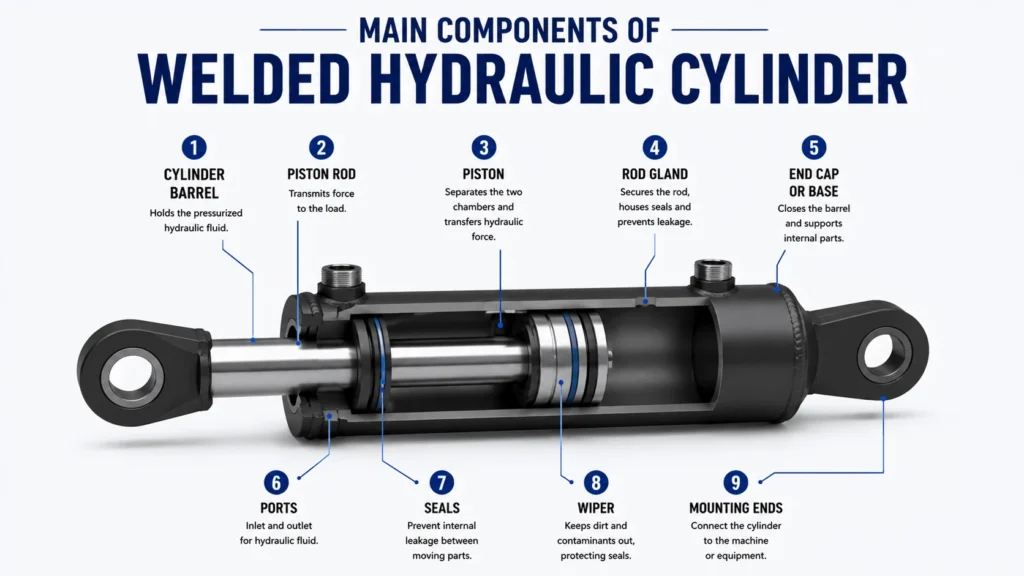
| Component | Function |
|---|---|
Cylinder barrel |
Contains pressure and guides piston movement |
Piston rod |
Transfers linear force to the machine |
Piston |
Separates pressure chambers and carries seals |
Rod gland |
Supports the rod and holds rod seals/wipers |
End cap or base |
Closes the cylinder body and carries mounting loads |
Ports |
Allow hydraulic oil to enter and exit |
Seals |
Prevent internal bypass and external leakage |
Wiper |
Keeps dirt away from the rod seal |
Mounting ends |
Clevis, eye, trunnion, flange, or custom mount |
Welded Hydraulic Cylinder vs Tie-Rod Cylinder
| Factor | Welded Hydraulic Cylinder | Tie-Rod Cylinder |
|---|---|---|
Body design |
Welded compact body |
Barrel clamped by tie rods |
Best use |
Mobile and heavy-duty equipment |
Industrial machinery and easier repair |
Space requirement |
Compact |
Larger outside profile |
Vibration resistance |
Strong |
Good, but tie rods can loosen if poorly maintained |
Customization |
High |
Often standardized |
Serviceability |
Depends on design |
Usually easier to disassemble |
Interchangeability |
Often custom |
Often better for NFPA-style cylinders |
A welded hydraulic cylinder is usually preferred when strength, compact packaging, and harsh-duty operation matter more than easy field disassembly.
Advantages of Welded Hydraulic Cylinder
Welded cylinders are compact because they do not need external tie rods. This makes them suitable for loaders, excavators, lift platforms, agricultural implements, trailers, forestry equipment, and refuse trucks.
They also handle shock, vibration, and contamination-prone environments well when designed with the right seals, rod coating, and mounting geometry.
Key advantages include:
- Compact outside diameter
- Strong welded construction
- Good resistance to vibration
- Flexible mounting design
- Suitable for custom OEM equipment
- Good performance in mobile hydraulic systems
Disadvantages and Limitations
The main limitation is serviceability. Some welded designs are harder to rebuild than tie-rod cylinders, especially if the base end is permanently welded and internal access is limited.
Other possible disadvantages include:
- Less interchangeability than standardized tie-rod cylinders
- More dependence on manufacturer drawings
- Higher custom tooling or engineering requirements
- Risk of weld-related defects if manufacturing quality is poor
- Longer lead time for custom designs
For replacement projects, matching only bore and stroke is not enough. Mounting center distance, rod diameter, port orientation, retracted length, pin size, and working pressure must also be checked.
Industrial Applications of Welded Hydraulic Cylinder
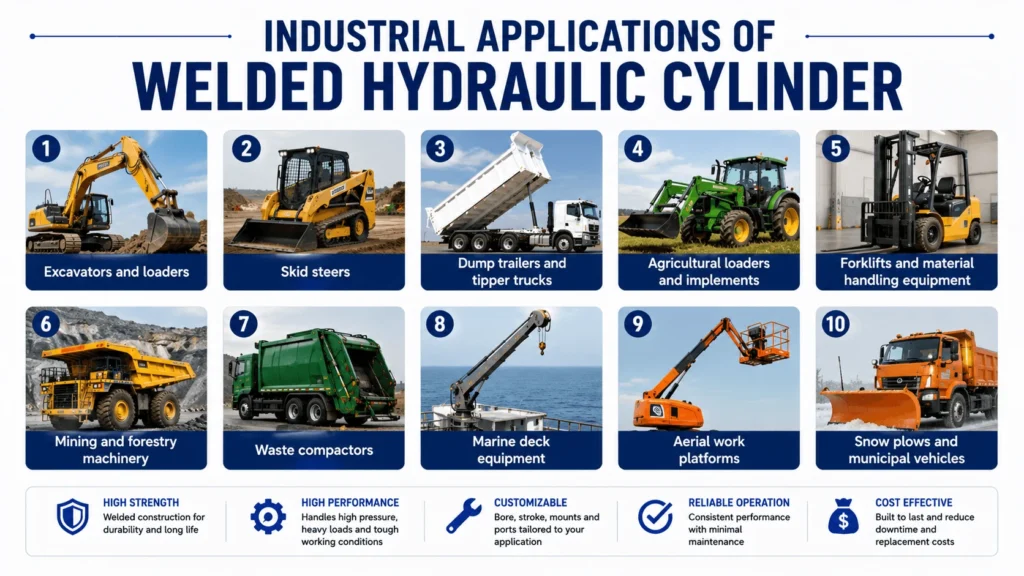
Welded hydraulic cylinders are common in:
- Excavators and loaders
- Skid steers
- Dump trailers and tipper trucks
- Agricultural loaders and implements
- Forklifts and material handling equipment
- Mining and forestry machinery
- Waste compactors
- Marine deck equipment
- Aerial work platforms
- Snow plows and municipal vehicles
In these applications, the cylinder often faces dirt, side loading, impact, vibration, and weather exposure. Rod surface quality, seal selection, and mounting alignment are critical.
Common Problems
| Problem | Likely Cause | Practical Check |
|---|---|---|
External oil leak |
Worn rod seal, scratched rod, damaged gland |
Inspect rod surface and seal area |
Cylinder drifts |
Piston seal bypass or valve leakage |
Isolate cylinder from valve circuit |
Slow movement |
Low flow, restriction, internal leakage |
Check pump flow, hoses, and seals |
Rod bends |
Side load, undersized rod, incorrect mounting |
Check alignment and rod buckling margin |
Seal failure |
Heat, contamination, wrong seal material |
Check oil temperature and cleanliness |
Jerky movement |
Air in system, dry seals, binding |
Bleed system and inspect mounting pins |
Weld crack |
Overload, fatigue, poor weld quality |
Inspect mounting areas and stress points |
Troubleshooting Guide
- Check for external leakage around the rod gland, ports, and welded joints.
- Inspect the rod for scoring, rust, chrome damage, or bending.
- Measure whether the cylinder drifts under load.
- Check oil temperature and contamination level.
- Verify system pressure with a calibrated gauge.
- Inspect mounting pins, bushings, and alignment.
- Compare actual load conditions with the original cylinder rating.
A common mistake is replacing seals without fixing the root cause. If the rod is scratched or the machine linkage is side-loading the cylinder, new seals may fail quickly.
Selection Guide
When selecting a welded hydraulic cylinder, confirm these parameters before quoting or purchasing:
| Selection Factor | Why It Matters |
|---|---|
Bore diameter |
Determines extend force |
Rod diameter |
Affects retract force and buckling resistance |
Stroke length |
Determines travel distance |
Working pressure |
Must match system pressure and load |
Mounting style |
Controls load path and alignment |
Pin diameter |
Must match machine linkage |
Port size and position |
Affects flow and installation |
Seal material |
Must match oil, temperature, and environment |
Rod coating |
Important for corrosion and wear resistance |
Cushioning |
Reduces end-of-stroke shock |
Duty cycle |
Affects heat, wear, and fatigue life |
For high-load or long-stroke cylinders, rod buckling should be checked instead of relying only on bore size. A cylinder can have enough hydraulic force but still fail mechanically if the rod is too slender for the application.
Maintenance Tips
Keep the rod clean and protected from impact. A damaged rod surface is one of the fastest ways to destroy rod seals.
Recommended maintenance practices:
- Inspect the rod chrome regularly
- Replace worn wipers before dirt reaches the rod seal
- Keep hydraulic oil clean and dry
- Avoid pressure spikes beyond design limits
- Grease pins and bushings where required
- Check cylinder alignment after equipment damage
- Monitor oil temperature
- Replace seals with the correct material and profile
For severe environments, consider upgraded rod coatings, heavy-duty wipers, high-temperature seals, or stainless steel components.
FAQ
What is a welded hydraulic cylinder?
A welded hydraulic cylinder is a hydraulic actuator with a welded barrel and end structure. It converts hydraulic pressure into linear force and is commonly used in mobile and heavy-duty machinery.
Are welded hydraulic cylinders better than tie-rod cylinders?
They are better for compact, rugged, mobile applications. Tie-rod cylinders are often easier to repair and more standardized for factory equipment.
Can welded hydraulic cylinders be repaired?
Many can be repaired, especially if the gland is removable. However, repairability depends on the cylinder design, weld structure, rod condition, and availability of seals or drawings.
What causes welded hydraulic cylinder failure?
Common causes include seal wear, rod scoring, contamination, side loading, pressure spikes, poor alignment, overheating, and fatigue around mounting or welded areas.
How do I choose the right welded hydraulic cylinder?
Confirm bore, stroke, rod diameter, pressure rating, mounting style, pin size, port location, seal material, operating temperature, duty cycle, and environmental exposure.
Authority Sources
Need a welded hydraulic cylinder for mobile equipment, agricultural machinery, construction vehicles, or custom OEM systems? Contact our engineering team with your bore, stroke, pressure, mounting style, and working conditions. We can help you select or customize a cylinder for reliable long-term operation.