
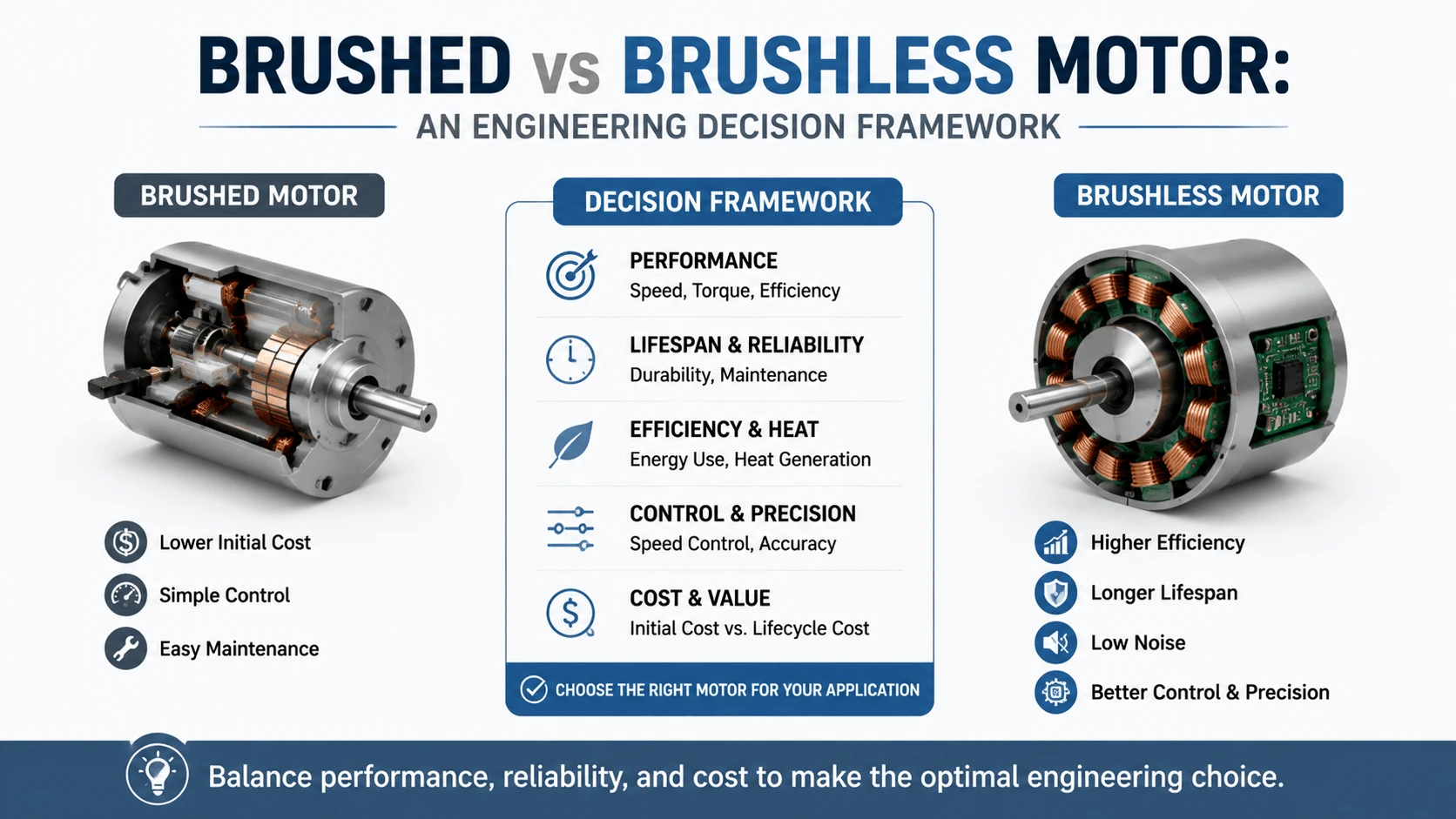
Pick the wrong motor technology, and you feel it every month. Either someone climbs into a machine every 600 hours to swap brushes, or you pay three times more than necessary for a conveyor that runs eight hours a week.
The brushed vs brushless motor question comes up constantly in equipment design and retrofits. Most published comparisons stop at “brushless costs more but lasts longer.” That is true, but useless. You need numbers, failure modes, and application-specific guidance to specify correctly. This article covers both technologies from the standpoint of someone who has to keep equipment running.
How Brushed Motors Work
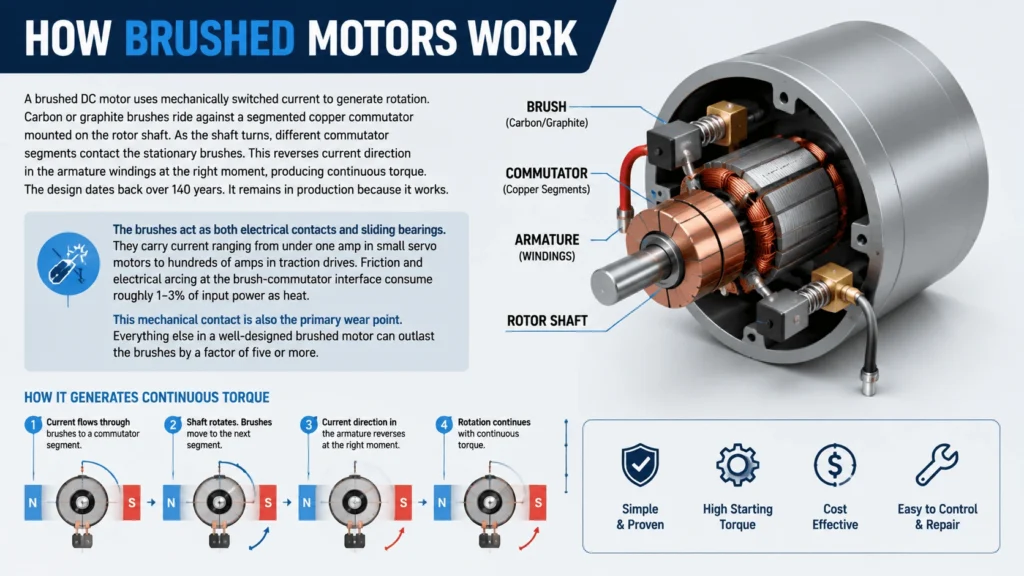
A brushed DC motor uses mechanically switched current to generate rotation. Carbon or graphite brushes ride against a segmented copper commutator mounted on the rotor shaft. As the shaft turns, different commutator segments contact the stationary brushes. This reverses the current direction in the armature windings at the right moment, producing continuous torque. The design dates back over 140 years. It remains in production because it works.
The brushes act as both electrical contacts and sliding bearings. They carry currents ranging from under one amp in small servo motors to hundreds of amps in traction drives. Friction and electrical arcing at the brush-commutator interface consume roughly 1-3% of input power as heat. This mechanical contact is also the primary wear point. Everything else in a well-designed brushed motor can outlast the brushes by a factor of five or more.
How Brushless Motors Work
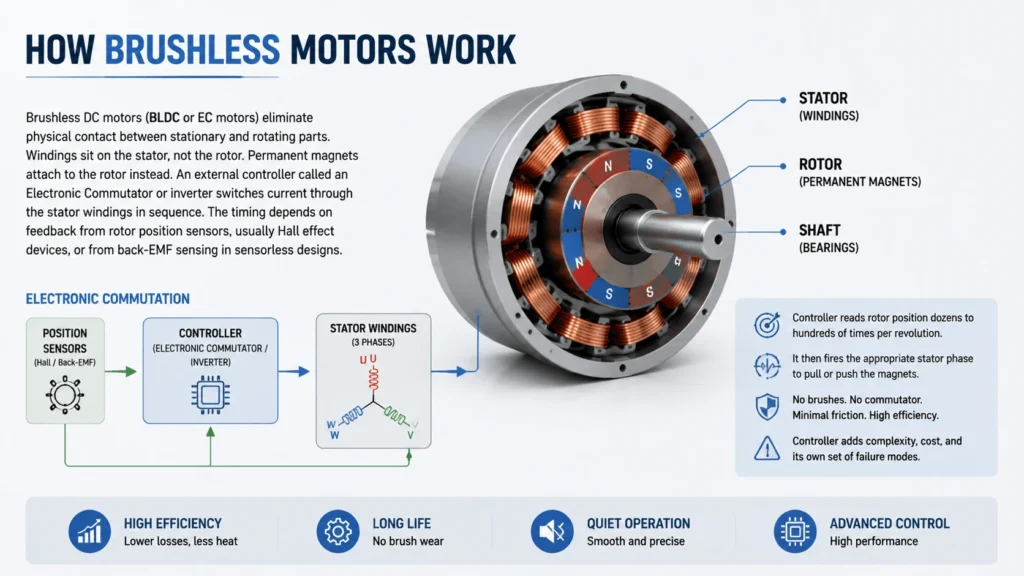
Brushless DC motors (BLDC or EC motors) eliminate physical contact between stationary and rotating parts. Windings sit on the stator, not the rotor. Permanent magnets attach to the rotor instead. An external controller, called an Electronic Commutator or inverter, switches current through the stator windings in sequence. The timing depends on feedback from rotor position sensors, usually Hall effect devices, or from back-EMF sensing in sensorless designs.
The controller reads the rotor position dozens to hundreds of times per revolution. It then fires the appropriate stator phase to pull or push the magnets. No brushes touch anything. No commutator segments arc against contacts. The only friction sources are the shaft bearings themselves, so mechanical losses drop dramatically. However, the controller adds complexity, cost, and its own set of failure modes.
Efficiency Comparison
Efficiency numbers tell a nuanced story. At rated load near the nameplate speed, a quality brushless motor reaches 85-92% efficiency depending on size and pole count. A comparable brushed motor manages 75-88%. The gap widens at high speeds where brush friction rises with RPM. A 3000 RPM brushed unit loses 2-4% more power than a brushless equivalent due solely to brush drag.
But look at partial loads below 30% of rated output. Brushless efficiency falls off sharply because the controller’s fixed switching losses become a larger share of total power. A brushed motor at 15% load still runs at 60-70% efficiency since copper losses scale with current squared, and there is no controller overhead. For applications that spend most of their time idling or running light, the efficiency advantage of brushless shrinks considerably.
Table: Typical Efficiency at Different Load Points (0.75 kW frame)
| Load Point | Brushed Motor | Brushless Motor |
|---|---|---|
100% rated |
82% |
89% |
75% rated |
80% |
87% |
50% rated |
76% |
83% |
25% rated |
68% |
72% |
10% rated |
55% |
48% |
Stall / zero speed |
0% (all heat) |
0% (all heat) |
Lifespan and Wear Mechanisms
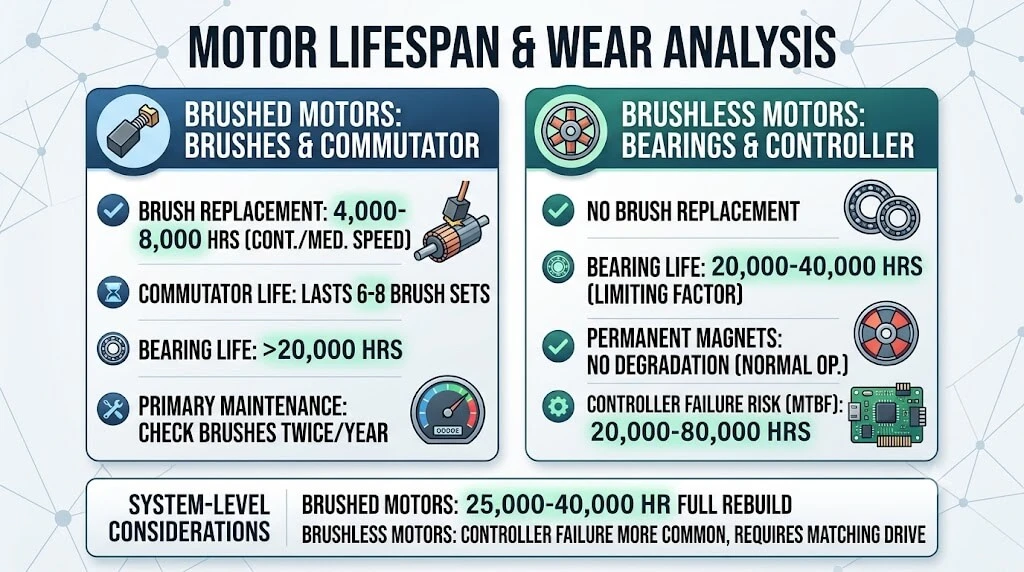
Brush life depends on load, speed, duty cycle, and brush grade. In continuous-duty applications at moderate speeds (1500-3000 RPM), industrial brushed motors typically need brush replacement every 4,000 to 8,000 operating hours. Intermittent duty with long off-periods extends this to 10,000-15,000 hours because brushes cool down and wear less per hour of actual run time. Heavy loads, high ambient temperatures, or contaminated atmospheres cut brush life in half or worse.
Commutator wear follows brush wear. A properly maintained commutator lasts through 6-8 sets of brushes before requiring turning or replacement. Bearing life usually exceeds 20,000 hours in properly aligned installations. So the realistic service interval for a brushed motor in normal industrial use comes down to checking brushes twice per year. Budget a full rebuild at 25,000-40,000 hours.
Brushless motors have no brushes to replace. The permanent magnet field does not degrade under normal operation. Bearing life becomes the limiting factor, typically 20,000-40,000 hours, depending on bearing class, load alignment, and temperature. The weak point shifts to the electronic controller. Power semiconductors fail from voltage spikes, thermal cycling, or capacitor drying. Controller MTBF ranges from 20,000 to 80,000 hours, depending on component quality and cooling. If the controller fails, the motor itself is usually fine. But you cannot run it without a matching drive.
Speed Control Methods
Controlling a brushed motor is trivially simple. Vary the applied DC voltage, and the speed changes proportionally. A basic PWM (pulse-width modulation) driver board costs 10-50 for small motors up to a few hundred watts. Larger drives top out around 200-800 for frames up to 5 kW. The relationship between voltage and speed is nearly linear across most of the operating range. Torque remains available even at very low speeds because the commutator keeps switching regardless of shaft position.
Brushless motors require the controller to be part of any speed regulation scheme. You cannot just apply a variable DC voltage. The controller must actively track rotor position and commutate phases correctly at whatever speed you command. This means the minimum viable system always includes the drive electronics. Entry-level BLDC controllers run 50-200 for fractional horsepower units. Industrial servo drives reach 500-4000+ for multi-kilowatt packages. On the plus side, these controllers offer precise speed holding, field-oriented control, regenerative braking, and communication interfaces that brushed drives rarely match at the same price point.
Cost Breakdown
Purchase price heavily favors brushed motors for smaller sizes. A 0.37 kW brushed DC motor might cost 40-80. Pair it with a basic PWM controller for 30-80 and your drive system totals 70-160. The equivalent BLDC motor runs 80-180, and the dedicated controller adds another $100-350. At this power level, brushless costs roughly 2-3 times as much upfront.
The gap narrows above 5 kW. A 7.5 kW brushed motor and SCR drive package costs 800-1,500. A comparable BLDC system with vector drive prices at 1,200-2,500. The premium drops to 1.5-2x. Above 20 kW, the difference shrinks further. The controller cost becomes a smaller share of the total package, and volume production has driven brushless drive prices down.
Total cost of ownership flips the math for high-duty applications. If a motor runs 24/7 and consumes significant power, the efficiency gain of brushless pays back the purchase premium in 1-3 years, depending on electricity rates. If the same motor runs two shifts or less, payback stretches to 5-8 years or never happens. Maintenance labor for brush changes matters too. Each intervention takes 30-90 minutes, including lockout/tagout, disassembly, inspection, reassembly, and testing. At 80-120/hour fully burdened labor cost, four interventions per year add 160-960 annually in maintenance expense alone.
Table: 0.75 kW System Cost Comparison (USD)
| Component | Brushed System | Brushless System |
|---|---|---|
Motor |
$55 |
$130 |
Controller/drive |
$60 |
$220 |
Installation |
$40 |
$50 |
Total installed |
$155 |
$400 |
Annual energy (2000 hrs) @ $0.10/kWh |
$183 |
$168 |
Annual brush maintenance (if applicable) |
$240 |
$0 |
5-year TCO |
$2,270 |
$2,140 |
Industrial Application Matrix
Different applications weigh the trade-offs differently. Here is where each technology earns its place.
Material handling conveyors running at a constant speed for one shift daily represent the sweet spot for brushed motors. The initial cost is low, speed control is unnecessary, and maintenance access during planned downtime is easy. A 150 brushed drive does the same job as a 400 brushless system that offers capabilities the application will never use.
CNC machines and precision positioning equipment almost always use brushless servos. The requirement for smooth rotation at varying speeds, rapid direction reversal, and accurate position feedback makes the controller a necessity anyway. Once you commit to a sophisticated drive, the marginal cost of going brushless is small. You also eliminate brush maintenance inside an enclosure packed with sensitive electronics.
Battery-powered mobile equipment strongly favors brushless. Every watt-hour of battery capacity counts. The 10-15% efficiency improvement extends run time noticeably. Reduced maintenance is also valuable because accessing motor brushes on a vehicle in the field is harder than opening a panel on a fixed machine.
HVAC fans and pumps running continuously at a fixed speed are split. Large installations often use AC induction motors rather than DC technology. When battery backup or variable speed demands DC, choose brushless on efficiency grounds if runtime exceeds 4,000 hours per year. Smaller rooftop units sometimes stick with brushed motors because the controller savings outweigh modest efficiency gains on short runtimes.
Explosive atmosphere applications (ATEX/Class I) may mandate brushless construction entirely. Arcing at the commutator-brush interface creates an ignition source that is unacceptable around flammable gases or dusts. Some certified brushed motors exist with sealed enclosures and inert gas purging, but they add substantial cost and complexity. Brushless motors with appropriately rated intrinsically safe controllers avoid the problem altogether.
Maintenance Requirements
A brushed motor needs periodic attention. Check brushes monthly in new installations until wear rate stabilizes, then quarterly thereafter. Measure remaining brush length against the manufacturer’s minimum specification, typically 5-8 mm above the holder. Inspect commutator surface for discoloration, grooving, or copper transfer buildup. Clean the commutator with fine-grit non-metallic abrasive paper if needed. Never use emery cloth or steel wool; embedded particles short out segments. Blow out carbon dust with dry compressed air before reassembling. Inspect bearings for noise and play at each brush service interval. Grease bearings per the nameplate schedule, typically every 2,000-4,000 hours.
A brushless motor requires far less routine work. Keep the air inlet and outlet passages clear of dust accumulation. Check bearing condition annually by listening for abnormal noise and feeling for shaft play. Verify controller fan operation if equipped. Tighten electrical connections during scheduled shutdowns; loose terminals cause voltage drops that overheat semiconductors. Monitor heatsink temperature if the application runs near the controller’s current limit. Replace electrolytic capacitors in the controller every 5-8 years as preventive maintenance before they dry out and fail catastrophically. Beyond that, the motor itself runs until something breaks.
EMI and Environmental Factors
Electromagnetic interference patterns differ sharply between the two technologies. Brushed motors produce broadband electrical noise from arcing at the commutator. The noise spectrum spans from kHz into low MHz. It can interfere with sensitive analog sensors, audio equipment, and poorly shielded low-frequency circuits. Mitigation involves capacitive filters across the motor terminals and twisted-pair wiring. Most industrial environments tolerate brushed motor EMI without issues because the noise stays localized and low-power.
Brushless motor controllers switch DC bus voltage at high frequency, commonly 10-20 kHz for IGBT-based drives and up to 100 kHz for MOSFET designs. This generates conducted and radiated EMI centered on the switching frequency and its harmonics. Long cable runs between the controller and the motor act as antennas. Poorly grounded systems inject switching noise into adjacent signal cables. Compliance with EMC standards (IEC 61800-3 for adjustable speed drives) requires proper shielding, filtered enclosures, and careful cable routing. In crowded control panels, a brushless drive may need a designated installation zone away from analog instrumentation.
Temperature limits differ, too. Brushed motors handle cold starts better because the commutator works regardless of temperature. Some early brushless controllers had trouble starting reliably below -10 C because capacitor values drifted and sensor thresholds shifted. Modern drives handle -25 C or lower in industrial grades, but check the datasheet for outdoor or refrigerated applications.
Dust and contamination affect both types, but in different ways. Conductive metal dust shorts out commutator segments and destroys brushes within hours. Non-conductive dust like wood flour or plastic particles, embeds in the brush face and accelerates uneven wear. Brushless motors avoid commutator problems, but their controllers contain air intakes for cooling fans. Dust-coated heatsinks reduce thermal margin and shorten semiconductor life. Both technologies require appropriate enclosure ratings (IP54 minimum for dusty environments).
Selection Decision Tree
Here is a practical framework for choosing between brushed and brushless in industrial applications.
Check whether the environment prohibits arcing
Hazardous location classification (Class I Div 1, Zone 0/1, IECEx Zone 0/1) eliminates standard brushed motors unless specifically certified. If yes, go brushless or use a certified explosion-proof brushed unit.
Evaluate duty cycle.
Continuous operation above 4,000 hours per year tilts toward brushless on TCO grounds. Intermittent operation below 1,000 hours per year makes the brushed motor’s lower capital cost hard to beat unless efficiency is critical.
Consider speed control requirements.
If the application needs precise speed holding, rapid acceleration profiles, or position feedback, you need a sophisticated controller anyway. The incremental step to brushless is small once you accept that complexity. If the motor runs at one speed from a fixed supply voltage, a brushed motor with a simple contactor or relay keeps things cheap and reliable.
Assess maintenance access.
Can technicians reach the motor easily during planned downtime? Is spare parts inventory available? If the motor sits inside a sealed assembly that takes four hours to tear down, minimizing maintenance events has real value. Brushless reduces those events. If the motor lives behind a hinged panel that opens in thirty seconds, changing brushes twice a year is a minor inconvenience.
Calculate the payback period
Take the purchase price difference, estimate annual energy savings from improved efficiency, add avoided maintenance costs, and divide. If payback is under three years, brushless makes financial sense for most organizations. If it exceeds five years, the business case depends on non-financial factors like reliability requirements or space constraints.
FAQ
Which motor type is more efficient?
At rated load and typical operating speeds, brushless motors win by 5-12 percentage points depending on size and design. Below about 30% of rated load, the gap narrows because brushless controller overhead becomes proportionally larger. At very light loads under 15%, some brushed motors actually achieve equal or better net efficiency.
How long do brushes typically last?
Industrial brushed motor brushes last 4,000-8,000 hours in continuous duty at moderate speeds. Lighter intermittent duty with cooling periods extends this to 10,000-15,000 hours. Heavy loads, high speeds (above 3600 RPM), low humidity, or contaminated atmospheres reduce brush life significantly, sometimes to under 2,000 hours.
Can I replace a brushed motor with a brushless one?
Mechanical replacement is straightforward if the frame size matches or an adapter exists. Electrical replacement requires swapping the entire drive system because brushed and brushless controllers operate on completely different principles. You cannot drive a brushless motor with a simple DC power supply or basic PWM driver. Budget for a new controller, possibly new cabling with shielding, and updated control signals if the original system used analog speed commands.
Do brushless motors require maintenance?
They need much less attention than brushed units. Tasks include keeping ventilation clear, checking bearings annually, tightening connections during shutdowns, and replacing controller capacitors every 5-8 years. No regular wear items like brushes exist. Bearing replacement at 20,000-40,000 hours is the major maintenance event, similar to the bearing service interval on a well-maintained brushed motor.
Why are brushless motors more expensive?
Three factors drive the premium. Permanent magnet materials require rare-earth elements like neodymium. The electronic controller must accompany every motor, and production volumes for many frame sizes remain lower than commodity brushed motors. As production scales and controller integration improve, the gap continues to narrow but has not disappeared.
Conclusion
Neither motor technology dominates across all applications. Brushed motors remain the correct choice for low-duty, cost-sensitive, easily accessible installations where simplicity has value. Brushless motors earn their premium in high-runtime, precision-controlled, or maintenance-hostile environments where the total cost of ownership favors reduced intervention.
The right pick comes from matching your specific duty cycle, environment, control needs, and financial horizon against the trade-offs outlined above. Run the numbers for your application rather than assuming newer technology automatically wins.