
Introduction
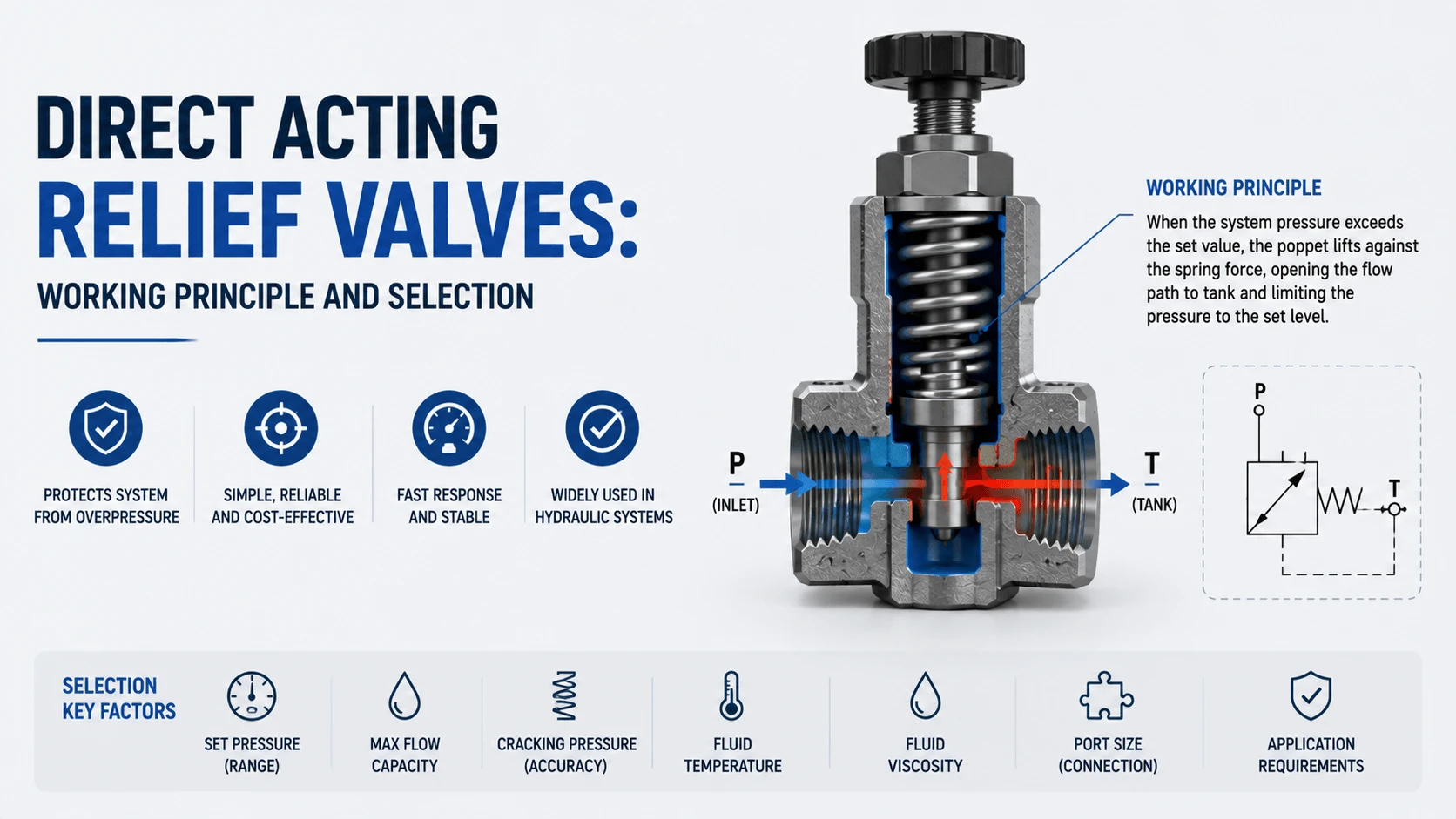
Every hydraulic circuit needs a pressure limit. The direct acting relief valve is the simplest device that sets that limit. A spring holds a seat closed until the pressure force lifts the poppet off.
This guide covers how these valves work, when to pick them over pilot-operated types, and how to size them. We wrote it for engineers and maintenance techs who specify or troubleshoot pressure relief. Real numbers follow: cracking pressures, override bands, flow limits, and response times.
What is a Direct Acting Relief Valve
A direct acting relief valve is a pressure-control valve. It opens when system pressure overcomes a spring force. Fluid then bypasses to the tank, and pressure stops climbing.
The “direct acting” name comes from the mechanism. System pressure pushes straight on the poppet or ball. No pilot stage sits between the pressure and the spring. That makes the valve simple, fast, and reliable.
These valves guard low-flow circuits, sub-circuits, and pilot lines. They also serve as shock reliefs and safety backups. Most designs run 50 to 350 bar, with some reaching 420 bar.
How a Direct Acting Relief Valve Works
System pressure acts on the poppet area. The poppet sits against an orifice. A spring holds it down, and a force balance controls the valve.
When pressure rises, the force on the poppet grows. At cracking pressure, the poppet force equals the spring force. Above the cracking, the poppet lifts and fluid flows to the tank.
As more fluid bypasses, the valve opens wider. The spring compresses further to allow the lift. That extra compression raises the pressure above cracking. We call this rise pressure override.
When pressure drops back, the spring pushes the poppet onto the seat. The valve reseats near cracking pressure. A small hysteresis gap sits between opening and reseating.
Key Components of Direct Acting Relief Valve
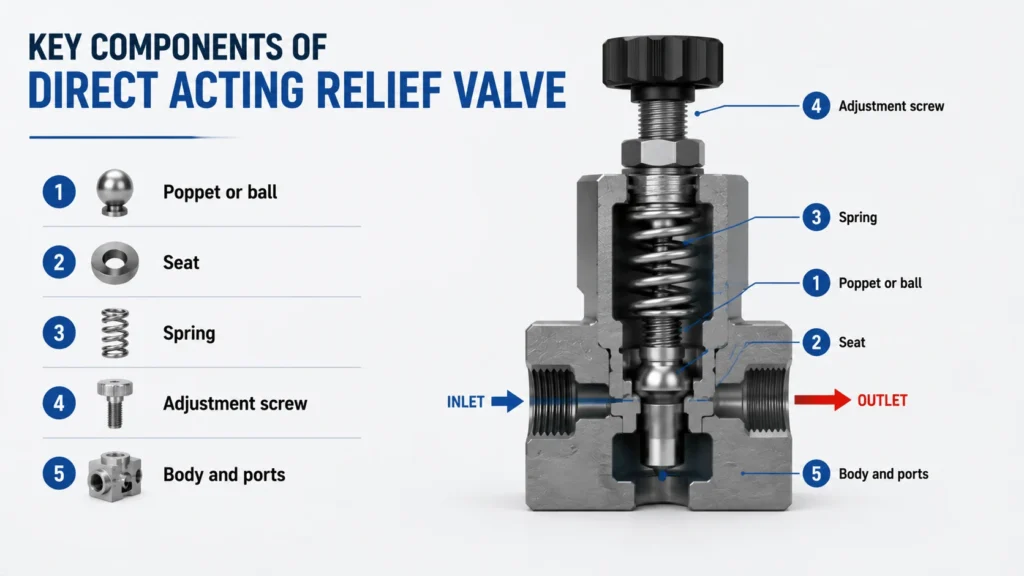
- Poppet or ball: the sealing element that lifts off the seat. Hardened steel handles high cycle counts.
- Seat: the orifice edge the poppet seals against. A sharp seat cracks cleanly; a soft insert seals tight below cracking.
- Spring: sets the cracking pressure. Color-coded springs cover different pressure bands.
- Adjustment screw: compresses the spring to raise cracking pressure. A locknut holds the setting.
- Body and ports: SAE J1926 or ISO 6149 threads carry inlet and tank connections.
Direct Acting vs Pilot Operated Relief Valve
Both valve types protect hydraulic circuits. They differ in flow capacity and pressure control.
| Feature | Direct acting | Pilot operated |
|---|---|---|
Max flow |
5 to 100 L/min |
100 to 1000 L/min |
Pressure override |
15 to 30 percent |
3 to 5 percent |
Response time |
2 to 10 ms |
20 to 50 ms |
Complexity |
Low |
Higher |
Cost |
Low |
Higher |
Heat at bypass |
More |
Less |
Pick direct acting for fast response and low flow. Pick a pilot operated for high flow and tight pressure control. Many circuits run both: a direct-acting valve for shock, plus a pilot valve for the main relief.
Pressure Override and Cracking Pressure
Pressure override defines a direct-acting valve. Cracking pressure opens the valve. Full-flow pressure passes the rated flow. The gap between them is the override.
Override comes from spring compression. More flow needs more lift. More lift compresses the spring. More compression means more force, which means more pressure.
On a 200 bar valve, override can run 30 to 60 bar. That sounds small, but it wastes energy as heat. The bypass fluid drops from system pressure to tank pressure across the seat.
Pilot-operated valves cut this loss. Their main poppet opens with little pressure rise. But they respond more slowly, so they miss sharp spikes. Direct-acting valves catch those spikes.
Types of Direct Acting Relief Valve
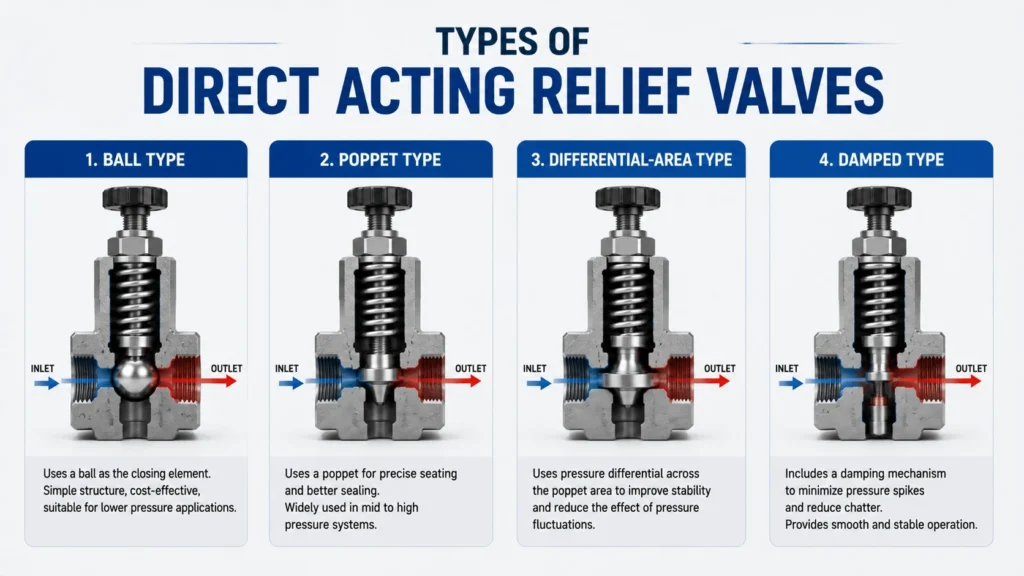
Ball Type
A ball seats against an orifice. The spring pushes the ball down. Ball valves cost little and stay simple. They suit low-flow, intermittent duty. The line contact seals well but wears faster than a cone.
Poppet Type
A conical poppet seats against a machined edge. The cone gives a larger contact area. Poppet valves handle more flow and last longer than ball types. Most threaded relief valves use this design.
Differential-Area Type
Pressure acts on a small annulus, not the full poppet face. That lets a weak spring hold high pressure. These valves reach 420 bar or more. The trade-off is lower flow from the small seat area.
Damped Type
A small dashpot cushions the poppet motion. Damping kills chatter on pulsating flow. These valves suit pump-discharge duty where pressure ripples constantly.
Key Specifications of Direct Acting Relief Valve
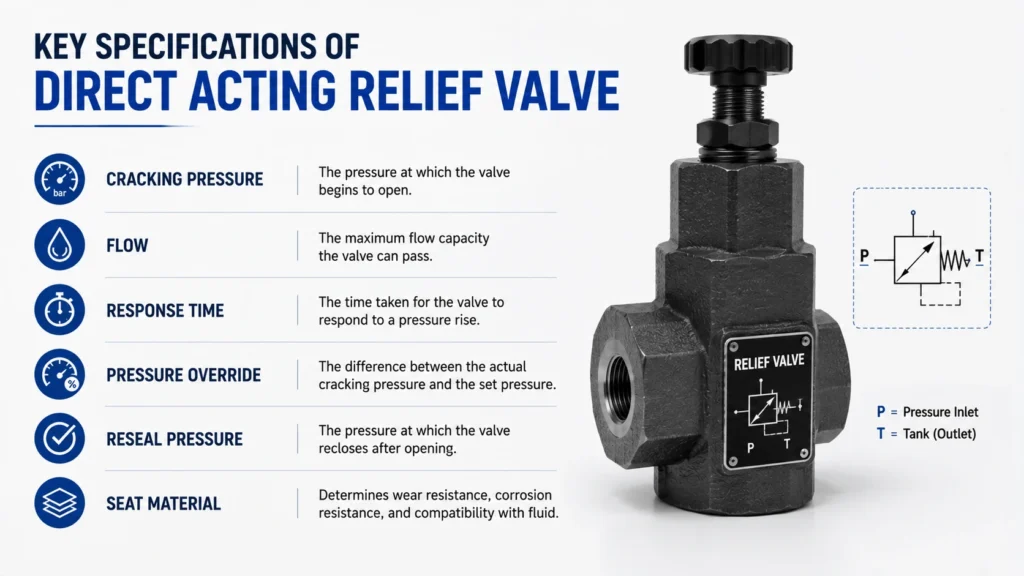
Match the valve to your circuit pressure and bypass flow. Then check the seat material and thread standard.
| Specification | Typical range | Notes |
|---|---|---|
Cracking pressure |
50 to 350 bar |
Some designs reach 420 bar |
Flow |
5 to 100 L/min |
Cartridge types reach 200 L/min |
Response time |
2 to 10 ms |
Faster than pilot-operated |
Pressure override |
15 to 30 percent |
Drops with low-flow duty |
Reseal pressure |
85 to 95 percent of crack |
Hysteresis causes the gap |
Seat material |
Hardened steel or NBR |
Steel for cycle life, NBR for seal |
Advantages and Disadvantages
Advantages
- Fast response catches shock spikes
- Simple construction with a few parts
- Low cost versus pilot-operated types
- Reliable in dirty-oil conditions
- Compact for sub-circuit and pilot duty
- Easy to set and adjust in the field
Disadvantages
- High-pressure override wastes energy
- Low flow capacity limits main-circuit duty
- Chatter damages the seat on pulsating flow
- Spring fatigue drifts the setting over time
- Heat builds fast at sustained bypass
Industrial Applications
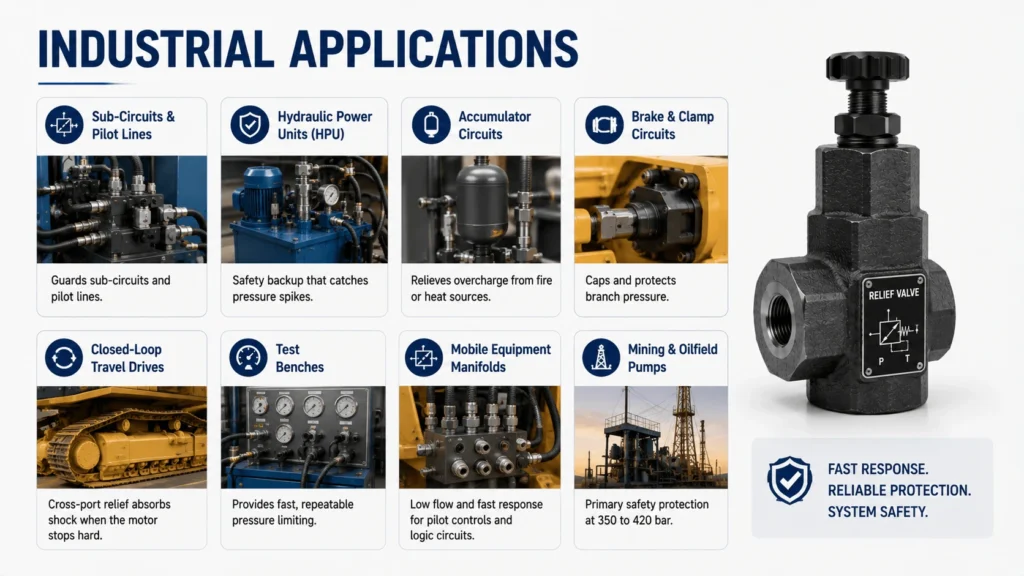
Direct acting relief valves guard sub-circuits and pilot lines. You will find them on hydraulic power units as a safety backup. They catch spikes, the main relief misses.
Accumulator circuits use them as safety devices. If a fire or heat source overcharges the accumulator, the relief dumps fluid. Brake and clamp circuits use them to cap branch pressure.
Closed-loop travel drives fit a cross-port relief on each side. It absorbs shock when the motor stops hard. Test benches use direct-acting valves for fast, repeatable pressure limiting.
Mobile equipment puts them in manifold blocks. Low flow and fast response suit pilot controls and logic circuits. Mining and oilfield pumps use them as primary safety at 350 to 420 bar.
Common Problems and Troubleshooting
| Symptom | Likely cause | Action |
|---|---|---|
Pressure won’t reach setpoint |
Spring broken or weak |
Replace spring, reset pressure |
Valve chatters or buzzes |
Pulsating flow, weak damping |
Switch to damped type, add orifice |
Pressure drifts down |
Spring fatigue or seat wear |
Trend setting, rebuild valve |
Oil runs hot |
Sustained bypass at high override |
Size for less bypass or switch to pilot |
Valve weeps below cracking |
Dirt on seat or worn seal |
Clean seat, replace soft insert |
Slow response |
Viscous oil or clogged drain |
Check oil temp, inspect passages |
Chatter is the top killer of direct-acting valves. It hammers the seat until the edge rounds. Once the seat rounds, the valve weeps below, cracking. Fix the cause, not just the seat.
Selection Guide
Start with the bypass flow you expect. Direct-acting valves suit 5 to 100 L/min. Above that, a pilot-operated valve controls pressure better.
Then pick the cracking pressure. Leave a margin above your working pressure. A common rule sets cracking at 110 to 120 percent of maximum working pressure.
Check the override against your heat budget. High override means heat. If bypass runs more than a few seconds, switch to a pilot valve.
Match the seat to your oil. Hardened steel handles dirty oil. Soft NBR seats seal tight but cut at high cycle counts. For shock duty, pick a damped poppet.
Confirm the threads and cavity. SAE J1926 and ISO 6149 cover most port threads. Cartridge valves follow ISO 7368 or ISO 6164 cavities. Check the symbol against ISO 1219-1.
Installation and Maintenance Tips
Mount the valve close to the pump discharge. Long lines between the pump and the relief slow the response. The spike travels the line before the valve catches it.
Set the pressure with a gauge on the pump port. Back off the adjuster, then raise pressure in steps. Lock the nut when you reach the target. Record the setting.
Keep the oil clean. Dirt under the seat causes weep and chatter. ISO 4406 18/16/13 protects the seat edge. Change filters before the bypass indicator trips.
Trend the cracking pressure every quarter. Spring fatigue drops the setting over the years. If the setting drifts more than 10 percent, rebuild or replace the valve.
FAQ
What is a direct acting relief valve?
It is a pressure-control valve that opens when system pressure exceeds a spring force. Fluid bypasses to the tank. No pilot stage sits between the pressure and the spring.
How does a direct acting relief valve work?
System pressure pushes on a poppet or ball. At cracking pressure, the force beats the spring. The poppet lifts and fluid flows to the tank. The spring resets the poppet when pressure drops.
What is the difference between direct acting and pilot-operated relief valves?
Direct-acting valves use one spring and a poppet. They respond fast but pass low flow with high override. Pilot-operated valves use a pilot stage to run a main poppet. They pass high flow with low override but respond more slowly.
What is pressure override in a relief valve?
Override is the pressure rise between cracking and full flow. Direct-acting valves run 15 to 30 percent override. The extra pressure comes from spring compression as the valve opens wider.
When should I use a direct-acting relief valve?
Use one for low-flow circuits, pilot lines, and shock protection. They suit 5 to 100 L/min and need a fast response. For high flow or tight pressure control, pick a pilot-operated valve.
Why does my relief valve chatter?
Chatter comes from pulsating flow and weak damping. The poppet opens and slams shut fast. It hammers the seat. A damped poppet or an inlet orifice usually fixes it.
Conclusion
The direct acting relief valve is the fast, simple pressure limit in a hydraulic circuit. It trades flow capacity and pressure control for speed and reliability. Engineers pick it for sub-circuits, pilot duty, and shock spikes.
Size it for bypass flow and cracking pressure. Watch the override against your heat budget. Keep the oil clean and the seat sharp. A well-chosen direct-acting valve protects a circuit for years of hard duty.