
Introduction
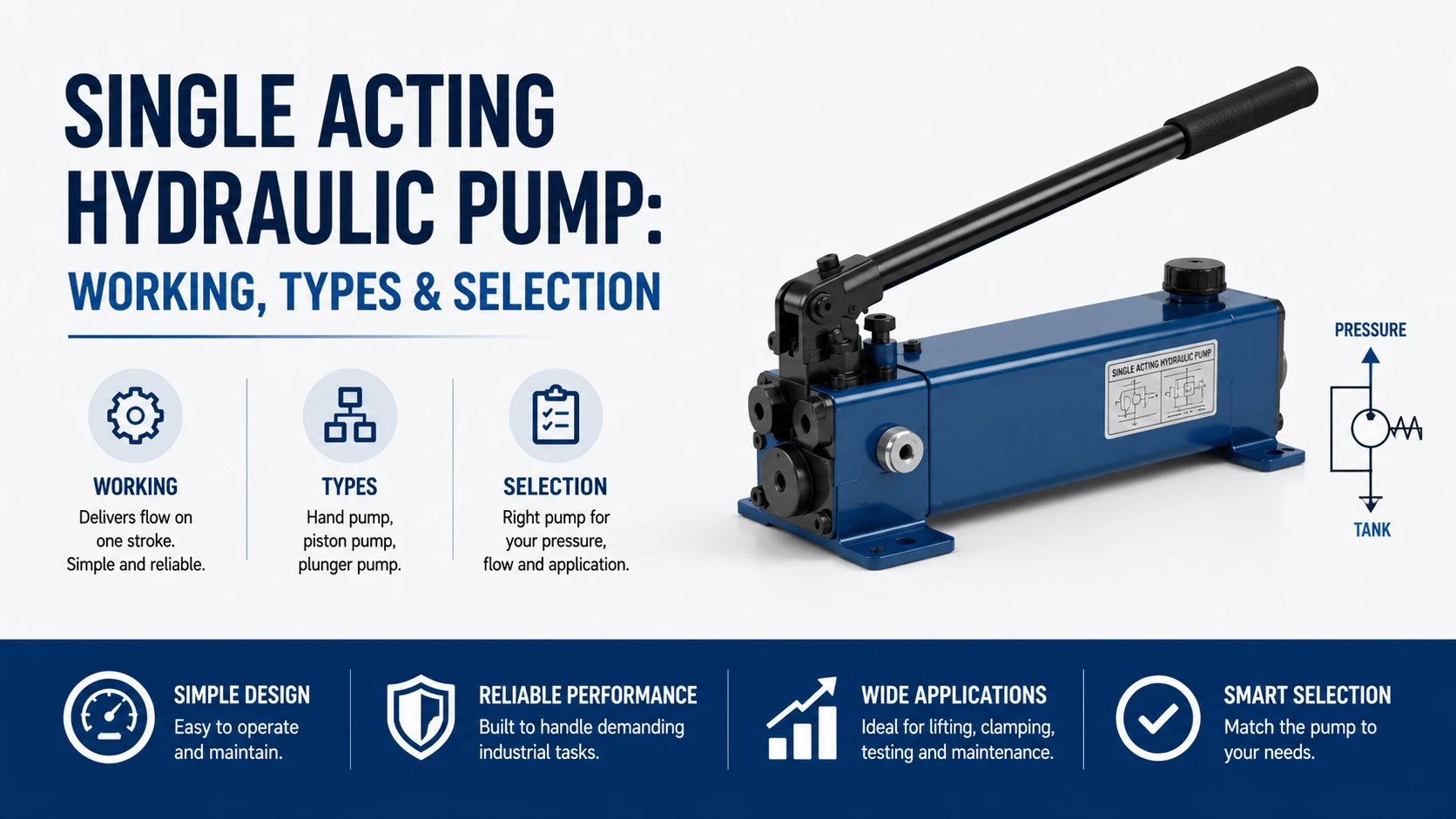
A single acting hydraulic pump delivers fluid on one stroke and idles on the return. The forward stroke pushes oil out. The return stroke simply refills the chamber. That gives you flow on every other stroke, not both.
Engineers pick this design for simple, low-flow jobs where cost matters more than smooth output. Hydraulic jacks, hand pumps, and lubrication circuits run on it. This guide covers the working principle, types, specs, and selection rules. Real pressure and flow numbers follow.
What is a Single Acting Hydraulic Pump
A single acting hydraulic pump is a reciprocating positive-displacement pump. A piston or plunger slides inside a cylinder. Two check valves control flow: one suction and one discharge. The pump moves fluid on only the forward stroke.
The return stroke refills the chamber through the suction valve. No fluid leaves the discharge side during refill. That sets it apart from a double acting pump, which delivers on both strokes through four check valves.
Do not confuse this with a single-acting hydraulic cylinder. A cylinder is an actuator that moves a load. A pump is the source that pressurizes the fluid.
How a Single Acting Hydraulic Pump Works
The piston splits the cylinder into one working chamber. A suction check valve sits at the inlet. A discharge check valve sits at the outlet. Both valves open and close from pressure differences, with no timing gear.
On the forward stroke, the piston moves to shrink the chamber. Pressure rises inside. The discharge valve opens and fluid flows out. The suction valve stays shut because chamber pressure beats inlet pressure.
The return stroke reverses the action. The piston moves back, and the chamber grows. Suction drops the chamber pressure below inlet pressure. The suction valve opens and fluid flows in. The discharge valve closes as the discharge-side pressure holds it shut.
The result is intermittent flow. You get fluid on the forward stroke only. The return stroke produces zero output. This makes the flow pulse higher than a double-acting pump.
Single Acting vs Double Acting Pump
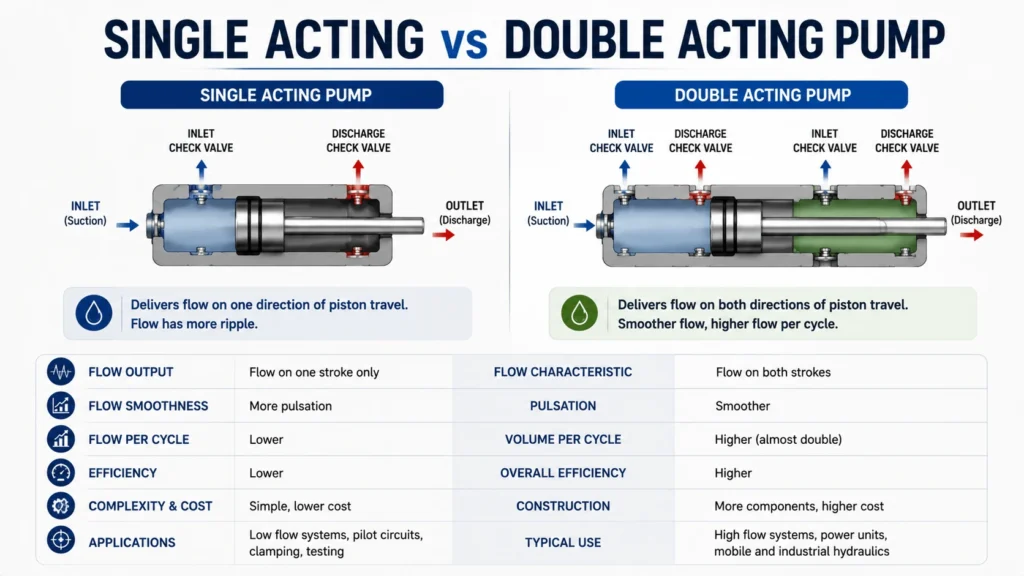
| Feature | Single acting | Double acting |
|---|---|---|
Delivery strokes |
One per cycle |
Two per cycle |
Check valves |
Two |
Four |
Flow per cycle |
Lower |
Roughly double |
Pulsation |
Higher |
Lower |
Complexity |
Simpler |
More complex |
Cost |
Lower |
Higher |
Best fit |
Intermittent, simple jobs |
Continuous duty, smooth flow |
Pick single-acting for simple jobs where cost and simplicity matter most. Pick double-acting when you need smoother flow, higher output, or continuous duty.
Types of Single Acting Hydraulic Pump
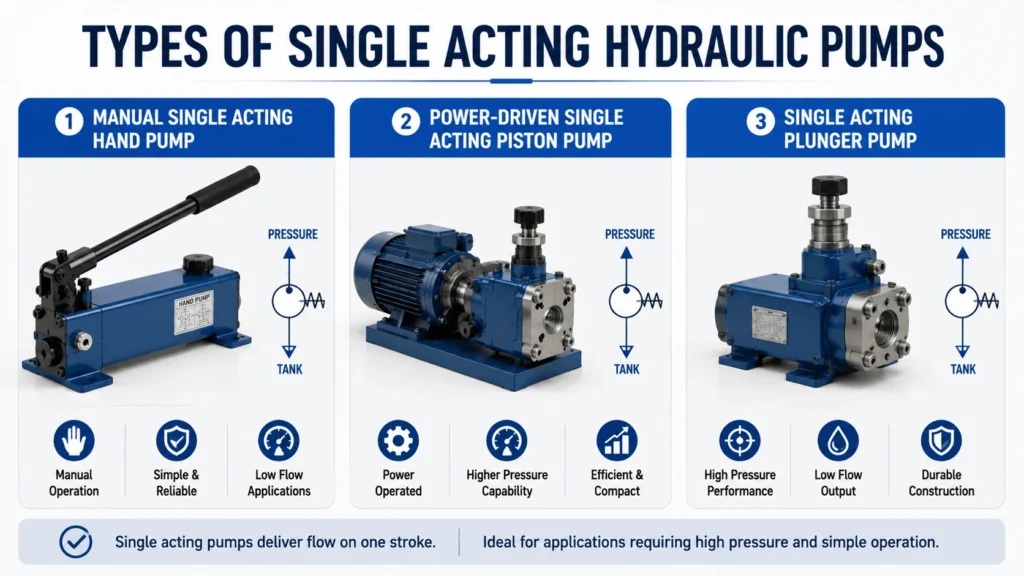
Manual Single Acting Hand Pump
A lever drives the piston by hand. These pumps serve field work where no power source exists. Bottle jacks, rescue tools, and bolt tensioners run on them. Pressure ratings reach 350 to 700 bar at very low flow, often under 1 L/min.
The operator pulls the lever for the discharge stroke. The return stroke resets the piston and refills the chamber. Each full cycle gives one discharge pulse. Most hand pumps use a simple two-valve layout.
Power-Driven Single Acting Piston Pump
An electric motor or engine turns a crank that drives the piston. These pumps handle metering, lubrication, and low-flow process duty. Multi-cylinder versions phase several pistons on one crankshaft to smooth the flow.
Pressure spans a wide band. Light service pumps run 70 to 210 bar. Heavy single-acting plunger pumps reach 700 bar for high-pressure testing. Flow ranges from 1 to 100 L/min depending on bore and speed.
Single Acting Plunger Pump
A plunger pump replaces the piston with a smooth plunger. The plunger seals against a stationary packing gland. This suits high-pressure duty because the seal stays fixed while the plunger moves.
Single-acting plunger pumps serve water jetting, chemical injection, and hydrostatic testing. Pressures reach 700 to 2,000 bar in specialized multi-cylinder builds.
Key Specifications
Match the pump to your pressure, flow, and duty first. Then check the speed range against your drive. Volumetric efficiency above 90 percent signals a healthy unit.
| Specification | Hand pump | Power-driven |
|---|---|---|
Pressure, continuous |
350 to 700 bar |
70 to 700 bar |
Flow |
under 1 L/min |
1 to 100 L/min |
Drive |
Manual lever |
Electric motor or engine |
Speed |
30 to 60 strokes/min |
300 to 1,800 rpm |
Volumetric efficiency |
88 to 95 percent |
90 to 96 percent |
Duty cycle |
Intermittent |
Continuous (multi-cylinder) |
Advantages and Disadvantages
Advantages
- Two check valves mean fewer leak paths and wear points than four
- Lower cost than a double-acting pump of the same bore
- Simpler to maintain, with only two valve seats to lap
- Compact and light, which suits portable hand pump duty
- Reliable for intermittent high-pressure work in the field
Disadvantages
- Half the flow per cycle of a double-acting pump
- Higher pulsation because the flow stops on the return stroke
- Needs a larger pulsation damper for smooth downstream flow
- Less suited to continuous duty in single-cylinder form
- Intermittent output can shake piping if not damped
Industrial Applications of Single Acting Hydraulic Pump
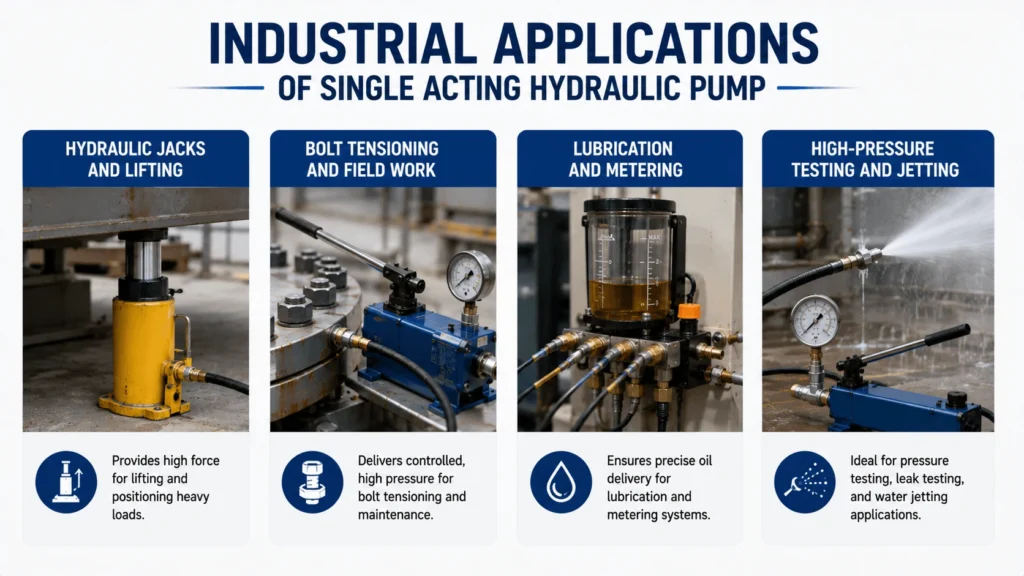
Hydraulic Jacks and Lifting
Bottle jacks and floor jacks run on single-acting hand pumps. The operator pumps to lift the load. A check valve holds the load. A release valve opens to lower it. Pressures of 350 to 700 bar are common.
Bolt Tensioning and Field Work
Portable bolt tensioners use single-acting hand pumps to stretch large bolts. The operator pumps to build force, tightens the nut, then releases pressure. Single-acting hand pumps keep the tool simple and light for field use.
Lubrication and Metering
Single-acting piston pumps serve grease and oil lubrication circuits. Each stroke meters a fixed volume. Multi-outlet versions feed several lubrication points from one drive. Flow stays low and precise.
High-Pressure Testing and Jetting
Multi-cylinder single-acting plunger pumps handle hydrostatic testing and water jetting. Several plungers phase on a crankshaft to smooth the flow. Pressures reach 700 to 2,000 bar for cutting and cleaning duty.
Common Problems and Troubleshooting
| Symptom | Likely cause | Action |
|---|---|---|
Low or no flow |
Valve seat wear or debris |
Inspect and lap seats, clean oil |
Pressure drop under load |
Discharge valve leaking |
Replace valve, check seat |
Spongy output |
Air trapped in chamber |
Bleed air from the chamber |
High pulsation |
No damper or worn damper |
Add or replace pulsation damper |
External leak at gland |
Packing wear |
Adjust or replace packing |
Overheating on fast stroking |
Cavitation or low inlet |
Slow stroke rate, enlarge suction line |
Selection Guide
Start with your required pressure and flow. Hand pumps fit pressures of 350 to 700 bar at low flow. Power-driven units cover the rest.
Choose manual when you work in the field without power, need portability, or run short intermittent cycles. Choose power-driven for higher flow, multi-point lubrication, or continuous duty.
Check the fluid against the seals and valve materials. Water, oil, and grease each need different elastomers. Add a pulsation damper if your downstream equipment cannot tolerate the single-stroke pulse. Match the ports to your hoses. Common options include NPT, BSPP, and ISO 16028 flat-face.
Installation and Maintenance Tips
Mount the pump close to the reservoir on powered units. Keep the suction line short and large to prevent cavitation. A flooded inlet helps cold starts and fast stroking.
Bleed air from the chamber before full-pressure work. Trapped air makes the output spongy and slows the build of pressure. Run the pump unloaded for the first few cycles.
Hold oil cleanliness to ISO 4406 19/17/14 for industrial service. Contaminant scores valve seats and causes internal leakage. Inspect check valves and lap the seats on a scheduled interval. Trend the flow and pressure to catch wear early.
FAQ
What is a single acting hydraulic pump?
It is a reciprocating pump that delivers fluid on only the forward stroke. Two check valves, one suction and one discharge, control flow in and out of the chamber. The return stroke refills the chamber and produces no output.
How does a single acting pump differ from a double acting pump?
A single-acting pump delivers on one stroke and idles on the return. A double-acting pump delivers on both. Single-acting units need two check valves; double-acting units need four. Single-acting gives lower flow per cycle at lower cost and complexity.
What pressure can a single acting hand pump reach?
Most single-acting hand pumps run 350 to 700 bar. Flow stays low, often under 1 L/min, because the operator supplies the power. Bottle jacks and bolt tensioners typify this duty.
Why does a single acting pump pulse more than a double acting pump?
A single-acting pump delivers fluid on only one stroke per cycle. The return stroke produces zero flow. A double-acting pump delivers on both strokes, which fills the gap. A pulsation damper smooths the output if your process needs steady flow.
When should I choose a single acting pump?
Choose single-acting for simple, intermittent, low-flow jobs where cost matters. Hand pumps for jacking and tensioning fit here. Switch to double-acting when you need smoother flow, higher output, or continuous duty.
Conclusion
A single acting hydraulic pump earns its place on simplicity and cost. Manual hand pumps give you 700 bar in the field without a power source. Power-driven units handle metering, lubrication, and high-pressure testing.
Match the type to the job. Hand pumps fit portable, intermittent work. Power-driven pumps fit higher flow and process duty. Keep the oil clean, the valve seats lapped, and the inlet flooded. Add a pulsation damper when downstream flow must stay smooth. Done right, a single-acting pump runs hard and stays reliable for years.