
Hydraulic fluid does five jobs at once inside a system. It transmits power from the pump to the actuators. It lubricates sliding parts, carries heat away from valves and pumps, seals clearances, and protects metal from rust. Pick the wrong fluid type, and you shorten pump life, waste energy, and risk fire in the wrong environment.
Most shops default to mineral oil because it works and costs little. But mines, steel mills, marine decks, and foundries often need fire-resistant or biodegradable fluids. This guide walks through every major hydraulic fluid types and the ISO 6743-4 classification. The numbers that matter at the spec stage follow each type.
What hydraulic fluid does in a system
A hydraulic fluid transmits pressure, lubricates moving parts, carries heat, seals clearances, and protects metal from corrosion. Each of those five jobs pulls the formulation in a different direction.
Power transmission wants high bulk modulus and low compressibility. Lubrication needs a stable viscosity film between the valve spool and bore, or between the piston slipper and swashplate. Cooling wants high specific heat and good thermal conductivity. Corrosion protection comes from additives that lay down a film on ferrous surfaces.
No single fluid optimizes all five. Every hydraulic fluid type on the market is a compromise. Reading the compromise tells you which type fits your machine.
How ISO 6743-4 classifies hydraulic fluids
The ISO 6743-4 standard sorts hydraulic fluids into two big families. The first family covers mineral oil and synthetic fluids with letter codes HH through HG. The second family covers fire-resistant fluids with codes HFA through HFD.
| Code | Description | Typical base |
|---|---|---|
HH |
Straight mineral oil, no additives |
Refined petroleum |
HL |
Mineral oil with rust and oxidation inhibitors |
Refined petroleum |
HM |
HL plus anti-wear additives, most common industrial fluid |
Refined petroleum |
HV |
HM with viscosity index improvers |
Refined petroleum |
HS |
Synthetic base fluid |
PAO, esters |
HG |
HM with anti-stick-slip additives |
Refined petroleum |
HFAE |
Oil-in-water emulsion, 80-95% water |
Fire-resistant |
HFAS |
Chemical solution in water, 90-95% water |
Fire-resistant |
HFB |
Water-in-oil emulsion, 40% water |
Fire-resistant |
HFC |
Water-glycol, 35-45% water |
Fire-resistant |
HFDR |
Phosphate ester |
Fire-resistant synthetic |
HFDU |
Other synthetic, water-free |
Fire-resistant synthetic |
The H prefix means hydraulic. The second letter sets the family. Most industrial plants run HM or HV. Mines, die casters, and steel mills run HFC or HFDR. Forestry and marine fleets increasingly run biodegradable fluids under ISO 15380: HETG, HEES, HEPG, and HEPR.
Mineral oil hydraulic fluids (HH, HL, HM, HV, HG)
Mineral oil still holds around 85-90% of the hydraulic fluid market by volume. Refined crude gives you good lubrication, decent oxidation stability, and low cost. The base oil runs $1.50-3.50 per liter in drum quantities. Most general-purpose systems ship from the factory with an HM 46 or HV 46 fill.
The HH grade is straight refined mineral oil with no additives. You rarely see it in modern equipment because it lacks anti-wear and oxidation protection. HL adds rust and oxidation inhibitors for moderate service. HM adds zinc-based anti-wear additives (ZDDP) and dominates industrial hydraulics. HV adds viscosity index improvers for systems that run cold starts and hot oil in the same shift. HG adds anti-stick-slip chemistry for machine tool slides.
Viscosity grades follow ISO 3448. The grade number equals the kinematic viscosity in cSt at 40°C, plus or minus 10%. ISO VG 46 covers 41.4-50.6 cSt and works for most industrial pumps. ISO VG 32 fits high-speed pumps and cold climates. ISO VG 68 fits heavy presses and high-temperature service.
Operating temperature for mineral oil runs -10°C to 80°C continuous, with peaks to 90°C. Viscosity index for a good HM runs 95-105. HV fluids climb to 140-180. Oxidation life roughly doubles every 10°C below 80°C, and halves above it.
Synthetic hydraulic fluids (HS)
Synthetic fluids start from an engineered base stock rather than refined crude. The most common hydraulic synthetics are polyalphaolefins (PAO), organic esters, phosphate esters, and polyglycols.
PAO fluids (HS class) cost 3-5x more than mineral oil but run cleaner and last longer. They handle -40°C cold starts and 120°C continuous service. Viscosity index sits at 130-160. PAO has excellent hydrolytic stability and resists sludge. You find PAO in aerospace, outdoor mobile equipment, and high-precision servos.
Phosphate ester fluids (HFDR) carry fire resistance by chemistry, not by added water. They self-extinguish after flame removal and survive 200°C hot spots. Density runs 1.1-1.4 kg/L, which means pumps need more torque to move the same volume. Seal compatibility is the trap. Phosphate esters swell nitrile (NBR) and need FKM, but FKM also has limits.
Biodegradable hydraulic fluids (HETG, HEES, HEPG, HEPR)
Regulations and spill fines push biodegradable fluids into forestry, marine, agriculture, and construction. The ISO 15380 standard defines four classes. HETG uses triglyceride base (rapeseed, sunflower). HEES uses a synthetic ester. HEPG uses polyglycol. HEPR uses polyalphaolefin or related synthetics.
HETG costs least but oxidizes fast above 70°C and cold-thickens below -10°C. HEES handles 90°C continuous and cold starts to -25°C. Most modern biodegradable fills are HEES. The price gap to mineral oil closed to 2-3x, and the performance meets normal industrial service.
Biodegradability targets 60% in 28 days under OECD 301. HEES reaches 80% in many formulations. Water hazard class lands at WGK 1 in most cases. Change intervals run 2000-3000 hours depending on thermal load.
Water-based and fire-resistant fluids
Fire-resistant fluids fall into two groups. Water-based fluids (HFA, HFB, HFC) get their fire resistance from the water content. Water-free synthetics (HFDR, HFDU) get fire resistance from the chemistry of the base molecule.
HFA fluids run 80-95% water. They cost little and cool well. But viscosity sits near water (1 cSt), and the fluid film is thin. HFA suits plunger pumps below 70 bar and runs in steel mills and coal mines. You must check the water concentration daily because evaporation shifts the mix.
HFB is a water-in-oil emulsion at 40% water. It lubricates better than HFA but stays unstable in storage. HFC is water-glycol at 35-45% water plus glycol and thickeners. HFC works to 200-250 bar in good pumps, runs -20 to 50°C, and dominates die casting and foundry hydraulics.
HFC limits: viscosity climbs fast as water evaporates, and pump speed must drop 20-30% versus mineral oil. Keep water content above 35%, or the fluid loses fire resistance.
HFDR (phosphate ester) survives 300 bar and 90°C continuous. It costs $15-30 per liter and needs FKM seals and a dedicated flush before fill. Aerospace, steam turbine, electrohydraulic systems, and die-cast machines run HFDR.
Fluid type comparison table
| Fluid type | ISO class | Base | Pressure | Temp range | Cost ($/L) | Fire resistance |
|---|---|---|---|---|---|---|
Mineral oil |
HM/HV |
Petroleum |
up to 350 bar |
-10 to 80°C |
1.5-3.5 |
Poor |
PAO synthetic |
HS |
PAO |
up to 350 bar |
-40 to 120°C |
6-15 |
Fair |
Synthetic ester |
HEES |
Ester |
up to 350 bar |
-25 to 90°C |
5-10 |
Fair |
Vegetable oil |
HETG |
Triglyceride |
up to 250 bar |
-10 to 70°C |
4-8 |
Poor |
Water-glycol |
HFC |
Water+glycol |
up to 250 bar |
-20 to 50°C |
4-8 |
Excellent |
Oil-in-water |
HFAE |
95% water |
up to 70 bar |
5 to 50°C |
1-2 |
Excellent |
Phosphate ester |
HFDR |
Phosphate ester |
up to 300 bar |
0 to 90°C |
15-30 |
Excellent |
Key properties that decide fluid selection
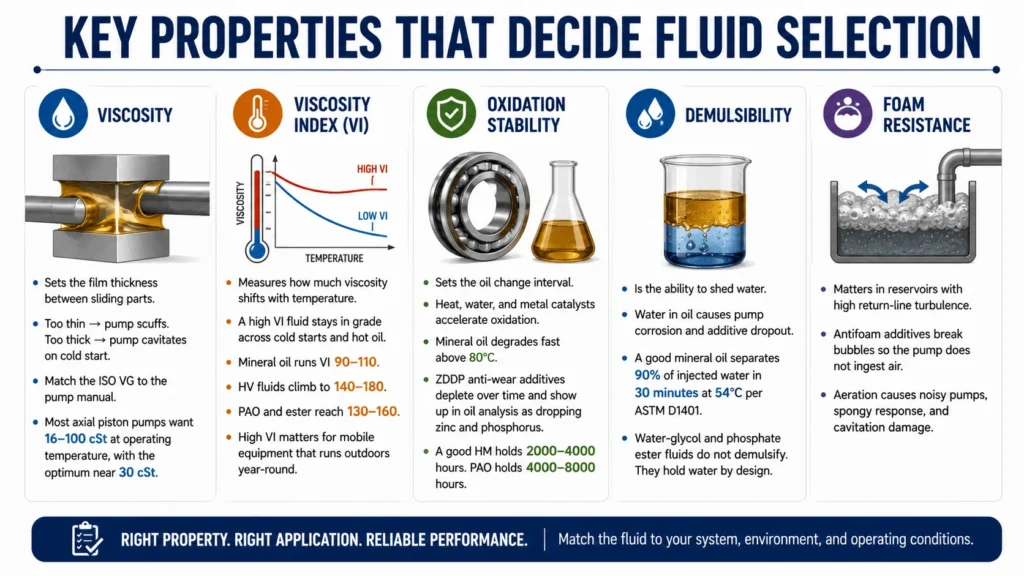
Viscosity sets the film thickness between sliding parts. Too thin and the pump scuffs. Too thick, and the pump cavitates on cold start. Match the ISO VG to the pump manual. Most axial piston pumps want 16-100 cSt at operating temperature, with the optimum near 30 cSt.
The viscosity index (VI) measures how much viscosity shifts with temperature. A high VI fluid stays in grade across cold starts and hot oil. Mineral oil runs VI 90-110. HV fluids climb to 140-180. PAO and ester reach 130-160. High VI matters for mobile equipment that runs outdoors year-round.
Oxidation stability sets the oil change interval. Heat, water, and metal catalysts accelerate oxidation. Mineral oil degrades fast above 80°C. ZDDP anti-wear additives deplete over time and show up in oil analysis as dropping zinc and phosphorus. A good HM holds 2000-4000 hours. PAO holds 4000-8000 hours.
Demulsibility is the ability to shed water. Water in oil causes pump corrosion and additive dropout. A good mineral oil separates 90% of injected water in 30 minutes at 54°C per ASTM D1401. Water-glycol and phosphate ester fluids do not demulsify. They hold water by design.
Foam resistance matters in reservoirs with high return-line turbulence. Antifoam additives break bubbles so the pump does not ingest air. Aeration causes noisy pumps, spongy response, and cavitation damage.
How to select the right hydraulic fluid
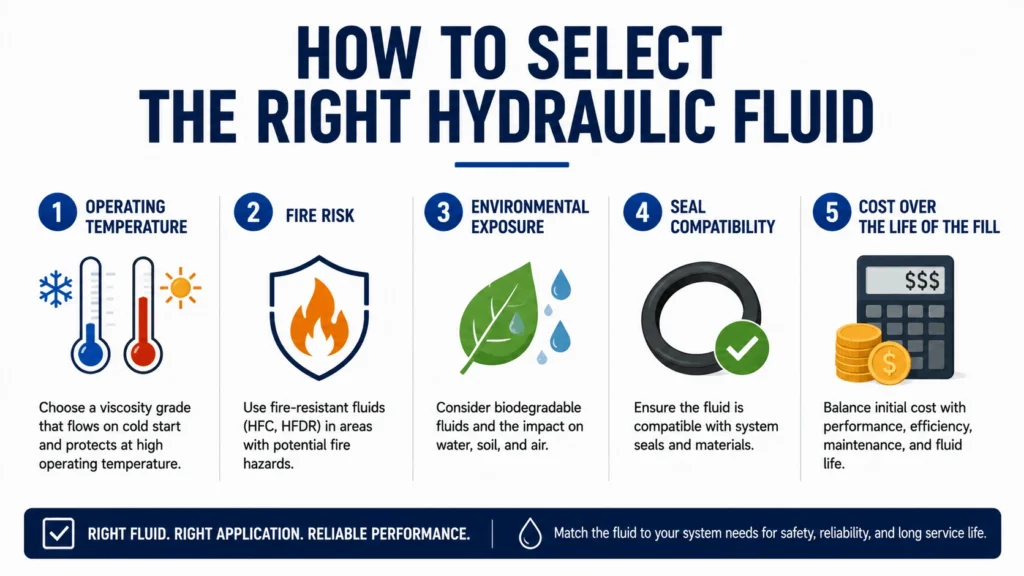
Start with the pump manual. The manufacturer names an ISO VG range, a viscosity band at operating temperature, and an approved fluid list. Stray outside that list and you void the warranty.
Then check five things in order.
1.0perating Temperature
Cold starts below -10°C push you toward HV mineral oil or PAO. Continuous service above 90°C pushes you toward PAO or ester.
2.Fire Risk
Steel mills, die casters, coal mines, and aircraft carriers need fire-resistant fluid. Pick HFC for general fire risk, HFDR for high pressure plus fire risk, HFA for low-pressure high-fire-risk service.
3.Environmental Exposure
Spills near water or on forest floor push you to HEES or HETG. The price gap to mineral oil is now 2-3x, well under the cleanup fine for a mineral spill.
4.Seal Compatibility
Nitrile (NBR) works with mineral oil, PAO, and HEES. Nitrile fails in phosphate ester. Phosphate ester needs FKM or epichlorohydrin. Water-glycol works with NBR but attacks zinc and cadmium parts.
5.Cost over the life of the fill.
A 15/L synthetic that runs 8000 hours beats a 3/L mineral oil changed every 2000 hours. Add labor and downtime, and the synthetic wins.
Common mistakes in fluid selection
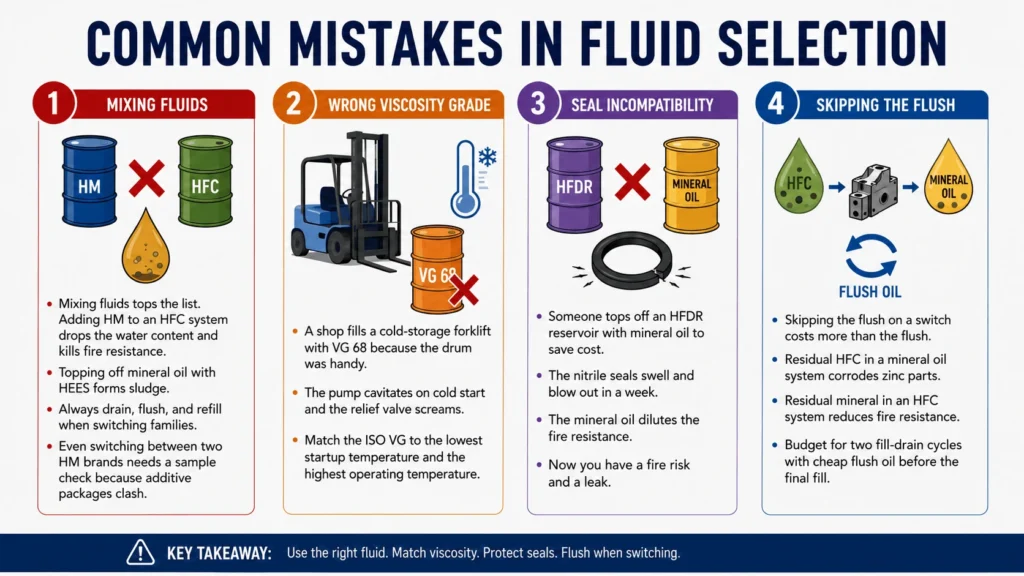
Mixing fluids tops the list. Adding HM to an HFC system drops the water content and kills fire resistance. Topping off mineral oil with HEES forms sludge. Always drain, flush, and refill when switching families. Even switching between two HM brands needs a sample check because additive packages clash.
The wrong viscosity grade is the second mistake. A shop fills a cold-storage forklift with VG 68 because the drum was handy. The pump cavitates on cold start, and the relief valve screams. Match the ISO VG to the lowest startup temperature and the highest operating temperature.
Seal incompatibility wrecks phosphate ester systems. Someone tops off an HFDR reservoir with mineral oil to save cost. The nitrile seals swell and blow out in a week. The mineral oil dilutes the fire resistance. Now you have a fire risk and a leak.
Skipping the flush on a switch costs more than the flush. Residual HFC in a mineral oil system corrodes zinc parts. Residual mineral in an HFC system reduces fire resistance. Budget for two fill-drain cycles with cheap flush oil before the final fill.
Maintenance and change intervals
Oil analysis drives the change interval, not the calendar. Sample every 500 hours for critical systems. Watch viscosity, water content, acid number, particle count, and additive metals.
Mineral oil in clean service runs 2000-4000 hours. The same oil in a hot, wet environment drops to 1000-1500 hours. PAO and HEES stretch to 4000-8000 hours. HFC needs 1000-2000 hours because water evaporates and viscosity climbs.
Water content matters most for mineral oil. The alert level sits at 500 ppm (0.05%). Saturation at 40°C hits 300-400 ppm for a VG 46. Anything above 200 ppm is a warning. Run a vacuum dehydrator or water-removing filter cart when water passes 300 ppm.
ISO 4406 cleanliness targets depend on the system. General industrial hydraulics targets 19/17/14. Servo systems target 16/14/11. A new fill is not clean oil. Drummed oil typically arrives at 22/19/16. Filter the new oil through a 3-5 micron cart before it enters the reservoir.
FAQ
What are the main hydraulic fluid types?
The main types are mineral oil, synthetic, biodegradable, and water-based fire-resistant fluids. ISO 6743-4 groups them with letter codes. Mineral HM oil is the most common industrial fill.
Which hydraulic fluid type is best for high temperatures?
PAO synthetic handles 120°C continuous and 150°C peaks. Phosphate ester survives 90-200°C. Mineral oil degrades above 80°C and needs short change intervals. For continuous service above 100°C, pick PAO or phosphate ester.
What is the difference between HM and HV hydraulic oil?
HM adds anti-wear additives to mineral oil. HV adds viscosity index improvers on top of the HM package. HM suits steady-temperature systems. HV suits systems with cold starts and hot operating oil in the same shift.
Can I mix different hydraulic fluid types?
No. Different families clash chemically. Mineral oil plus water-glycol forms sludge and reduces fire resistance. Mineral oil plus phosphate ester destroys nitrile seals. Switch families only after a full drain and flush. Same-family top-offs between brands still need an oil sample to check additive compatibility.
How do I choose the right ISO VG grade?
Match the grade to the pump’s viscosity window at operating temperature. Most axial piston pumps want 30 cSt plus or minus 10 at running temperature. Gear and vane pumps accept 20-100 cSt. Pick the grade that hits that window at your normal oil temperature. Check the cold-start viscosity against the pump’s maximum startup viscosity.
How often should I change hydraulic fluid?
Change when oil analysis says so, not by calendar. Mineral oil in clean service runs 2000-4000 hours. PAO and HEES run 4000-8000 hours. HFC runs 1000-2000 hours. Sample every 500 hours and watch viscosity, water, acid number, and particle count.
Conclusion
Hydraulic fluid selection comes down to five questions. What temperature does the system see? What pressure? Does the application need fire resistance? Do environmental rules apply? What seals does the pump use? Answer those, and the fluid type narrows fast.
Mineral HM oil covers most industrial systems. Move to HV for wide temperature swings. Move to PAO for extreme cold or heat. Move to HFC or HFDR where fire risk drives the spec. Move to HEES where spills hit soil or water. The right fluid costs less than the wrong one across the life of the pump.
Pick the type, then run oil analysis on a schedule. The pump will tell you when you got it wrong.