
Introduction
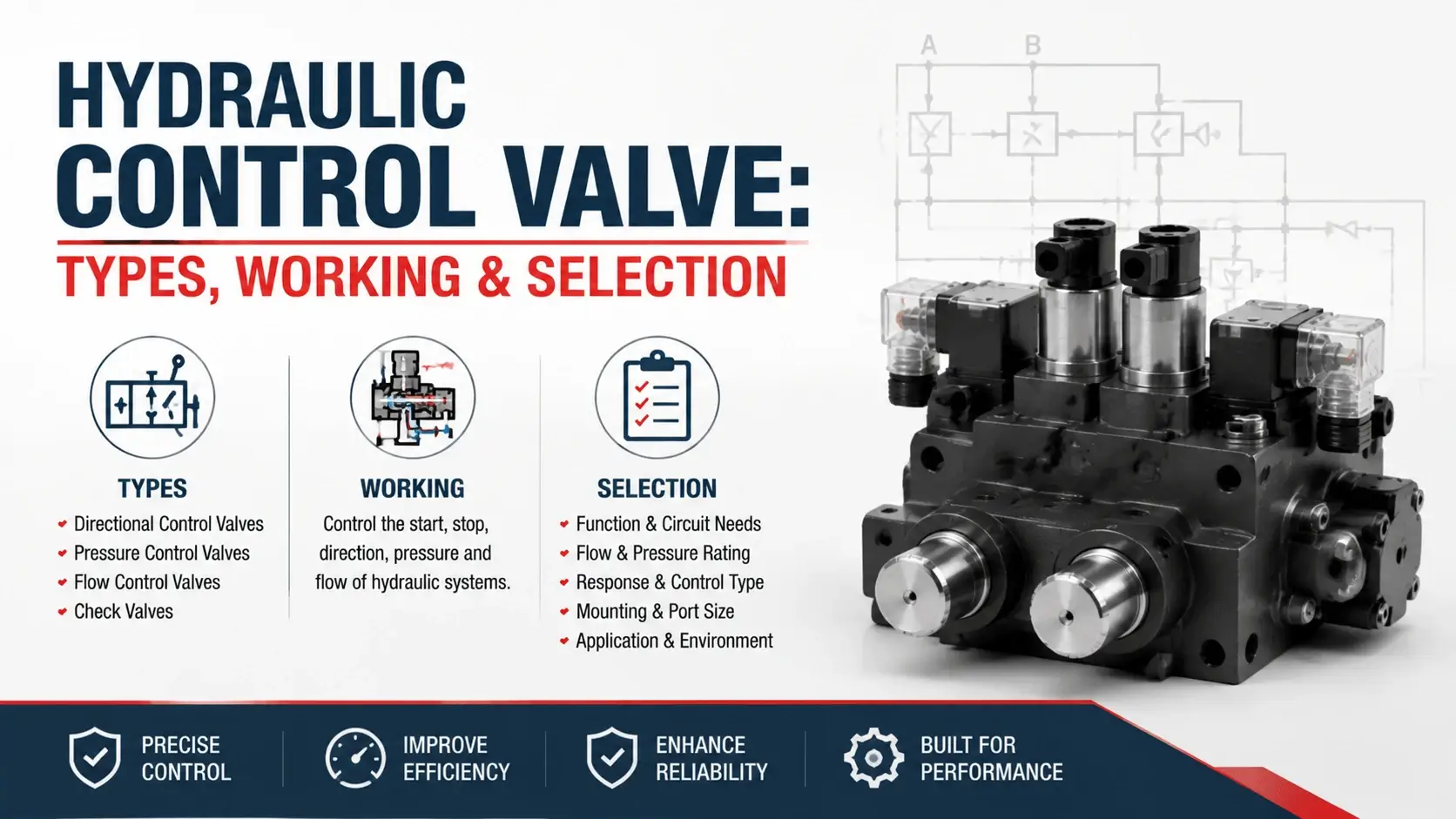
Every hydraulic machine relies on one component to send oil to the right place at the right time. That component is the hydraulic control valve. Pull a loader joystick or cycle a press, and a control valve makes the decision in milliseconds.
Get the valve wrong, and the symptoms show up fast. Slow actuators, drifting loads, hot oil, and an overworked pump all point back to the valve. Get it right and the machine runs cool, responds crisply, and holds its settings for years.
This guide explains how the valve works internally and how the main construction styles differ. The focus stays practical: spool mechanics, circuit arrangements, sizing, failures, and procurement.
What is a Hydraulic Control Valve?
A hydraulic control valve is a device that directs, limits, or meters the flow of pressurized oil inside a circuit. In everyday shop language, the term usually points to the directional valve that starts, stops, and reverses cylinders and motors. In a wider sense it also covers the pressure and flow functions that keep a circuit safe and efficient.
Three jobs define the category:
- Direction control decides which actuator port receives oil.
- Pressure control limits or regulates force somewhere in the circuit.
- Flow control sets how much oil passes per minute, which fixes the actuator speed.
Most machines combine these jobs in one envelope. A loader valve directs oil to the lift cylinders and relieves excess pressure. It also meters flow for smooth lowering, all inside one casting.
How a Hydraulic Control Valve Works
The heart of most control valves is a sliding spool inside a precision bore. The spool carries raised sections called lands, and each land blocks or uncovers a port as the spool moves. Shift the spool one way, and the pump flow reaches the cylinder cap end. Shift it back, and the flow reverses.
Between the lands sit undercut grooves. These grooves create the flow paths that connect the pump, tank, and work ports in each spool position. The fit between the spool and the bore runs tight, typically with a few micrometers of radial clearance. That tiny gap keeps internal leakage low but makes the valve sensitive to dirty oil.
Metering and Notches
A spool does more than switch on and off. As a land begins to uncover a port, the small opening acts like a variable orifice. Skilled operators feather the lever to control speed, and the spool edge shapes how smooth that control feels.
Many spools carry small notches machined into the land edges. V-notches and U-notches widen the metering zone and give finer low-speed control. Flow forces matter as well: oil jetting through the metering edge pushes the spool toward closure. Designers add compensation grooves to keep lever effort low and prevent spool lock.
Spring Centering and Detents
In a three-position valve, centering springs push the spool back to neutral when the operator releases the handle. A weak or broken spring shows up as a valve that fails to center and a load that keeps creeping.
Detent mechanisms hold the spool in a chosen position instead. A detent suits functions like the float position on a loader bucket. The operator wants the valve to stay put without hand pressure.
Construction Styles: Monoblock, Sectional, and Stack Mount
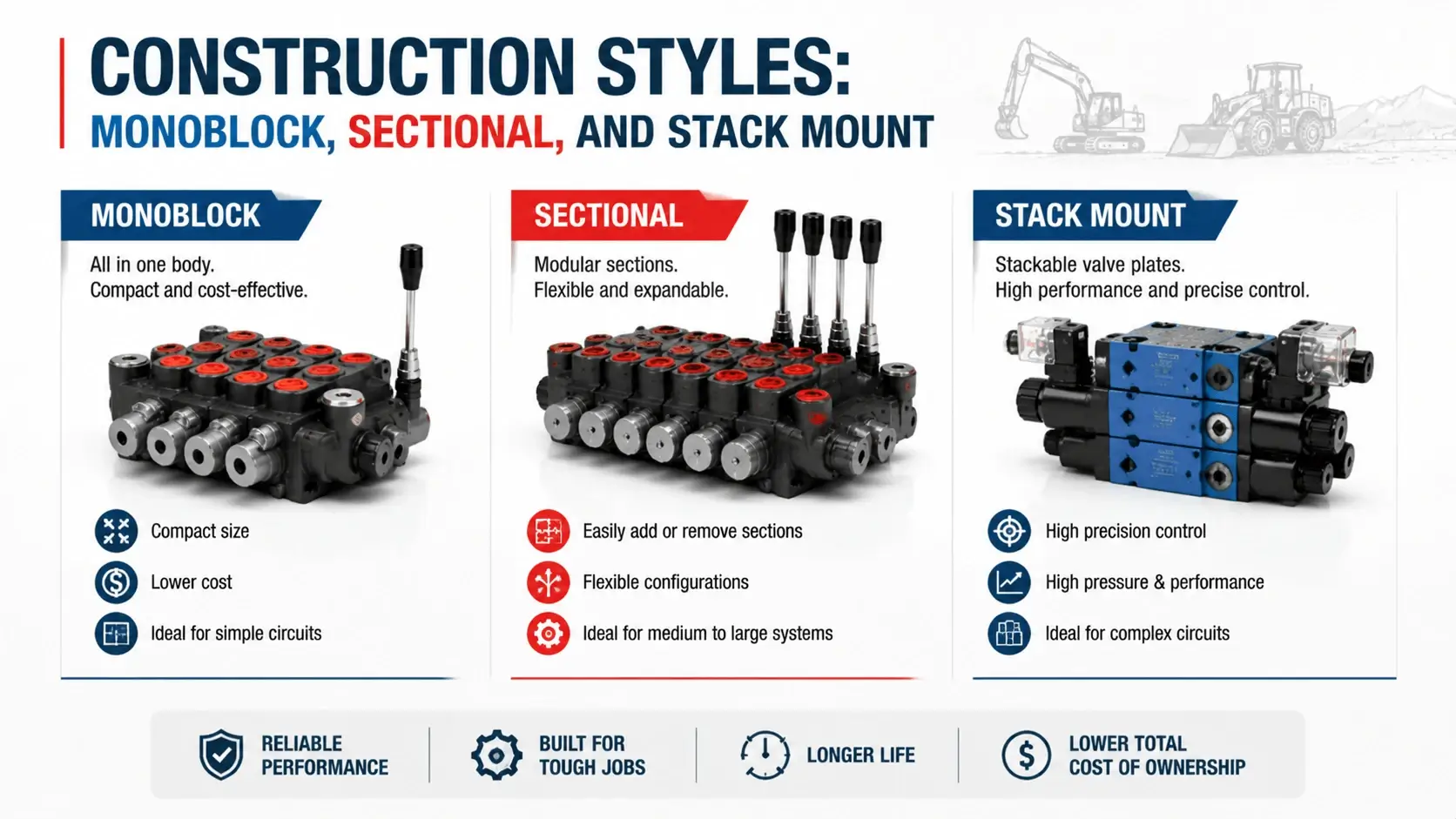
| Format | Construction | Strengths | Weaknesses | Typical Use |
|---|---|---|---|---|
Monoblock |
One casting holds all spools |
Low cost, compact, few leak points |
One bad section scraps the whole valve |
Log splitters, small tractors, tippers |
Sectional |
Individual sections bolted together |
Easy repair, add or swap sections |
Higher cost, tie-rod leaks possible |
Loaders, backhoes, agricultural machines |
Stack (sandwich) |
Modules stacked on ISO 4401 pattern |
Dense functions, fast field swaps |
Height and weight grow per station |
Machine tools, presses, industrial units |
Monoblock valves dominate the low-cost mobile market. A two-spool monoblock rated at 50 L/min and 250 bar covers most small implement duties. The price sits well below any sectional alternative.
Sectional valves win where uptime matters. A harvester crew can swap one worn section in an hour instead of replacing a whole monoblock. OEMs also like the format because they configure the valve per machine option list.
Industrial systems take a different path. Sandwich modules bolt between a directional valve and its subplate. They stack relief, check, and flow functions into one compact station on an ISO 4401 pattern.
Internal Circuits: Series, Parallel, and Tandem
Multi-spool valves route oil between sections in three ways, and the arrangement decides whether functions can run together.
- Series circuits feed return oil from one spool into the next, so functions combine but pressures add up.
- Parallel circuits give every spool full pump flow at once, so several functions move together at reduced speed.
- Tandem circuits pass oil through the open center when spools sit in neutral, a common layout in fixed-displacement mobile systems.
Parallel arrangements dominate modern mobile equipment because operators expect to lift and crowd at the same time. The trade-off appears under heavy load. The lightest function takes most of the flow, and the heavier one slows or stalls.
Spool Center Configurations and Pump Matching
The center position of a 4/3 spool defines what happens in neutral. Match it to the pump type; this is a basic design rule that protects efficiency and oil temperature.
| Center Type | Neutral Behavior | Best Pump Match | Common Use |
|---|---|---|---|
Open center |
Pump port drains to tank |
Fixed displacement |
Tractors, older mobile machines |
Closed center |
All ports blocked |
Variable displacement, pressure compensated |
Industrial power units |
Tandem center |
Pump to tank, work ports blocked |
Fixed displacement |
Loaders, backhoes |
Float center |
Both work ports to tank |
Either, per circuit design |
Dozer blades, loader buckets |
Run a closed-center valve on a fixed-displacement pump, and the pump deadheads across the relief valve in neutral. Oil temperature climbs and fuel burns for nothing. Pair an open-center valve with a compensated pump, and the pump stalls against its compensator.
The float center deserves a note of its own. It lets an implement follow ground contour under its own weight, which is why graders and snow plows specify it.
Actuation Methods
The same valve body can accept several actuation styles:
- Manual lever or pedal for direct operator control on mobile machines.
- Cable or linkage remote control for cabs and awkward mounting spots.
- Solenoid for PLC-driven automation, typically 12 or 24 VDC on mobile and 110 or 230 VAC in plants.
- Hydraulic pilot joystick for excavators and cranes, where low-pressure pilot oil shifts the main spool.
- Electro-hydraulic for large valves that need solenoid control beyond direct-acting force limits.
Solenoid force sets a practical ceiling. Above roughly NG10 or CETOP 5, full-flow spools need pilot assistance, and manufacturers switch to electro-hydraulic two-stage designs.
Response matters too. A direct solenoid shifts in 20 to 80 milliseconds, while a piloted stage needs 30 to 150 milliseconds. For most machinery, that gap is invisible, but high-dynamic axes live in another world entirely.
Pressure Ratings and Flow Sizing
Every control valve carries two headline numbers: maximum pressure and rated flow. Industrial valves commonly carry 210, 315, or 350 bar ratings. Mobile monoblocks typically run 180 to 250 bar, and high-pressure specialties reach 420 bar.
The rated flow number needs care. Manufacturers rate flow at a defined pressure drop per metering edge, often around 5 bar total for the valve. Push more flow through the same spool and the pressure drop climbs with the square of flow. Twice the flow means roughly four times the pressure drop, and that lost pressure turns straight into heat.
A quick sizing example: a cylinder circuit needs 60 L/min at 210 bar. An NG6 or CETOP 3 valve tops out near 40 to 50 L/min. The right call is NG10 or CETOP 5, with margin in hand.
Common Failures and Field Fixes
Control valves fail in predictable ways, and most failures trace back to oil condition or abuse.
| Symptom | Likely Cause | Field Fix |
|---|---|---|
Spool sticks or shifts slowly |
Silt or varnish in the spool gap |
Clean valve, fix filtration, check oil |
Load drifts in neutral |
Worn spool lands or scored bore |
Measure leakage past spool, replace section or valve |
Valve fails to center |
Broken or weak centering spring |
Replace spring kit |
External leak at section joints |
Tie-rod stretch or aged O-rings |
Re-torque to spec, replace seals |
Solenoid coil burns out |
Jammed spool or low supply voltage |
Free the spool, verify voltage under load |
Chatter or buzzing |
Relief instability or air in oil |
Bleed air, check relief setting and condition |
How to Select a Hydraulic Control Valve
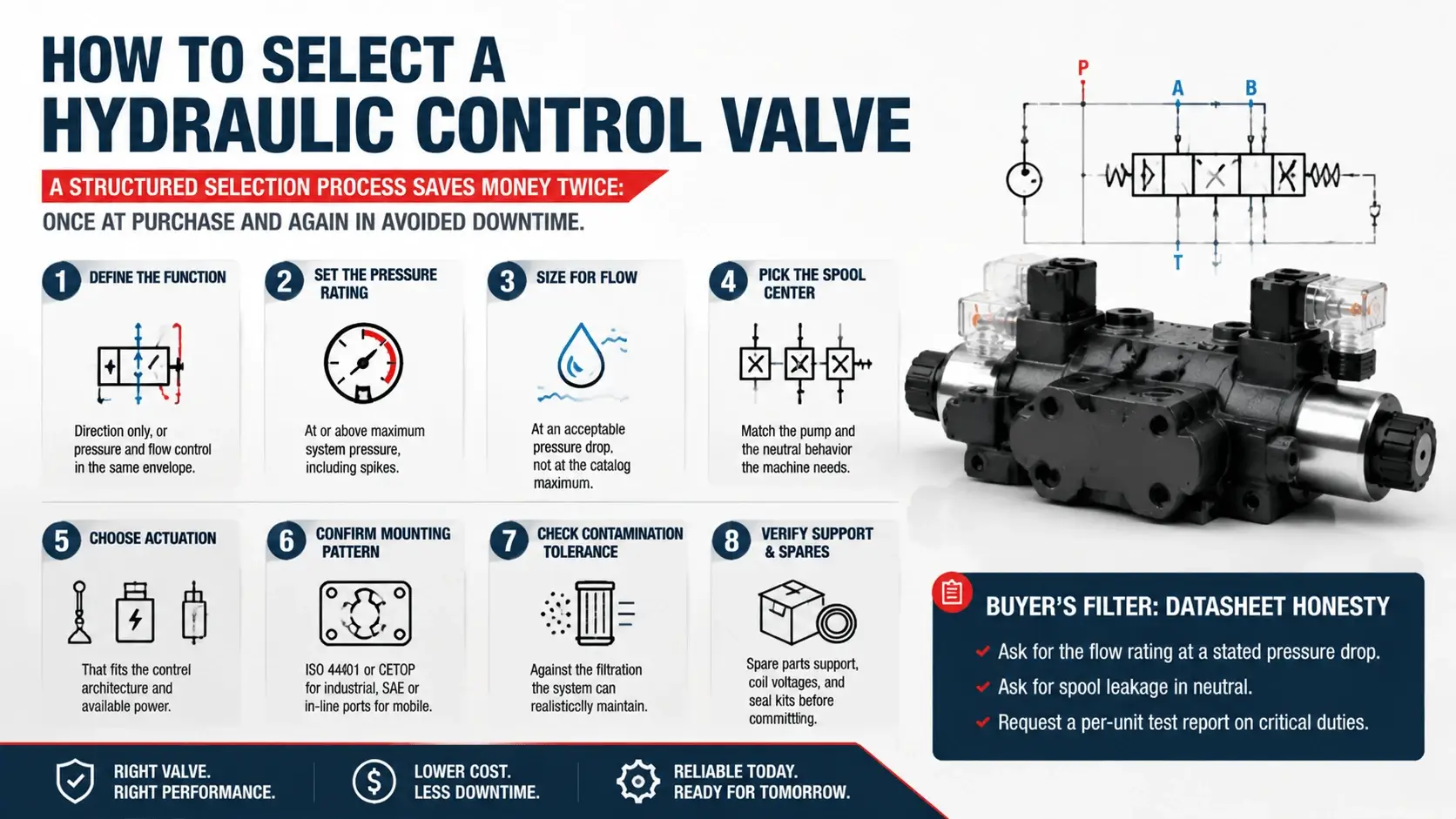
A structured selection process saves money twice: once at purchase and again in avoided downtime.
- Define the function: direction only, or pressure and flow control in the same envelope.
- Set the pressure rating at or above maximum system pressure, including spikes.
- Size for flow at an acceptable pressure drop, not at the catalog maximum.
- Pick the spool center to match the pump and the neutral behavior the machine needs.
- Choose an actuation that fits the control architecture and available power.
- Confirm the mounting pattern: ISO 4401 or CETOP for industrial, SAE, or in-line ports for mobile.
- Check contamination tolerance against the filtration that the system can realistically maintain.
- Verify spare parts support, coil voltages, and seal kits before committing.
One more filter applies to buyers: datasheet honesty. Ask for the flow rating at a stated pressure drop. Ask for spool leakage in neutral and a per-unit test report on critical duties.
Industrial and Mobile Applications
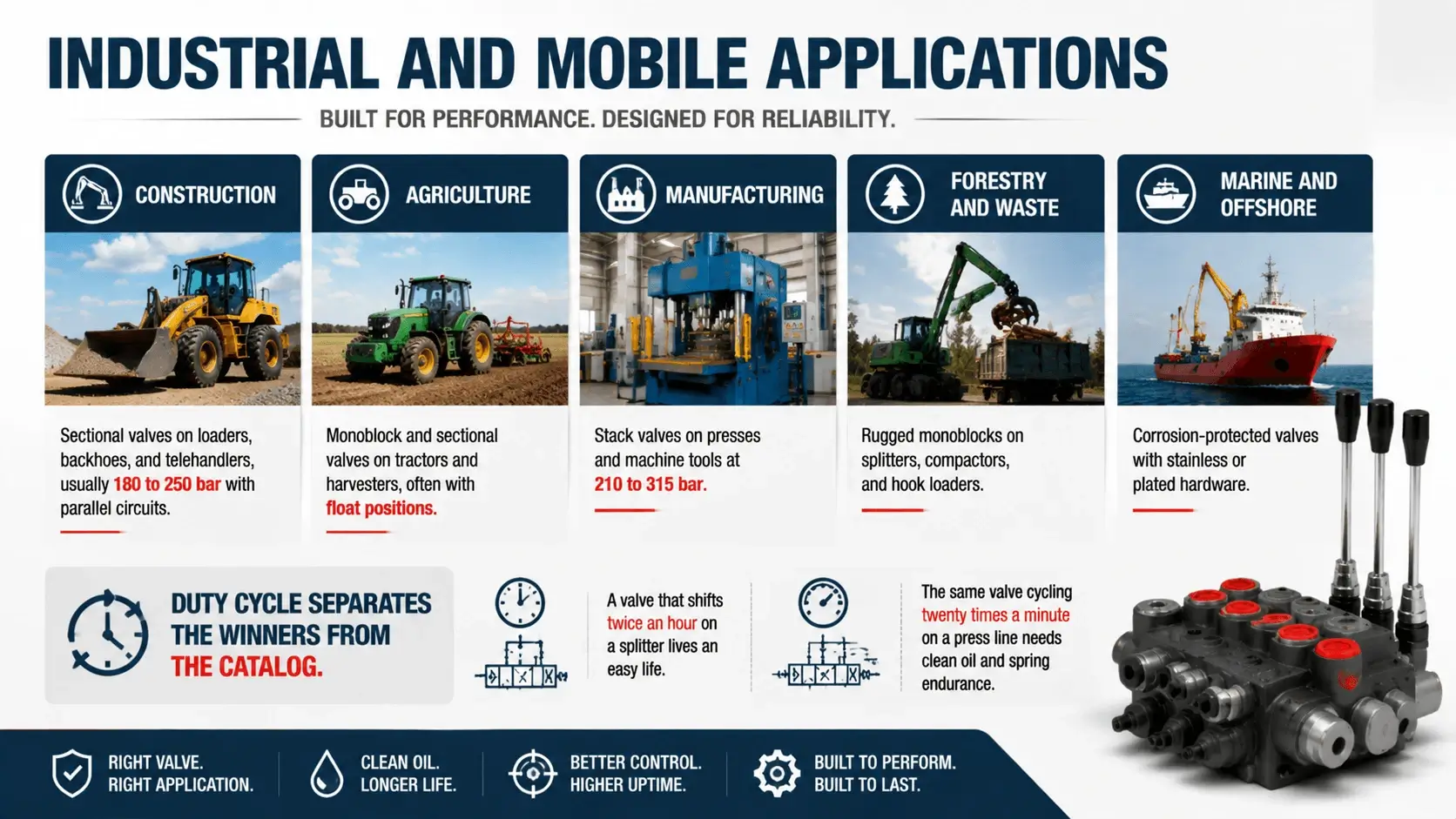
- Construction: sectional valves on loaders, backhoes, and telehandlers, usually 180 to 250 bar with parallel circuits.
- Agriculture: monoblock and sectional valves on tractors and harvesters, often with float positions.
- Manufacturing: stack valves on presses and machine tools at 210 to 315 bar.
- Forestry and waste: rugged monoblocks on splitters, compactors, and hook loaders.
- Marine and offshore: corrosion-protected valves with stainless or plated hardware.
Duty cycle separates the winners from the catalog. A valve that shifts twice an hour on a splitter lives an easy life. The same valve cycling twenty times a minute on a press line needs clean oil and spring endurance.
FAQ
What is a hydraulic control valve used for?
A hydraulic control valve starts, stops, and reverses hydraulic actuators, and many designs also limit pressure or meter flow. On mobile machines, it sits between the pump and the cylinders or motors. On industrial systems, it works as part of a stacked valve station driven by a PLC.
What is the difference between monoblock and sectional control valves?
A monoblock valve machine has all spool bores in one casting. That cuts cost and leak points, but the whole valve becomes one repair unit. A sectional valve bolts individual sections together, so technicians can swap one failed section and OEMs can add functions later. Monoblock suits simple, price-sensitive machines; sectional suits fleets and configurable equipment.
Open center or closed center: how do I choose?
Match the center to the pump. Fixed-displacement pumps need an open or tandem center so oil has a path to the tank in neutral. Pressure-compensated variable pumps pair with closed centers because the pump destrokes at standby. Mixing the two wastes energy and overheats the oil.
Why does my control valve get hot?
Heat comes from the pressure drop. An undersized spool, long periods at partial meter, or constant relief bypass all turn pressure into heat. Check actual flow against the rating at the stated pressure drop. Look for internal leakage past worn lands as well.
Can I replace a monoblock valve with a sectional valve?
Yes, if pressure, flow, spool functions, and port sizes match. Check the mounting footprint and linkage too; sectional valves often run longer than the monoblock they replace. Many owners make the swap to gain repairability and future expansion.
Conclusion
The hydraulic control valve earns its place as the decision maker of every hydraulic machine. Its spool decides direction, and its center configuration sets what the pump does at rest. Its metering edges decide how the machine feels to the operator.
Selection rewards discipline. Match the center to the pump, and size the flow at a real pressure drop. Pick a construction that fits the service plan, and protect the oil. Do those four things, and the valve will outlast the machine around it.