
Why the Right Element Matters
I once watched a mining operation burn through three piston pumps in a single shift. The culprit was a cheap knockoff hydraulic filter element that looked identical to the OEM part. It fits the housing. It spun into place. But the media had no real beta rating. Hard particles sailed straight through and tore up the swash plates in hours.
That day cost the site over EUR 80,000 in parts and downtime. The original filter would have cost EUR 35. This guide covers what the element does and how to read the specs. You will learn to pick the right one for your system.
What is a Hydraulic Filter Element?
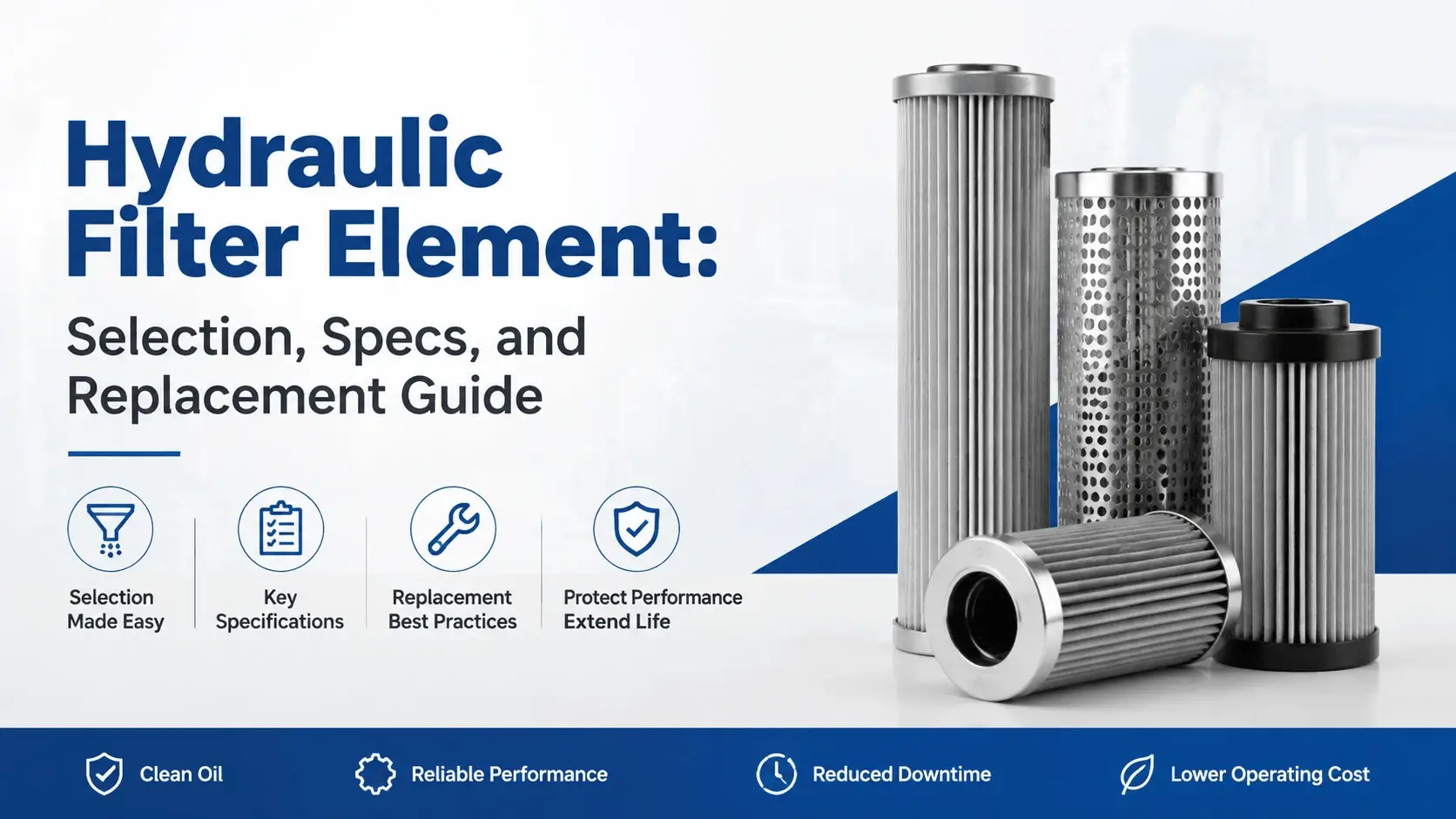
A hydraulic filter element is the replaceable cartridge inside a filter housing that captures contaminants from hydraulic fluid. The housing holds it in place. The element does the actual work of trapping particles. When the element loads up with debris, you swap it out and keep the housing in service.
The element contains filter media, a support core, end caps, and seals. Fluid enters the housing, passes through the media, and exits cleaner than it went in. The media traps solid particles while letting oil flow through with minimal resistance. Without a functioning hydraulic filter element, abrasive debris circulates freely and destroys pumps, valves, and cylinders.
How the Hydraulic Filter Element Works
The mechanism is straightforward. Fluid flows through the filter media under system pressure. The media has pores or fibers that block particles above a certain size. Smaller particles get trapped in the depth of the media through interception and adhesion. Clean fluid passes through and continues downstream.
Pressure builds across the element as debris accumulates. A differential pressure indicator tracks this drop. When the pressure reaches a set threshold, the indicator signals that the hydraulic filter element needs replacement.
Most housings also include a bypass valve. If the element plugs completely, the bypass opens and lets fluid through unfiltered rather than starving the pump.
Types of Filter Elements

Filter elements come in several media types. Each suits different applications and cleanliness targets.
Surface Filter Elements
Surface filters trap particles on the outside of a thin media sheet. Paper and wire mesh are common materials. They offer low pressure drop and easy flow. Surface filters work well for coarse filtration above 25 microns. They clog faster than depth filters but cost less to replace.
Depth Filter Elements
Depth filters capture particles throughout the thickness of the media. Multi-layer glass fiber and cellulose are standard materials. They hold more debris before clogging and achieve finer ratings. Most high-performance element designs use depth construction. They achieve beta ratings of 1000 or better at 3 to 10 microns.
Wire Mesh Elements
Stainless steel wire mesh handles high pressures and temperatures. You can clean and reuse mesh elements instead of throwing them away. They suit suction strainers and coarse return line duty. Mesh elements do not achieve fine ratings, typically stopping particles above 40 to 60 microns.
Key Specifications You Must Understand
Beta Ratio
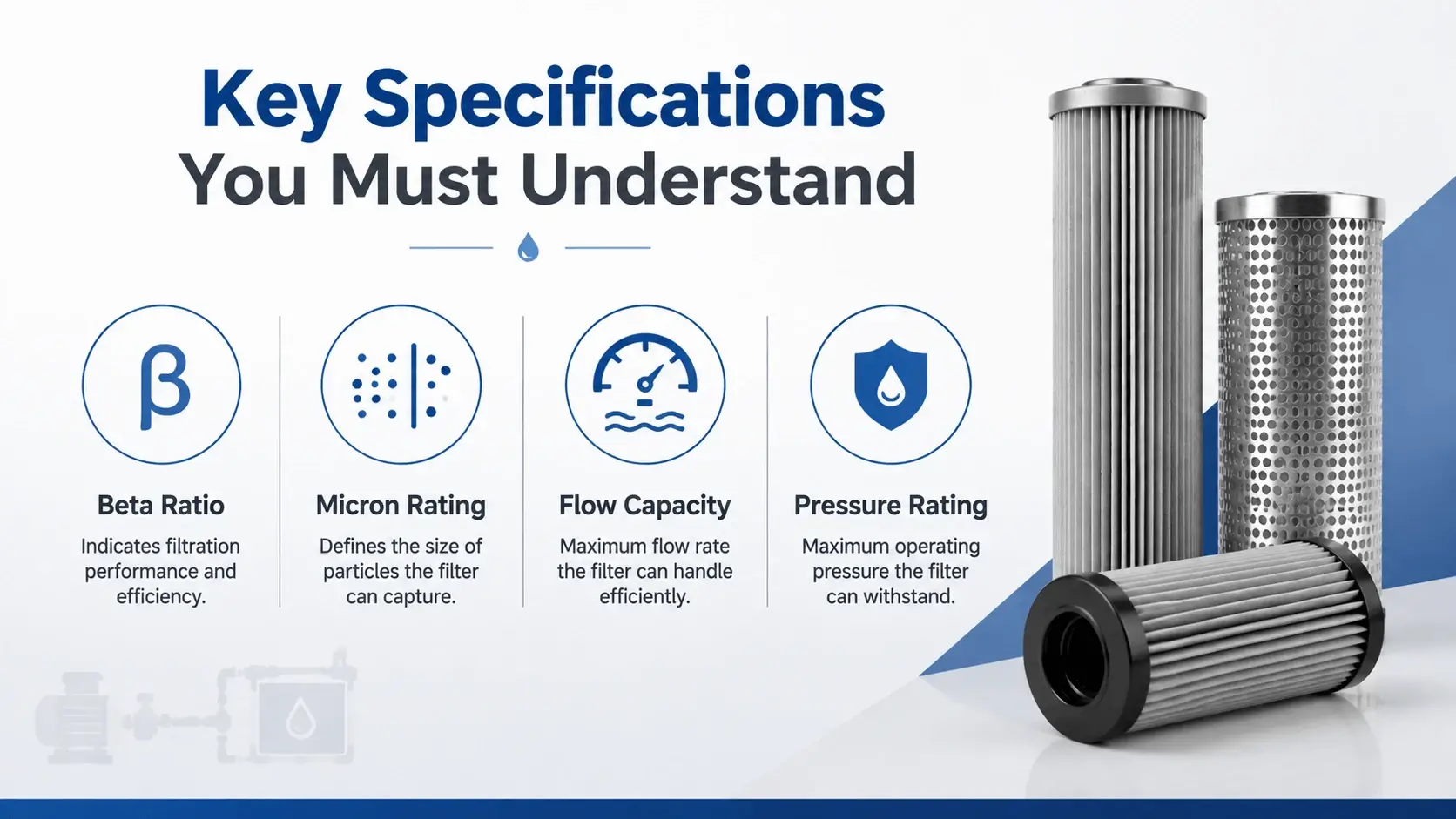
The beta ratio defines filtration efficiency. A beta-10 rating of 1000 means high efficiency. For every 1000 particles at 10 microns entering the filter, only one gets through. That translates to 99.9% efficiency at that size. Always check the beta ratio at the micron rating that matters to your components. A claim of “10 micron filtration” means nothing without the beta number.
Micron Rating
The micron rating tells you the particle size the element targets. But the rating alone does not guarantee performance. A 10-micron hydraulic filter element with beta-2 only removes 50% of 10-micron particles. The same element with beta-1000 removes 99.9%. Read both numbers together.
Flow Capacity
Every element has a maximum flow rate. Exceeding it starves the pump and can collapse the element. Check the rated flow against your system’s maximum output, not the nominal operating flow. Leave a margin of 20 to 30% for safety.
Pressure Rating
The element and housing must handle your system’s maximum pressure. A return line element rated for 10 bar will fail in a 350 bar pressure line. Match the pressure class to the installation location.
Filter Element Selection by System Location
Where you install the element determines what it needs to do. Suction strainers protect the pump from large debris. Pressure line filters protect sensitive downstream valves. Return line filters clean oil before it re-enters the reservoir. Offline loops provide continuous conditioning independent of main system flow.
| Location | Typical Rating | Pressure Class | Purpose |
|---|---|---|---|
Suction strainer |
60 to 150 micron mesh |
Low (vacuum) |
Protect pump from large debris |
Pressure line |
3 to 10 micron, beta-1000 |
Full system pressure |
Protect downstream valves and actuators |
Return line |
10 to 25 micron, beta-1000+ |
10 to 35 bar |
Clean oil before it returns to tank |
Offline loop |
3 to 10 micron, beta-1000 |
10 to 20 bar |
Continuous conditioning independent of main flow |
Your system likely needs more than one filter location. Most industrial systems run suction strainers plus return line filters. Systems with servo valves add pressure line filters. Critical systems add offline kidney loops for continuous conditioning.
Common Problems With Filter Elements
Bypass Valve Opens Too Often
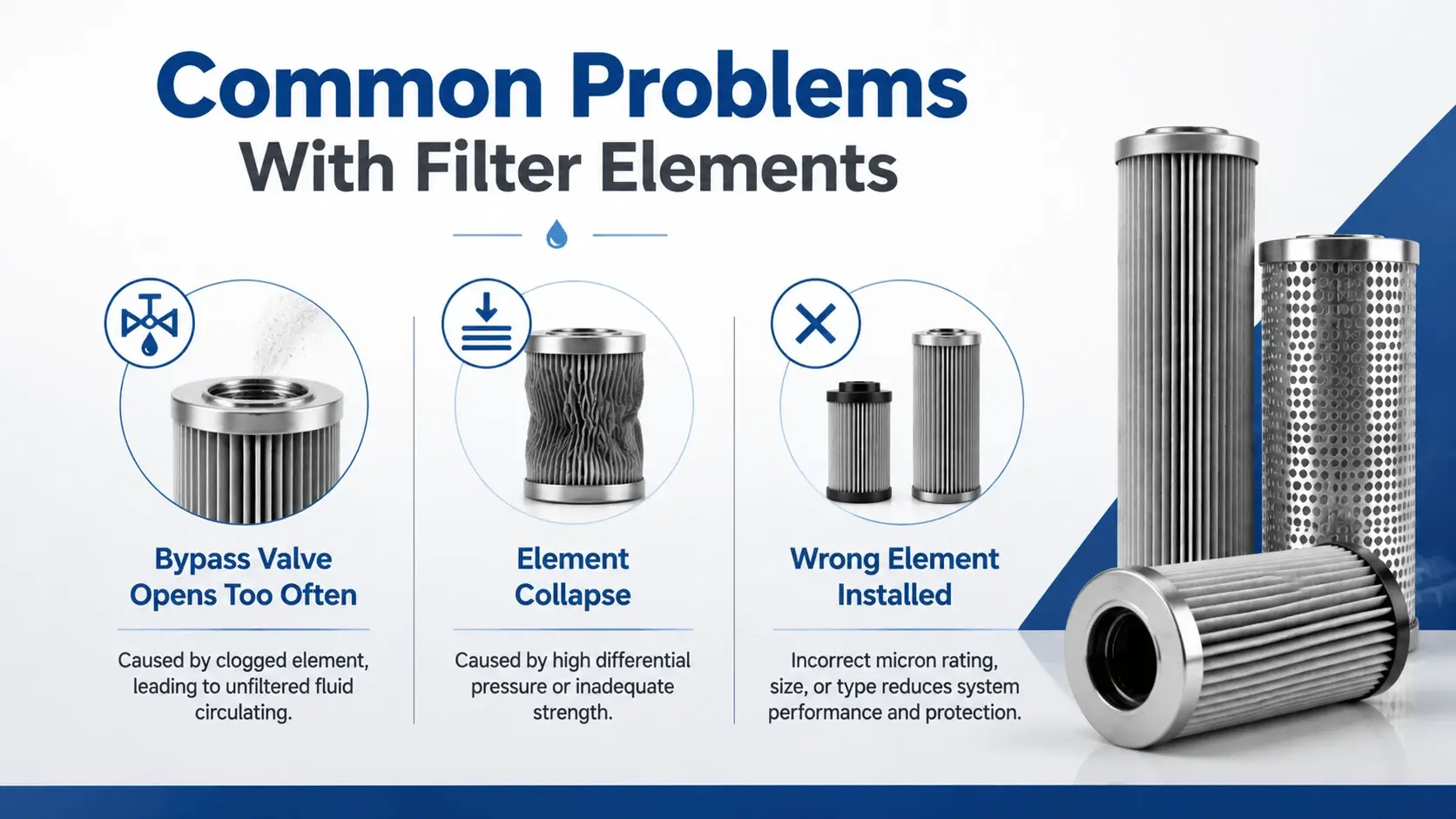
When the bypass opens, unfiltered oil flows straight to your components. Causes include an oversized element for the contamination load, wrong micron rating, or degraded oil that has turned to sludge. Check the element condition when you remove it. A plugged element in days means a bigger problem upstream.
Element Collapse
High flow spikes or a blocked bypass valve can crush the element core. Debris from the damaged media then enters the system. Always verify the bypass valve works before installing a new hydraulic filter element. A stuck bypass turns your filter into a failure waiting to happen.
Wrong Element Installed
Cross-referencing part numbers between brands saves money but introduces risk. Knockoff elements often skip the glass fiber layer and use paper instead. They look identical from the outside. The first sign of trouble is usually a pump failure three months later. Buy from authorized sources or test off-brand elements against OEM specs before trusting them.
When to Replace Your Filter Element
Several signals tell you the element has reached the end of its life. The differential pressure indicator trips. Flow drops off. Pump noise increases from cavitation. Any of these means you waited too long.
Condition-based replacement works best. Track the differential pressure over time. Replace the element when it reaches 70 to 80% of the bypass setting, not after the bypass opens. This keeps filtration active at all times.
For systems without indicators, follow the OEM hour interval but adjust based on oil analysis results. A new system or one running after a major repair will plug filters fast. Expect to change elements every 50 to 200 hours during break-in. A clean, steady-state system might run 2000 hours between changes.
Never judge a hydraulic filter element by appearance alone. A dark, loaded element needs replacement. But a clean-looking element can still have lost its beta efficiency if the media has degraded.
Maintenance Best Practices
Keep a log of every filter change. Record the date, system hours, differential pressure, and element part number. Over time, this log reveals your system’s contamination profile and helps you optimize replacement intervals.
Stock spare elements for every filter housing in your plant. A two-day wait for a replacement element costs more than holding inventory. Store elements in their original packaging, upright, in a dry area. Elements absorb moisture and can grow mold if left open.
When you change an element, fill the housing with clean oil before closing it. This prevents air from entering the system and causing cavitation on startup. Torque the housing to spec. Over-tightening damages seals. Under-tightening causes leaks.
Sample your oil before and after a filter change. The before sample tells you what the old element caught. The after sample confirms the new element works. If the particle count does not drop after a change, something went wrong.
FAQ
How often should I replace my filter element?
Most systems need element changes every 1000 to 2000 operating hours. New systems and post-repair systems need changes every 50 to 200 hours during break-in. Always replace based on differential pressure, not just hours. The indicator tells you when the element has reached its limit.
What is the difference between a hydraulic filter element and a filter housing?
The housing is the permanent metal body bolted to your system. The element is the replaceable cartridge inside it. You buy the housing once. You replace the element many times over the housing’s life. The two work together but serve different roles.
Can I clean and reuse a filter element?
Wire mesh elements clean well with solvent and compressed air. Paper and fiberglass depth elements do not. Attempting to wash a deep element damages the media and releases trapped debris back into your system. Replace disposable elements. Clean only reusable mesh types.
What micron rating do I need?
Match the rating to your most sensitive component. Gear pumps tolerate 25 microns. Piston pumps need a 10 micron. Servo valves demand 3 to 5 microns. When in doubt, go finer. The cost difference between a 10 micron and 3 micron element is small compared to a pump replacement.
Are off-brand filter elements safe to use?
Some meet OEM specs. Many do not. Test any off-brand element with a particle counter before committing to bulk use. Check the beta ratio, flow capacity, and collapse pressure. If the supplier cannot provide test data, walk away. A cheap element costs more in the long run.
Conclusion
A hydraulic filter element looks like a simple cartridge. It costs less than most other parts in your system. But it protects everything downstream from the contamination that causes the majority of hydraulic failures.
Get the specs right. Match the beta ratio and micron rating to your components. Replace elements before the bypass opens. Log your changes. Sample your oil. These steps cost almost nothing and prevent the failures that cost everything.
The EUR 80,000 pump failure I mentioned at the start came from a EUR 35 savings on a filter. That math does not work. Buy the right element. Install it correctly. Replace it on time. Your equipment will run longer because of it.