Introduction
A trailer
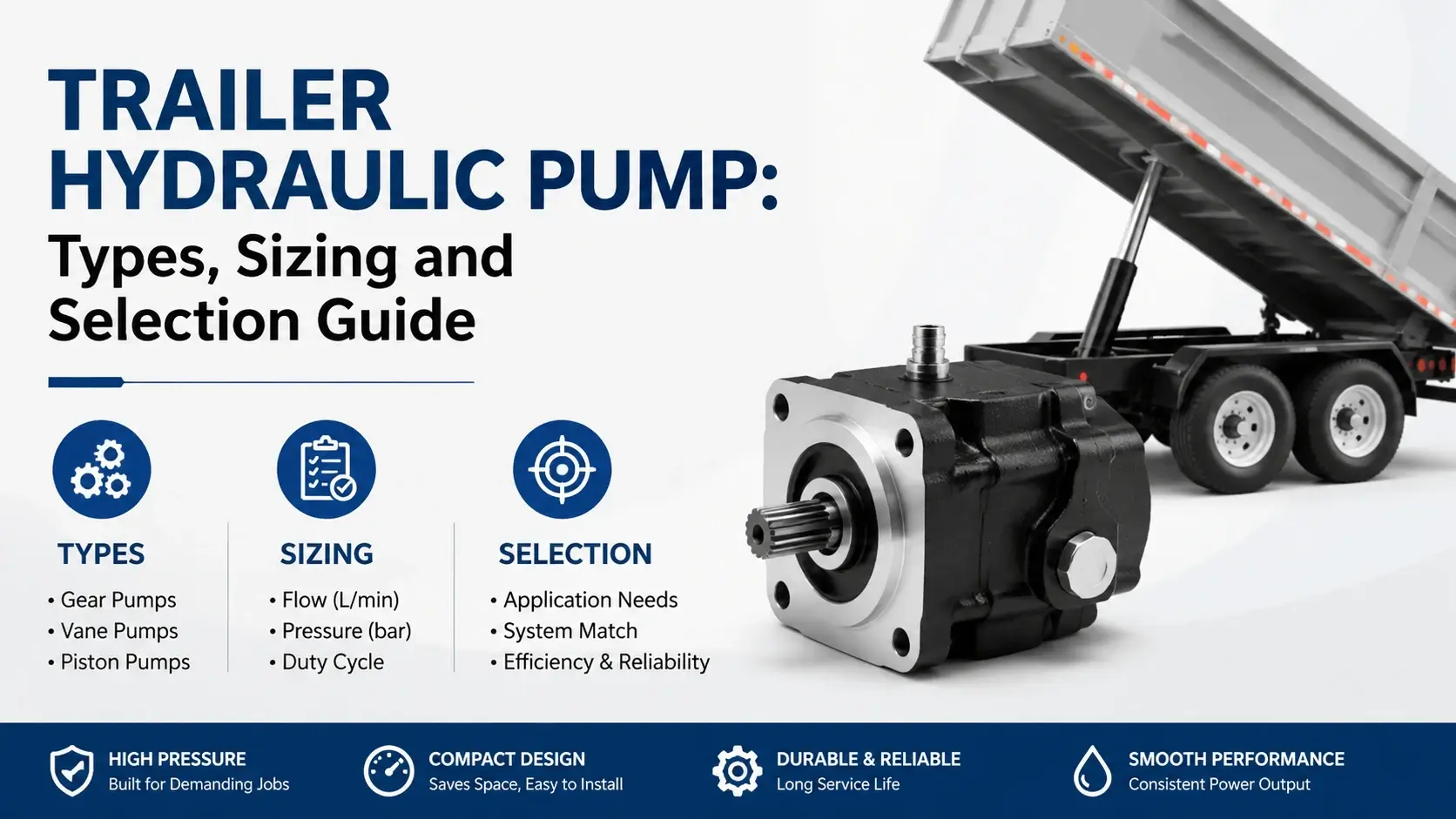
hydraulic pump feeds the oil that lifts a tipper bed or tilts a deck on a towed trailer. On boat trailers, it also drives the disc brakes. Dump trailers, livestock trailers, car haulers, and boat trailers all rely on one. The pump turns engine or battery power into the pressure that moves a cylinder or a brake caliper.
Most buyers pick a pump by lift capacity and stop. That shortcut hides the choices that decide whether the trailer tips in 20 seconds or stalls halfway up. Pump type, drive source, relief pressure, and cylinder match matter more than the nameplate. This guide walks through the ratings and trade-offs you need to specify a trailer hydraulic pump that survives road work.
What is a Trailer Hydraulic Pump?
This pump is a positive-displacement unit that feeds oil to a tipping cylinder, a tilt mechanism, or a brake circuit on a towed trailer. It sits between the power source and the actuator. The pump moves oil from a reservoir into the valve block at working pressure.
On small trailers, the pump runs from a 12V or 24V DC motor and a battery. On agricultural and heavy tippers, it runs from a tractor or truck PTO. The pump type stays the same in both cases. What changes are the drive, the flow, and the pressure band?
The pump is not the whole system. It works with a reservoir, a directional valve, a relief valve, and the cylinder. Get the pump right, and the rest of the circuit falls into place.
How a Trailer Hydraulic Pump Works
The cycle starts when power reaches the pump. A DC motor spins the gear set, or a PTO shaft drives a larger pump. Oil pulls from the reservoir through a suction port and moves to the outlet.
A directional valve routes that flow to the rod end or the cap end of the tipping cylinder. Oil pushes the piston, and the bed rises. A relief valve caps the maximum pressure so the pump cannot burst a line when the bed hits the stop.
When the valve returns to center, the pump flow dumps to the tank at low pressure. The bed holds on a check valve or a pilot-operated lock. Return oil flows back through the valve block and into the reservoir. The whole cycle takes 15 to 30 seconds on a typical dump trailer.
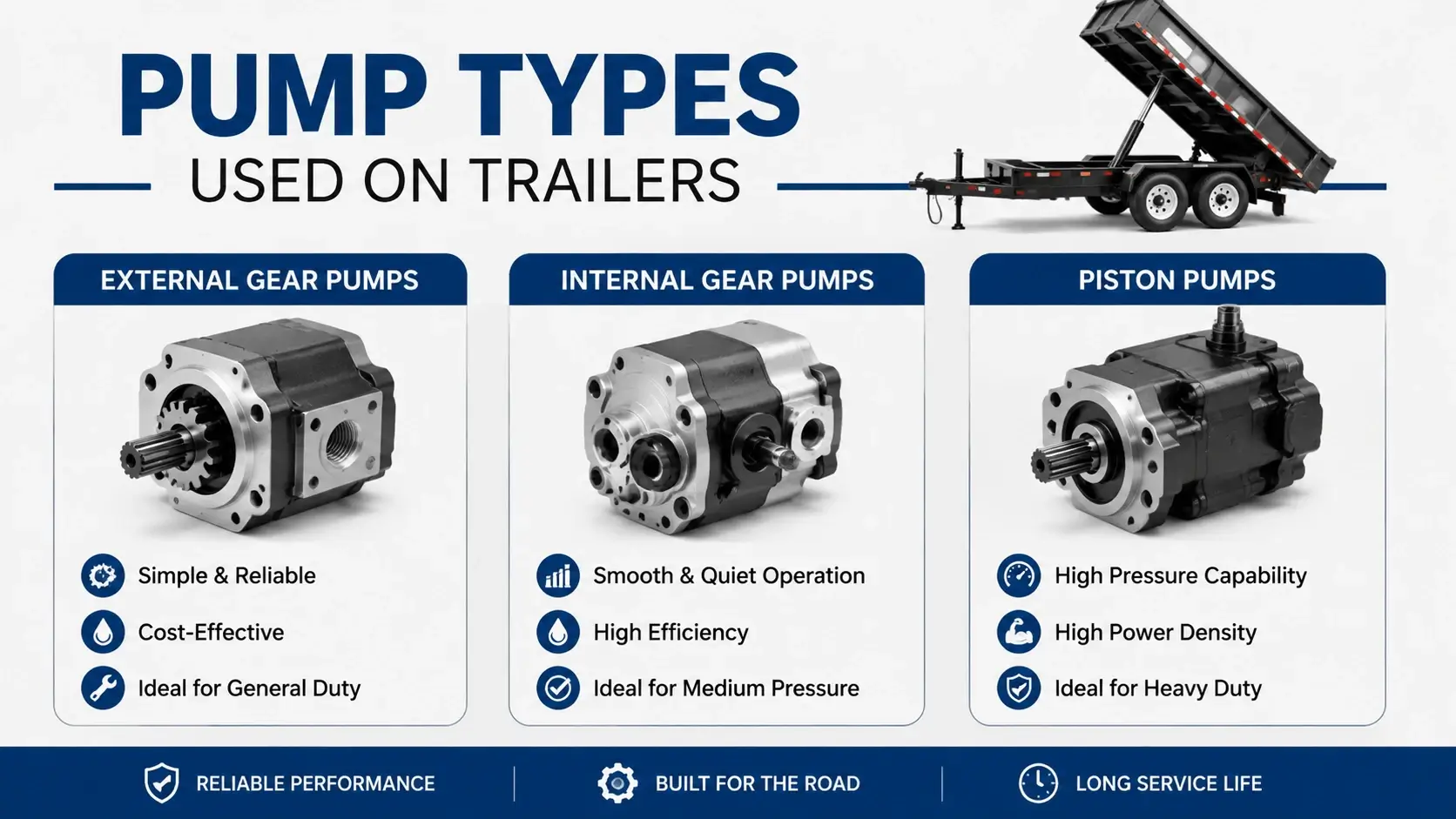
Three pump families cover nearly every trailer build. Each suits a different pressure, flow, and drive.
External Gear Pumps
External gear pumps dominate small and mid-size trailers. They run 0.5 to 25 cc/rev, top out near 250 bar, and cost the least. The two gears mesh inside a close-fitting housing, and oil rides the tooth spaces from inlet to outlet.
Gear pumps shrug off the dirt and vibration that come with road service. That makes them the default trailer hydraulic pump for dump and tilt units.
Internal Gear Pumps
Internal gear pumps run quieter and smoother than external types. They suit boat trailer brake systems and livestock trailers where noise reaches the operator. Pressure runs to 300 bar, but flow stays modest. The cost runs higher, and the tighter clearances demand cleaner oil.
Piston Pumps
Piston pumps show up on large agricultural and road tippers with PTO drive. They handle 350 to 450 bar and flows from 30 to 100 L/min. A piston pump costs more and demands cleaner oil than a gear pump. It delivers the flow a 20-tonne tipper needs to lift in seconds.
DC Electric vs PTO Drive
The drive source splits the trailer pump market into two.
DC electric pumps run from a 12V or 24V battery and a PMDC motor. Flow runs 2 to 8 L/min, and pressure tops out at 150 to 207 bar. They suit dump trailers up to about 5 tonnes, tilt decks, and car haulers.
The pump, motor, tank, and valve often share one housing as a trailer power pack. Run time stays short, so duty cycle lands in S2 territory. Read our 12V hydraulic pump guide for the component-level detail on these units.
PTO-driven pumps run from the tractor or truck gearbox. Flow runs 30 to 100 L/min, and pressure reaches 250 bar or more. They suit large agricultural tippers, grain chasers, and muck spreaders. The pump bolts to the PTO shaft, and a separate reservoir and valve bank sit on the trailer frame.
The Tipping Circuit
A tipping circuit has four parts that work together. The pump moves the oil. A directional valve, usually a 3-position spool, routes flow to raise, hold, or lower the bed. A relief valve caps pressure. The tipping cylinder does the work.
Cylinder bore sets the force. A 3-inch bore at 200 bar gives about 22 tonnes of push, enough for a 10-tonne load at a 2-to-1 leverage. Stroke sets the lift height. A 48-inch stroke lifts a 6-meter bed to 45 degrees, the legal tip angle in most markets.
The relief valve sits at 10 to 15 percent above working pressure if the cylinder needs 180 bar to lift a full load, set the relief at 200 to 207 bar. A relief set too low stalls the lift. One set too high bursts hoses and bends rams.
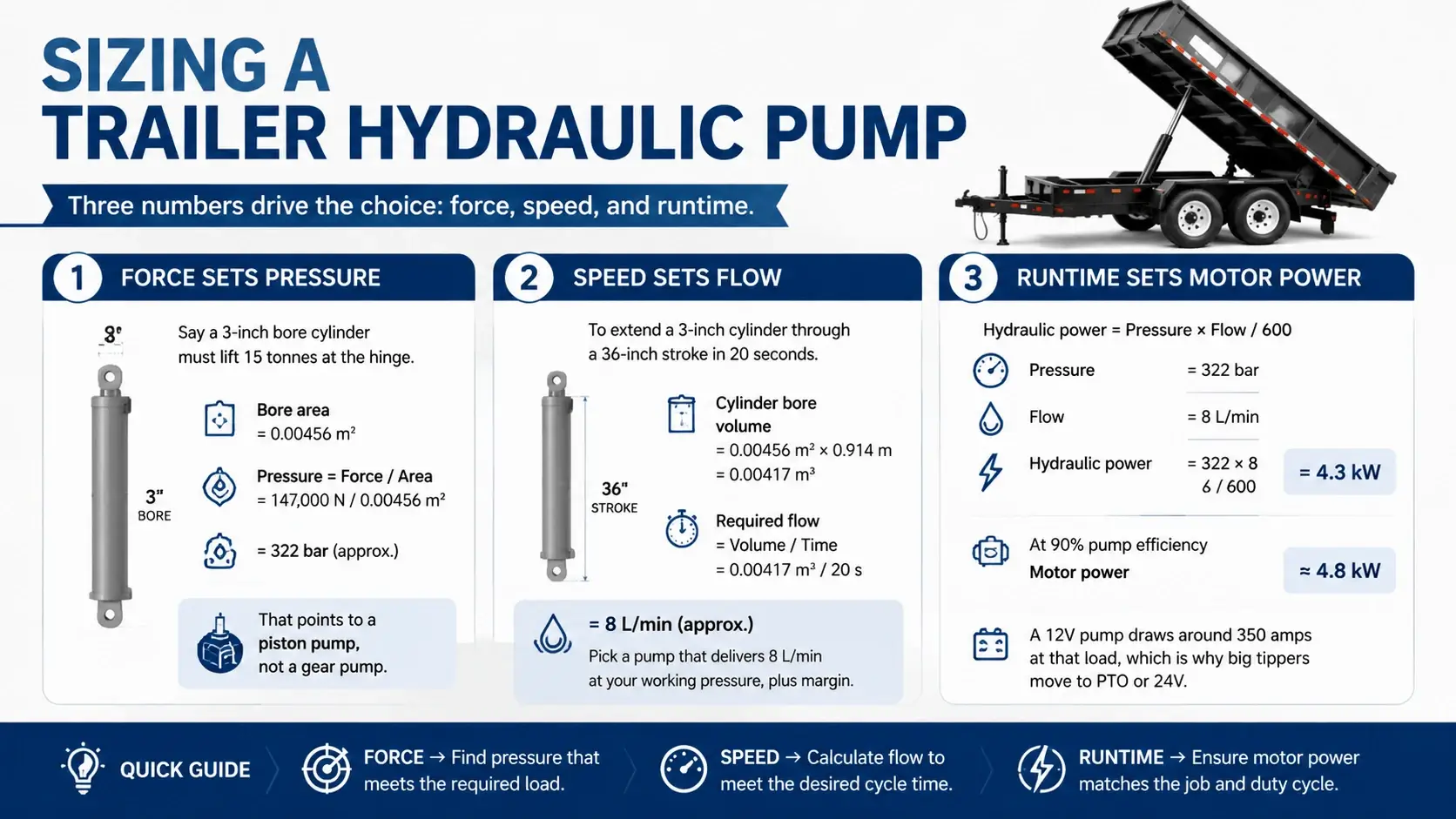
Three numbers drive the choice: force, speed, and runtime.
Force sets pressure. Say a 3-inch bore cylinder must lift 15 tonnes at the hinge. Bore area equals 0.00456 m². Pressure equals force over area, so 147,000 N divided by 0.00456 m² gives about 322 bar. That points to a piston pump, not a gear pump.
Speed sets flow. To extend a 3-inch cylinder through a 36-inch stroke in 20 seconds, you need the cylinder bore volume over time. That works out to about 8 L/min. Pick a pump that delivers 8 L/min at your working pressure, plus margin.
Runtime sets motor power. Hydraulic power equals pressure times flow divided by 600. Here, 322 times 8 divided by 600 gives 4.3 kW. At 90 percent pump efficiency, the motor must deliver about 4.8 kW. A 12V pump draws around 350 amps at that load, which is why big tippers move to PTO or 24V.
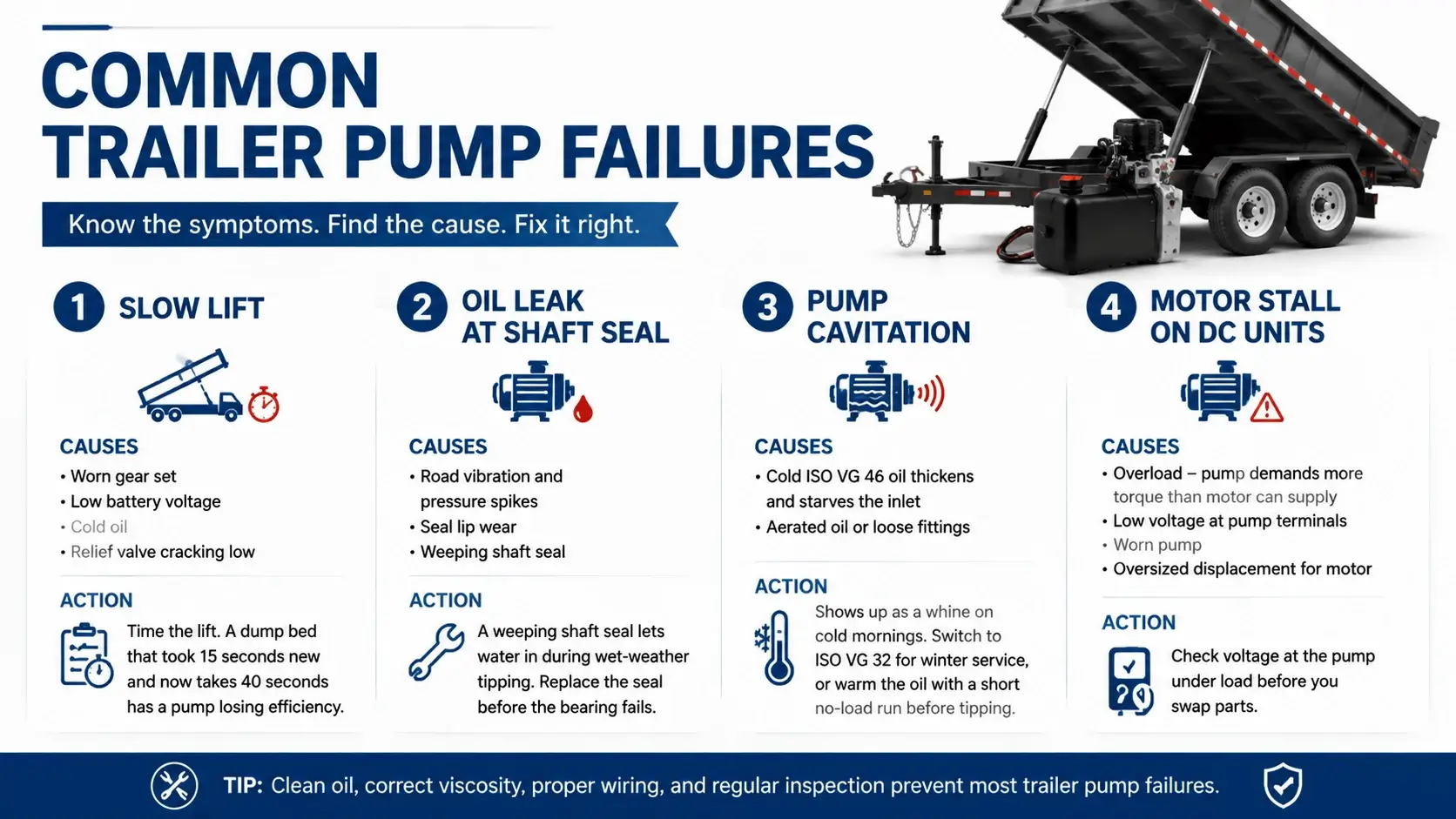
Slow lift ranks first. Causes include a worn gear set, low battery voltage, cold oil, or a relief valve cracking low. Time to lift. A dump bed that took 15 seconds, new and now takes 40 seconds, has a pump losing efficiency.
Oil leak at the shaft seal comes second. Road vibration and pressure spikes wear the seal lip. A weeping shaft seal lets water in during wet-weather tipping. Replace the seal before the bearing fails.
Pump cavitation shows up as a whine on cold mornings. Cold ISO VG 46 oil thickens and starves the inlet. Switch to ISO VG 32 for winter service, or warm the oil with a short no-load run before tipping.
Motor stall on DC units points to overload. The pump demands more torque than the battery and motor can supply. Causes include low voltage at the pump terminals, a worn pump, or an oversized displacement for the motor. Check the voltage at the pump under load before you swap parts.
Selection Checklist
- Load and leverage set the cylinder force.
- Cylinder bore sets the working pressure.
- Lift time sets the flow at that pressure.
- Pressure and flow set the pump type and displacement.
- Available power sets DC electric or PTO drive.
- Duty pattern sets S2 rating and motor margin.
- Climate sets oil grade for cold-start service.
- Road exposure sets sealing and breather spec.
Maintenance Best Practices
- Check the oil level before each tipping day. Top up with the correct ISO VG grade.
- Time to lift monthly. A 20 percent slowdown means the pump or relief needs attention.
- Inspect the shaft seal each season. Road grit and water destroy seals fast.
- Change oil yearly, or every 500 hours on heavy tippers.
- Keep the breather clean. A blocked breather starves the pump inlet.
- Verify relief pressure with a gauge during service. A drifting relief causes slow lifts and overheating.
- Grease the cylinder pivot and hinge pins. A stiff hinge loads the pump harder than a full bed.
FAQ
What is a trailer hydraulic pump?
It is a positive-displacement pump that feeds oil to the tipping cylinder, tilt mechanism, or brake circuit on a towed trailer. Dump trailers, livestock trailers, car haulers, and boat trailers all use one. The pump turns battery or PTO power into the pressure that moves the load.
How much pressure does the pump produce?
Small DC electric pumps run 150 to 207 bar for dump and tilt service. PTO-driven pumps on large agricultural tippers reach 250 to 350 bar. Boat trailer brake pumps run lower, around 70 to 100 bar. The pressure matches the cylinder force and the leverage at the hinge.
How long should a dump trailer take to lift?
A typical 5-tonne dump trailer lifts in 15 to 25 seconds with a 12V pump. Large PTO tippers lift in 10 to 15 seconds at higher flow. A lift that slows past 40 seconds points to a worn pump, low voltage, or a relief valve cracking low.
Can I replace just the pump on a power unit?
Yes, in most cases. The pump, motor, tank, and valve on a DC unit bolt together but stay separate parts. A worn pump with a good motor and tank calls for a pump swap, not a whole unit. Match the displacement, shaft size, and port pattern to the original.
Why does the pump slow down under load?
Two reasons. The pump loses volumetric efficiency as pressure rises, so flow drops. The DC motor also slows under load, which cuts pump speed and flow a second time. A pump rated 6 L/min at zero pressure may deliver 4 L/min at 180 bar on a tired battery.
What oil goes in the pump?
Use a clean anti-wear hydraulic oil. ISO VG 46 suits most trailer services at normal temperatures. Switch to ISO VG 32 for winter tipping, since cold VG 46 thickens and starves the pump inlet. Maintain cleanliness at ISO 4406 20/18/15 to protect the gear set.
Pump or power pack: what is the difference?
The pump is one component that moves the oil. The power pack is the whole assembly that includes the pump plus the DC motor, reservoir, directional valve, relief valve, and sometimes a cooler. The pump generates flow and pressure. The power pack delivers a ready-to-run hydraulic source for the trailer.
Conclusion
A trailer hydraulic pump turns battery or PTO power into the lift that dumps a load, tilts a deck, or sets a brake. Get the spec right and the trailer tips in seconds for years. Get it wrong and you chase slow lifts, stalled motors, and leaking seals every season.
The spec that decides service life is not lift capacity alone. It is pump type matched to the pressure band, drive matched to the available power, relief matched to the cylinder force, and oil matched to the climate. Get those four right, and the rest of the circuit follows.
Whether you build dump trailers, specify a PTO tipper, or rebuild a tilt deck, the components, ratings, and sizing math above take you from “which pump?” to a fully specified, road-ready trailer hydraulic pump without guesswork.