
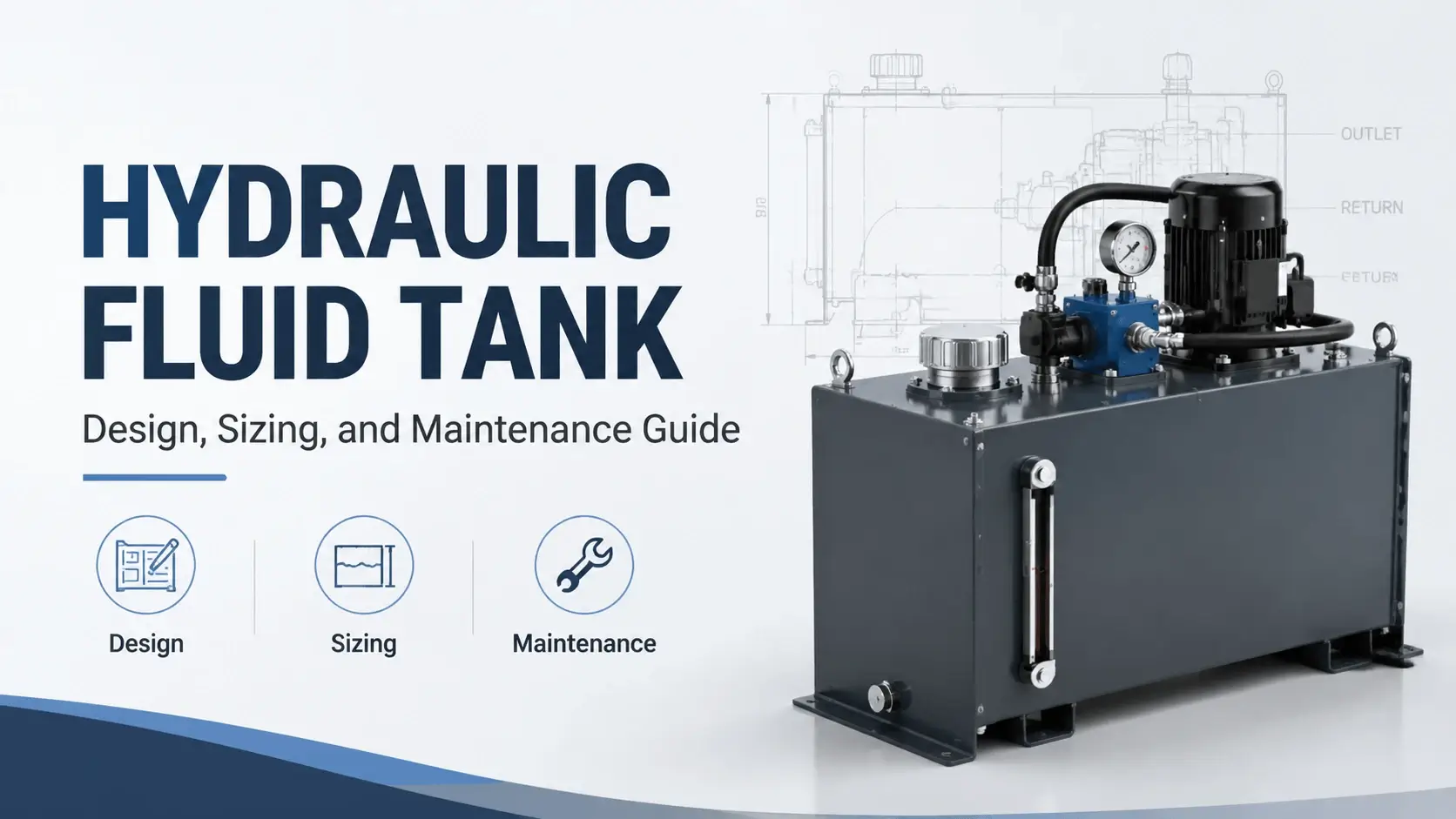
A hydraulic fluid tank does more than store oil. It cools the fluid, lets air and water separate, gives contaminants a place to settle, and feeds clean oil back to the pump inlet. Size it wrong and the pump cavitates, the oil runs hot, and the system loses efficiency fast. This guide covers sizing rules, internal layout, accessory selection, and the maintenance that keeps a tank working.
What a reservoir actually does
Every hydraulic fluid tank handles four jobs simultaneously. First, it holds enough fluid to supply the system plus a reserve for cylinder extension, accumulator precharge loss, and thermal expansion.
Second, it provides residence time so air bubbles rise out and particles sink to the bottom. Third, it dissipates heat through the tank walls to the surrounding air. Fourth, it maintains acceptable suction conditions at the pump inlet so the pump does not starve or pull in air.
The tradeoff between functions
Most problems trace back to a hydraulic fluid tank that handles one job well but fails at another. A tank large enough for volume might circulate fluid too fast for good air separation.
A tank with good baffles might run a return line straight down into the suction zone and stir up sediment inside a hydraulic fluid tank. Good tank design balances all four functions.
How to size a hydraulic fluid tank
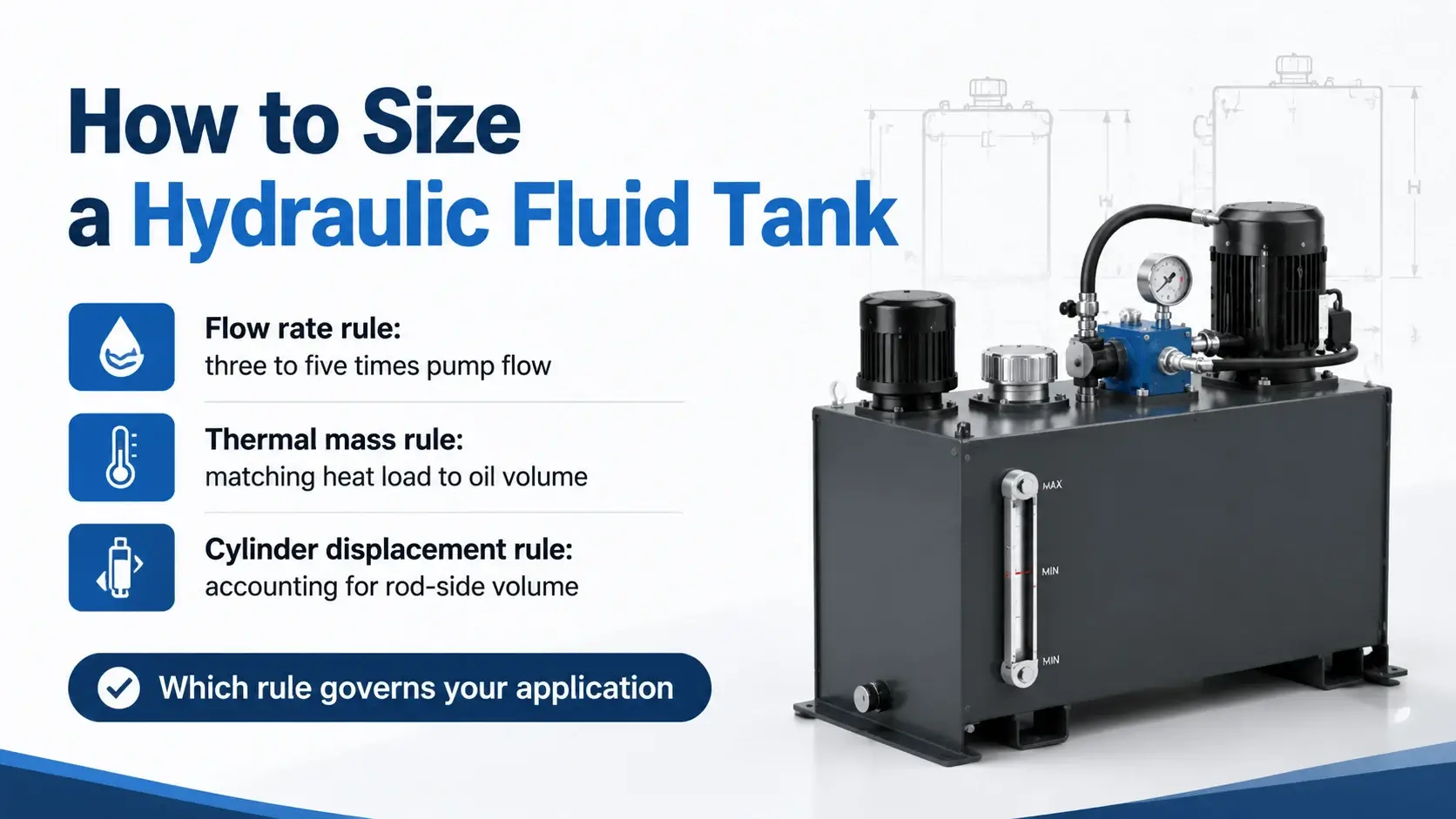
Three rules govern reservoir sizing. Pick the one that gives the largest capacity and you cover the worst case.
Flow rate rule: three to five times pump flow
The flow rate rule says the tank holds three to five times the pump flow per minute. A 60 L/min pump needs a 180-300 liter tank. This rule ensures enough residence time for air separation and cooling. Industrial systems commonly use 3x. Mobile systems where weight matters sometimes drop to 2x but pay for it with hotter oil and shorter filter life.
Thermal mass rule: matching heat load to oil volume
The thermal mass rule matters when the system generates significant heat. Calculate the heat load in kilowatts from pressure drops, pump inefficiency, and relief valve dumping. Each degree Celsius of acceptable temperature rise requires roughly 0.5-1.0 liter of oil per watt of heat load for a 30-minute operating cycle. A 5 kW heat load with a 10°C allowable rise needs 25-50 liters just for thermal buffering on top of the flow-rule capacity.
Cylinder displacement rule: accounting for rod-side volume
The cycle rule applies to systems with large cylinders. The tank must hold all the fluid that leaves the cylinders when they fully retract plus the normal working volume. A cylinder with 20 liters of rod-side displacement adds 20 liters to the minimum tank size regardless of pump flow. Ignore this rule and the tank overflows on retraction or sucks air on extension.
Which rule governs your application
For most industrial installations, the flow rule governs. Add the cylinder displacement margin and verify the result against the thermal calculation. Round up to the next standard tank size. An oversized tank costs little extra and pays back in cooler oil, longer fluid life, and fewer cavitation events.
Tank internals: baffles, diffusers, strainers, and floor slope
Baffle function and chamber division
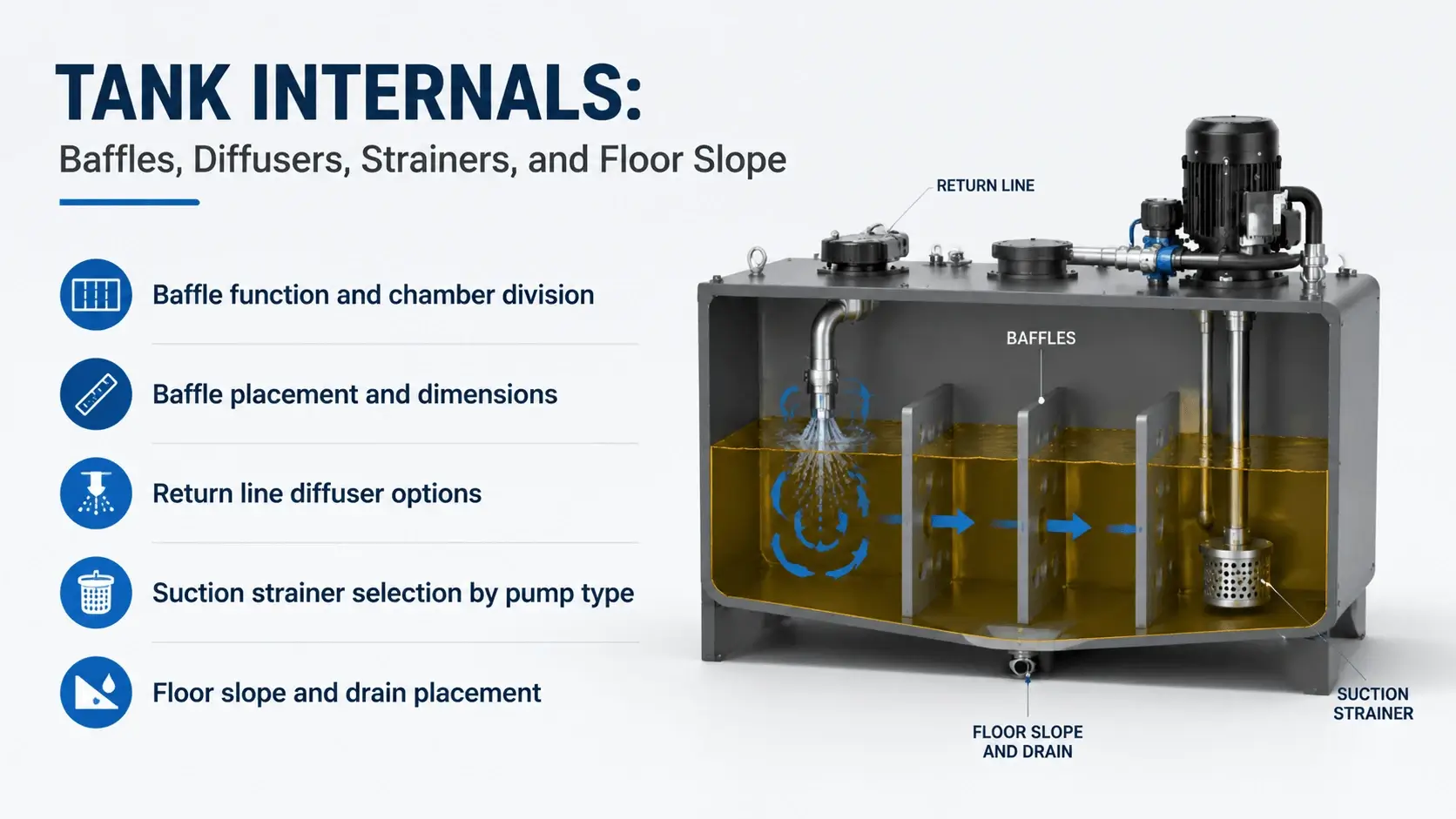
Baffles divide a reservoir into two chambers. Return oil enters one chamber. The pump draws from the other. The baffle forces fluid to travel over or around it, which adds residence time and keeps the hottest, dirtiest oil away from the pump suction.
Baffle placement and dimensions
Position the baffle at roughly two-thirds of the tank length from the end where the pump mounts. The top of the baffle sits 50-75 mm below the normal oil level so oil flows over it rather than around the ends. Drill a 10 mm weep hole near the bottom of the baffle so the tank drains completely for maintenance and so oil equalizes slowly during shutdown. Without the weep hole, the return chamber overfills during shutdown and the suction chamber runs dry on startup.
Return line diffuser options
The return line needs a diffuser where it enters the tank. A plain pipe end pointed straight down shoots a jet to the tank floor, stirs sediment, and creates a vortex that pulls air into the suction. Options range from simple to effective: cut the pipe end at a 45-degree angle and point it toward the tank wall, weld a T-fitting with the crossbar oriented horizontally, or install a commercial diffuser plate that spreads flow across a wide area. Commercial diffusers cost more but work well for flows above 100 L/min.
Suction strainer selection by pump type
Suction strainers sit inside the tank on the pump inlet line. Mesh size matters. Gear pumps tolerate 74 microns (200 mesh). Piston pumps need 150 microns (100 mesh) minimum because tighter meshes cause pressure drop and cavitation at startup when the oil is cold. Mount the strainer 50-75 mm above the tank floor so it does not suck sediment that settles there.
Floor slope and drain placement
Slope the tank floor toward the drain port at least 3 degrees. Water and heavy particles collect at the low point where the drain valve removes them. A flat floor traps water in corners and promotes rust and bacterial growth in the reservoir bottom.
Tank accessories: breathers, gauges, level switches, sensors, and magnets
Breather function and flow rating
The tank breather handles air exchange as the fluid level rises and falls. Every liter of oil that leaves the tank draws one liter of air in through the breather. That air carries dust, humidity, and particulate matter unless the breather filters it.
Select the breather flow rating based on the maximum rate of fluid level change, not the pump flow. A cylinder that extends at 10 L/min draws 10 L/min of air through the breather. A 60 L/min pump with a 3-liter accumulator might only draw 1-2 L/min during normal operation.
Size for the worst-case cylinder speed plus a safety factor of 1.5 to 2. Auto-breathers with color-indicating desiccant cartridges show when saturation occurs. Replace the cartridge when it turns from blue to pink. A flooded breather admits unfiltered air and moisture directly into the reservoir.
Level gauges and level switches
Level gauges give operators a visual check. Sight glasses with temperature markings work better than dipsticks because the operator sees both level and oil color. Level switches trigger alarms or shutdowns on low level. Magnetic float switches mount externally and last longer than internal float switches that jam with sludge.
Temperature sensor mounting position
Temperature switches or transmitters mounted on the tank wall track bulk oil temperature. Mount them in the middle of the tank height, not near the return line or the suction outlet. Oil near the return line reads 10-15°C higher than the average. Oil near the suction reads lower. Mid-height mounting gives a representative value.
Magnetic separator rods
Magnetic separator rods bolt inside the tank above the floor. They catch ferrous wear particles from pumps and cylinders. Inspect them weekly in new systems and monthly in mature ones. Cleaned rods reveal the wear rate trend. A sudden increase in ferrous debris means a component is failing upstream.
Material options for reservoirs
| Material | Pressure limit | Temp range | Cost factor | Best applications |
|---|---|---|---|---|
Mild steel (welded) |
Atmospheric |
-20 to 80°C |
1.0x |
General industrial |
Stainless steel 304 |
Atmospheric |
-40 to 250°C |
3-4x |
Food, marine, corrosive |
Aluminum |
Atmospheric |
-40 to 150°C |
2-3x |
Mobile equipment, weight-sensitive |
Polyethylene |
Atmospheric |
-20 to 70°C |
0.7-0.9x |
Small portable units, corrosive fluids |
Material selection by environment
Mild steel dominates industrial applications. Paint the interior with epoxy or oil-compatible coating to prevent rust. Stainless steel costs more but handles washdown environments, food processing, and marine salt spray without corrosion. Aluminum saves weight on mobile equipment and conducts heat faster than steel, which helps cooling. Polyethylene works for small tanks under 100 liters and resists corrosion but deforms at temperatures above 70°C and cannot hold pressure.
Construction methods: welded, formed, or molded
Welded steel tanks allow custom shapes and integrated mounting brackets. Formed sheet metal tanks cost less for standard sizes. Rotationally molded polyethylene tanks have no weld seams to leak but limited size options.
Common problems with reservoirs
Overheating from undersized capacity
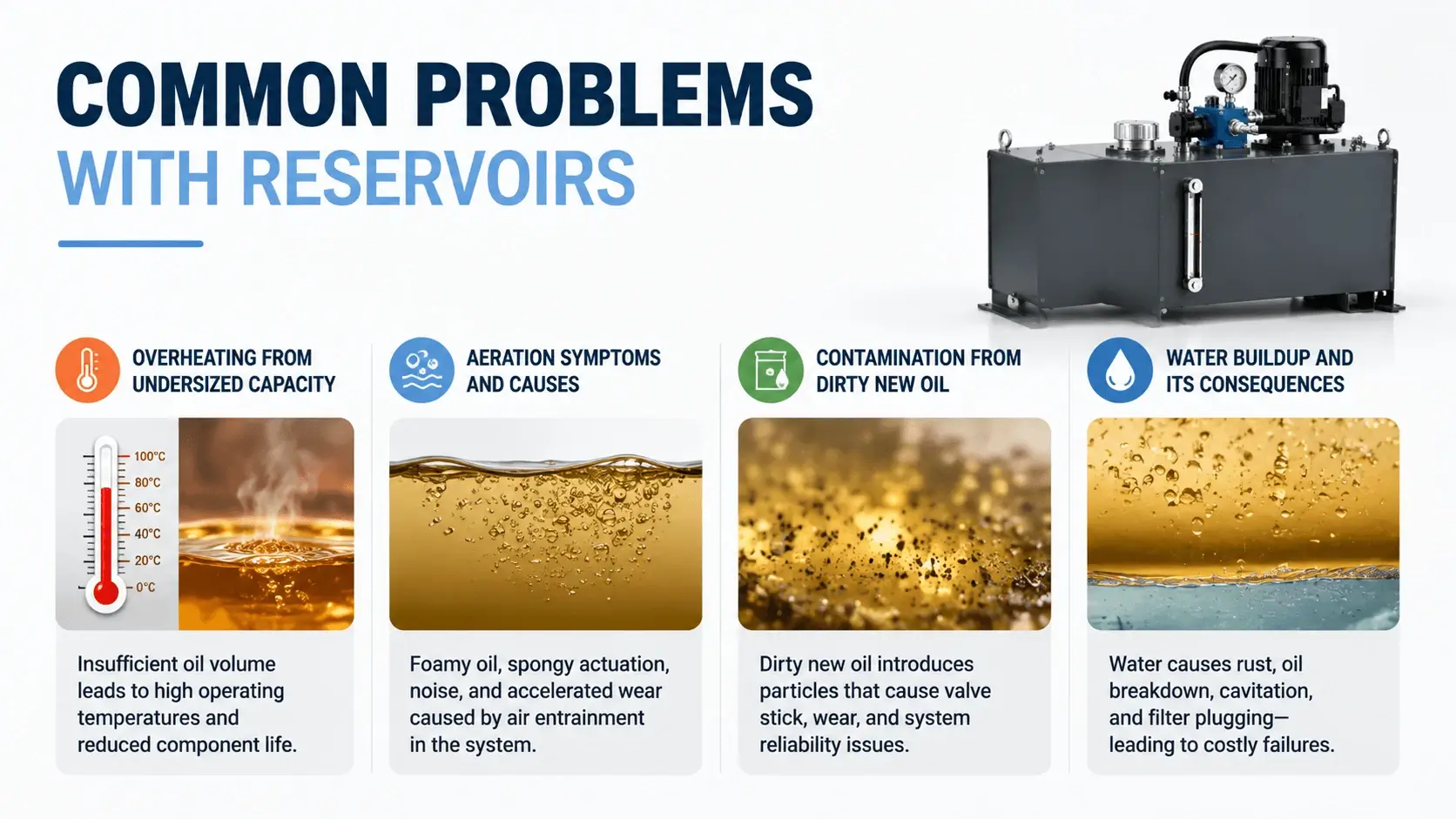
Overheating ranks first. An undersized reservoir circulates fluid too fast for effective heat rejection. The oil enters the pump at 55-60°C instead of 40-45°C. Viscosity drops, leakage increases, and the pump wears faster. Fix it by adding capacity, installing a heat exchanger, or both. Every 10°C above 55°C cuts oil life roughly in half.
Aeration symptoms and causes
Aeration ranks second. Symptoms include a milky appearance in the sight glass, spongy actuator response, and loud pump noise. Causes include a return line that shoots above the oil level, a clogged breather that creates vacuum on pump suction, or a low oil level that exposes the return pipe to air. Check the breather first. A flooded or restricted breather costs less than ten dollars to replace and fixes half of all aeration cases.
Contamination from dirty new oil
Contamination ranks third. New oil arrives dirty. Drummed mineral oil typically meets ISO 4406 22/19/16 at best. Pouring it straight into the reservoir seeds the system with particles that damage pumps and valves. Filter new oil through a portable filtration cart to 16/14/11 or better before it enters the tank. Keep the tank covered during service. Dust falls in during every minute the filler cap sits open.
Water buildup and its consequences
Water buildup causes rust, bacterial growth, and additive depletion. Water enters through the breather, through shaft seals on immersed pumps, and through condensation on cold tank walls. A well-designed reservoir with a sloped floor and bottom drain allows periodic drainage of accumulated water. Desiccant breathers reduce moisture ingress significantly compared to vent caps.
Maintenance guide for hydraulic fluid tank
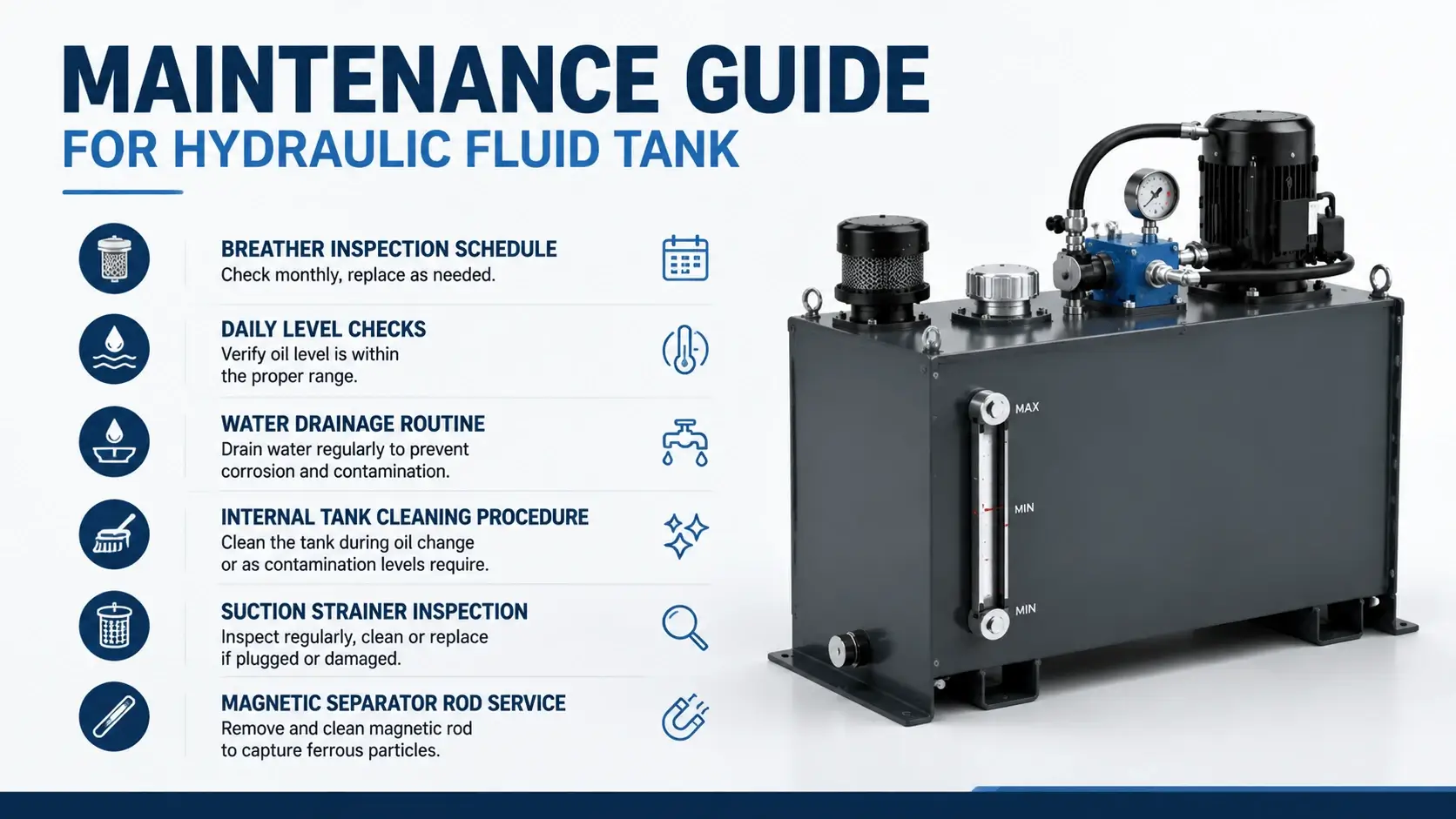
Breather inspection schedule
Inspect the breather weekly in dusty or humid environments. Replace desiccant cartridges when the indicator changes color. Clean or replace the breather element per manufacturer rating, typically every 2000 hours or when pressure drop across the element exceeds specification.
Daily level checks
Check oil level daily on critical systems. A dropping level indicates a leak somewhere. A rising level suggests water or coolant ingress from a heat exchanger. Track the trend.
Water drainage routine
Drain water from the tank bottom weekly during the first month of operation and monthly thereafter. Use a sample bottle to visually confirm water presence. Cloudy oil or a distinct water layer at the drain port means the breather, seals, or cooler need attention.
Internal tank cleaning procedure
Clean the tank internally during major overhauls or after a major component failure. Pump failure, hose rupture, or wrong-fluid contamination all require a full tank clean. Drain the oil, remove the access covers, wipe down all surfaces with lint-free cloth, and flush with clean system oil or dedicated flushing oil. Do not use solvents that leave residue or attack seal materials.
Suction strainer inspection
Inspect suction strainers at every oil change. Remove the strainer, clean it with solvent, and check the mesh for tears or blockage. A torn strainer lets large particles reach the pump. A blocked strainer causes cavitation.
Magnetic separator rod service
Replace magnetic separator rods if they show permanent magnetism loss or surface pitting. Otherwise, clean and reinstall.
Selection checklist: nine questions before you buy or build
Run through these questions before selecting a reservoir.
One, what is the pump flow rate?
Multiply by three to get the minimum tank size in liters.
Two, what is the total cylinder displacement?
Add the largest single cylinder’s rod-side volume to the minimum size.
Three, what is the system heat load?
Calculate or estimate the kilowatts and verify the tank provides adequate thermal mass.
Four, what are the space constraints?
Measure the available width, height, and depth. Tanks come in upright, flat, and L-shaped configurations.
Five, what material suits the environment?
Steel for general use, stainless for washdown or corrosive, aluminum for mobile, polyethylene for small and corrosive.
Six, what accessories are required?
Breather with desiccant, level gauge, level switch, temperature switch, magnetic separator, and suction strainer form the standard package.
Seven, how will the return line enter?
Plan for a diffuser that matches the flow rate and available space inside the tank.
Eight, what are the mounting requirements?
Integrated feet, mounting flanges, or vibration isolation pads depend on whether the tank sits on the power unit base or a separate frame.
Nine, what is the cleanliness target?
Plan for new-oil filtration, flushing procedure, and ISO 4406 verification before commissioning.
Answer these nine questions and the correct reservoir specification writes itself. Skip one and the tank either costs too much or fails in service.
FAQ
What size hydraulic fluid tank do I need?
Multiply your pump flow rate in L/min by three. Add the displacement of your largest cylinder. Verify the result handles your heat load. A 60 L/min pump with a 10-liter cylinder displacement needs at least 190 liters. Round up to 200 or 220 liters for safety margin.
Why does a reservoir need baffles?
Baffles separate the return zone from the suction zone. Without a baffle, hot, dirty, aerated return oil flows straight into the pump inlet. The baffle forces oil to take a longer path, which lets air bubbles escape, particles settle, and heat dissipate before the pump draws the oil.
How often should I replace the tank breather?
Check desiccant breathers weekly. Replace the desiccant cartridge when the color indicator shows saturation, typically every 3-6 months depending on humidity and fluid level cycling. Replace the filter element every 2000 hours or per the manufacturer’s pressure-drop specification.
Can a reservoir be too large?
Oversizing has minor drawbacks. A very large tank holds more oil than necessary, which increases initial fill cost and makes fluid changes more expensive. It also takes up more floor space. But an oversized tank runs cooler, cleaner, and with less aeration than a marginal one. The cost penalty rarely outweighs the reliability benefit.
What causes foaming in a reservoir?
Foam comes from air entrainment at the return line, low oil level exposing the return to air, contaminated fluid with degraded antifoam additives, or a suction leak that pulls air into the pump and returns it as foam. Fix the root cause rather than adding more antifoam additive, which masks the problem temporarily.
Where should the temperature sensor be mounted on a reservoir?
Mount it at mid-tank height, away from the return line entry and the suction outlet. Return-zone oil reads artificially high. Suction-zone oil reads low. Mid-height gives the true average temperature that the pump actually experiences.
Conclusion
A hydraulic fluid tank determines whether a hydraulic system runs cool and clean or hot and contaminated. Size it using the flow rule, add the cylinder displacement margin, and verify against the thermal load. Install a baffle, a proper return diffuser, a correctly sized suction strainer, and a desiccant breather. Maintain it with regular breather checks, water drainage, and strainer inspections.
Most tank problems cost little to prevent and much to ignore. A twenty-dollar breather replacement stops thousands of dollars in pump wear. A weekly water drain prevents tank-bottom rust that contaminates the entire system. Get the tank right and the rest of the system lasts longer.