
Double Acting Hydraulic Cylinder Guide for Engineers

Double Acting Hydraulic Cylinder Guide for Engineers and Buyers

Table of Contents

Introduction

A press platen that creeps down during hold time usually tells a simple story. The cylinder, valve, or load circuit no longer controls oil the way the designer expected.
 
A double acting hydraulic cylinder sits at the center of many of those machines. It can push, pull, stop, and hold a position. The circuit must give it clean oil, enough pressure, and a fair load path.
 
The mistake I see most often is treating the cylinder like a catalog line item. Bore, stroke, and pressure matter. Mounting geometry, rod diameter, seal material, cushioning, and port size matter too. So does the dirt that reaches the rod every shift.

What is a Double Acting Hydraulic Cylinder

A double acting hydraulic cylinder uses pressurized oil on both sides of a piston. Oil entering the cap end extends the rod. Oil entering the rod end retracts it.
 
That two-way control separates it from a single-acting cylinder. A single-acting design relies on a spring, gravity, or outside load for return. A double-acting design uses hydraulic power in both directions.
 
This matters when a machine must pull as well as push. Common examples include a press slide, mold clamp, steering system, log splitter return stroke, or lifting arm with controlled lowering.

How It Works

A directional valve sends oil to one side of the piston and opens the other side to the tank. The piston moves because pressure acts on an area.
 
The extension force depends on full bore area. Retraction force depends on annulus area, because the rod takes up part of the piston face. That is why the same pressure produces less pulling force than pushing force.
 
Speed follows the same logic. The cylinder extends at the flow divided by the bore area. It retracts faster with the same flow because the rod end has less volume.

Main Components of Double Acting Hydraulic Cylinder
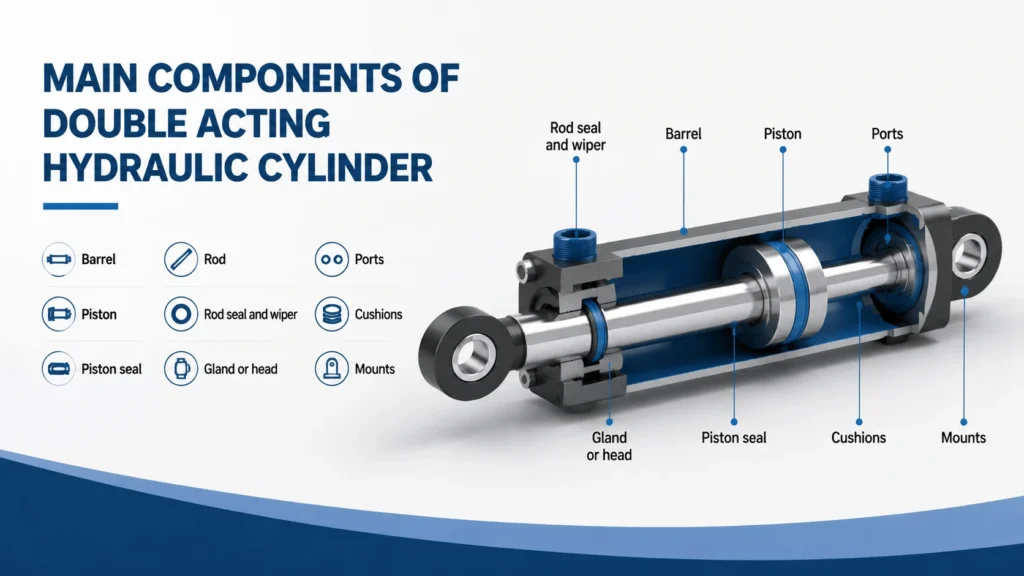
Main Components of Double Acting Hydraulic Cylinder
Component What it does What to check
Barrel
Guides the piston and contains pressure
Tube finish, wall thickness, straightness
Piston
Separates cap-end oil from rod-end oil
Seal grooves, wear band fit, piston nut security
Piston seal
Controls internal leakage
Seal type, temperature range, oil compatibility
Rod
Transfers force to the machine
Diameter, chrome finish, buckling margin
Rod seal and wiper
Keep oil in and dirt out
Dirt load, rod damage, seal material
Gland or head
Supports the rod and seals the open end
Bearing length, gland retention, service access
Ports
Move oil in and out
Port type, size, orientation, pressure drop
Cushions
Slow the piston near stroke end
Speed, load mass, adjustment range
Mounts
Connect cylinder force to the frame
Pin fit, alignment, side load risk
Most field problems start at the seal, rod, or mount. The barrel gets the blame, but side loading and contamination often start the damage.

Typical Pressure and Flow Ranges

Most industrial double-acting cylinders work around 1,500 to 3,000 psi, or about 100 to 210 bar. Many mobile machines run near 2,500 to 3,500 psi.
 
Heavy mill-type and specialty cylinders can run higher. The supplier should confirm the pressure rating, proof pressure, burst margin, and test method. Do not match a 3,000 psi pump to a cylinder just because the bore looks right.
 
Flow controls speed, not force. If a cylinder feels too slow, check valve capacity, hose size, and port size before blaming the pump.

Advantages

A double acting hydraulic cylinder gives controlled force in both directions. That helps with clamps, presses, lifts, excavator attachments, injection molding machines, and test rigs.
 
The design also gives better cycle control than gravity return. Operators can slow a load near the stroke end and retract under load. The right valve arrangement can also hold position.
 
Another practical advantage is compact force. Hydraulics can deliver high linear force from a smaller package than many electric actuators. That still depends on duty cycle, cooling, seal friction, and oil quality.

Limitations and Trade-Offs

The cylinder will not forgive bad alignment. Side load bends rods, wears glands, and scores barrels. A clevis mount can help with angular movement, but it cannot fix a twisted frame.
Leakage also changes the conversation. External leakage makes a mess and raises safety concerns. Internal leakage lets the piston drift or lose holding force, even when the pump sounds healthy.
 
Maintenance teams should also think about heat. High cycle rates, undersized lines, and restrictive valves turn flow into heat. Hot oil shortens seal life and thins the oil film on the rod.

Industrial Applications of Double Acting Hydraulic Cylinder
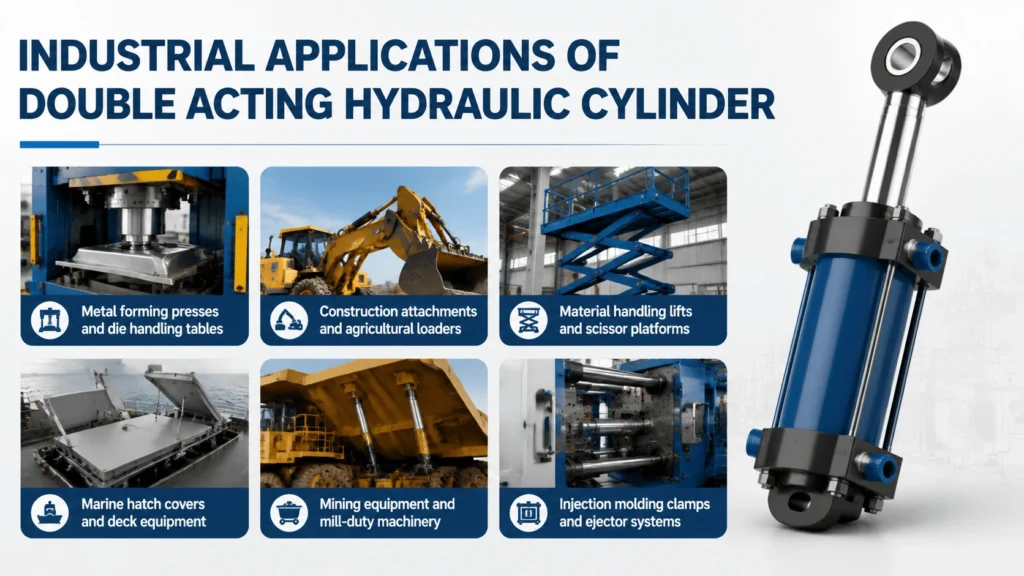
Industrial Applications of Double Acting Hydraulic Cylinder

Plants and OEMs use double acting cylinders anywhere they need powered extension and powered return.

  • Metal forming presses and die handling tables
  • Construction attachments and agricultural loaders
  • Material handling lifts and scissor platforms
  • Marine hatch covers and deck equipment
  • Mining equipment and mill-duty machinery
  • Injection molding clamps and ejector systems

For dirty outdoor equipment, protect the rod and wiper. For high-cycle factory machines, focus on heat, seals, and cushion tuning. For heavy presses, check column alignment and frame deflection before blaming the cylinder.

Common Problems and Causes

Symptom Likely cause Field check
Cylinder drifts
Internal piston seal leakage or valve leakage
Isolate the cylinder from the valve, then watch movement
Rod seal leaks
Rod damage, dirt, overpressure, worn bushing
Inspect rod chrome and gland
Slow movement
Low flow, restricted port, undersized hose, air in oil
Compare flow at valve and cylinder
Jerky movement
Air, sticky seals, side load, poor lubrication
Bleed the circuit and inspect mounts
Rod bends
Overload, long stroke, poor guidance
Recheck buckling load and alignment
End impact
No cushion, wrong cushion setting, high speed
Adjust cushion or add deceleration control

A quick field rule helps. If the same failure returns after a seal change, the seal was probably the victim. The root cause sits upstream.

Troubleshooting Guide

Start with the symptom, then separate the cylinder from the circuit. A drift problem can come from piston seals, a load-holding valve, a directional valve, or thermal expansion.

Check the easy items early. Look for scored rod chrome, loose pins, dry bearings, damaged wipers, low oil level, foaming oil, and hot return lines.

If the machine runs after a seal change and fails again in a month, ask why the seal died. Rod side load, contaminated oil, overpressure spikes, and rough tube finish can all ruin a new seal.

Selection Guide

Match the cylinder to the load case and pump pressure.

  1. Calculate the push force from the bore area and pressure.
  2. Calculate the pull force from the annulus area and pressure.
  3. Check rod buckling for long strokes and compression loads.
  4. Choose a mount that lets the load move naturally.
  5. Size ports and hoses for speed without excess pressure drop.
  6. Choose seals for oil type, temperature, and contamination level.
  7. Add cushions when high speed meets hard end stops.
  8. Confirm stroke tolerance, rod finish, paint, test reports, and lead time.

A quick sizing note helps buyers avoid a common mistake. A 4-inch bore at 3,000 psi can push about 37,700 lbf before losses. The same cylinder with a 2 inch rod pulls about 28,300 lbf. The rod area matters.

Single Acting vs Double Acting Hydraulic Cylinder
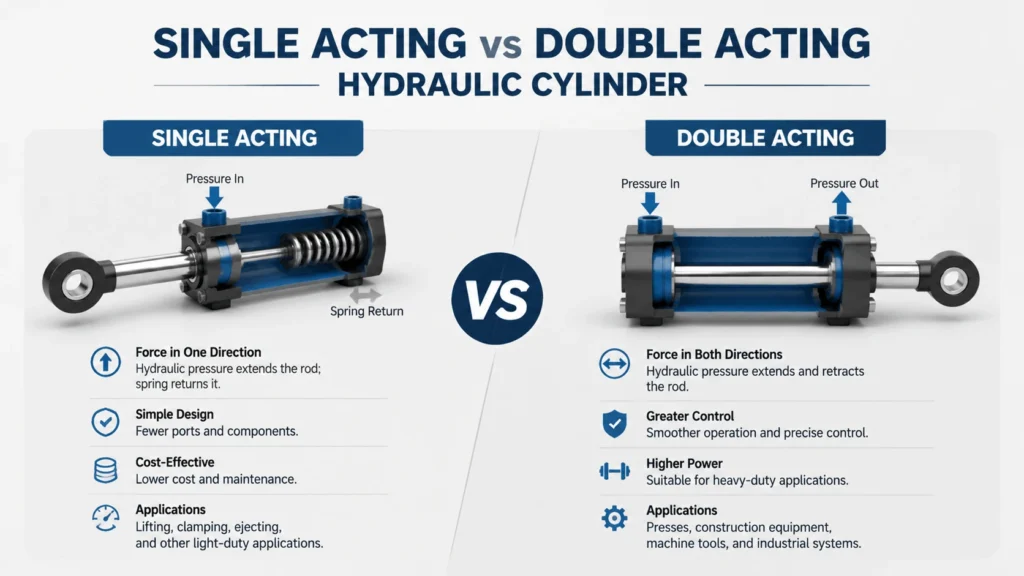
Single Acting vs Double Acting Hydraulic Cylinder
Feature Single acting cylinder Double acting cylinder
Power direction
One hydraulic direction
Hydraulic extension and retraction
Return method
Spring, gravity, or outside load
Pressurized oil
Circuit needs
Simpler valve and hose layout
More valve and hose work
Best fit
Lift, dump, simple return
Clamps, presses, steering, positioning
Risk area
Weak return force
More seals and ports to manage
A single acting cylinder still has a place. It often costs less and works well on simple vertical lifts. Choose double acting when the machine needs force, speed, or control in both directions.

Procurement Notes

A good RFQ gives the supplier enough detail to protect you from assumptions. Include bore, rod, stroke, pressure, speed, mount, port type, oil, temperature, environment, duty cycle, and target standard.
Ask which series matches ISO 6020, ISO 6022, NFPA, or the OEM drawing. Standards help with envelope dimensions and replacement planning, but they do not remove the need for a real load review.
For replacement cylinders, send photos of mounts and ports. Add pin diameters, closed length, open length, and any cushion details. A small port rotation error can turn into hours of rework on site.

Maintenance Tips

Keep the rod clean, straight, and protected. The rod carries dirt straight to the wiper, then to the rod seal, then into the gland area.
Change filters before the oil looks bad. A cylinder may survive a short overload, but abrasive particles keep cutting every stroke.
Watch pin wear too. A loose pin changes the load path and adds side load. Many leaking rod seals started with a cheap bushing that ran too long.
Document seal changes, oil temperature, and failures by machine hour. Patterns show up faster when the technician has more than a memory and a parts invoice.

FAQ

What does a double acting hydraulic cylinder do?

It converts hydraulic pressure into linear motion in two directions. Oil pressure extends the rod and retracts it, so the machine can push and pull under control.

Why is retraction force lower than extension force?

The rod reduces the pressure area on the rod side. The same oil pressure acts on a smaller area, so pull force drops.

Can a double acting cylinder hold a load?

Yes, if the circuit supports it. Use a suitable load-holding valve, good piston seals, and a structure that does not side-load the rod.

What causes a double acting cylinder to drift?

Piston seal leakage, valve leakage, thermal expansion, or external load changes can cause drift. Isolate the cylinder from the valve to narrow the cause.

How do I choose the right bore size?

Start with required force, then divide by available pressure. Add a margin for losses, friction, and pressure drop, then check rod buckling and mounting loads.

How long should a hydraulic cylinder last?

Clean oil, good alignment, and a protected rod can give years of service. Dirty oil or side load can shorten seal life fast.

Conclusion

A double acting hydraulic cylinder looks simple from the outside. In the machine, it behaves like a load-bearing structure and a pressure vessel. It also acts as a motion control device.
The best specifications come from the actual job. Define the force, stroke, speed, mounting, environment, and duty cycle before you compare prices. That small amount of work usually costs less than one failed changeout.


Related Articles

Scroll to Top
Shoot Us An Email

Professional Manufacturer