
This guide covers the four high speed hydraulic motor families: gear, vane, axial piston, and bent-axis piston. You will get real speed bands, torque and power math, and the failure rules that catalogs understate. The goal is simple. You should be able to size a motor, pick a type, and keep it alive once it bolts to your machine.
What is a High Speed Hydraulic Motor?
A high speed hydraulic motor converts pressurized fluid flow into continuous rotational output at speeds from roughly 500 to 8,000 rpm. It pairs with a pump that feeds it flow, and it delivers torque at the shaft. The “high speed” label separates it from low-speed high-torque (LSHT) motors, which turn at 10 to 500 rpm.
Most high-speed motors are fixed-displacement. You feed them more flow, and they spin faster. You raise pressure, and they make more torque. The work happens inside a gear set, a vane cartridge, or a piston barrel. Each design trades cost, efficiency, pressure rating, and top speed differently.
How a High Speed Hydraulic Motor Works
Pressurized oil enters the motor port and pushes against an internal rotating member. In a gear motor, oil pushes two gears apart and forces them to turn. In a vane motor, oil acts on vanes sticking out of a rotor. In a piston motor, oil pushes pistons that ride against an angled plate.
The angled plate is the trick. A flat plate produces no rotation. Tilt the plate, and each piston stroke creates a force component tangent to the shaft. That tangent force becomes torque. The barrel spins, the shaft spins, and the oil exits at low pressure through the return port.
Every motor leaks internally as it runs. The leakage, called case drain flow, exits through a third port. You must plumb that port back to the tank. Block it, and the shaft seal blows out in minutes.
High Speed vs Low-Speed High-Torque (LSHT) Motors
Engineers often ask whether a high-speed motor plus a gearbox can replace an LSHT motor. Sometimes it can. The trade-off matters.
| Factor | High speed motor | LSHT motor (geroler/radial piston) |
|---|---|---|
Speed range |
500–8,000 rpm |
10–500 rpm |
Torque density |
Low to medium |
High |
Typical pressure |
100–450 bar |
150–350 bar |
Needs a gearbox |
Often yes |
Rarely |
Efficiency at rated speed |
85–95% |
75–88% |
Cost |
Lower |
Higher |
Noise at full speed |
Higher |
Lower |
The high-speed-plus-gearbox package usually wins on efficiency and cost. It loses on package size and on the extra maintenance a gearbox brings. If your load already spins fast, skip the LSHT motor entirely.
Types of High Speed Hydraulic Motors
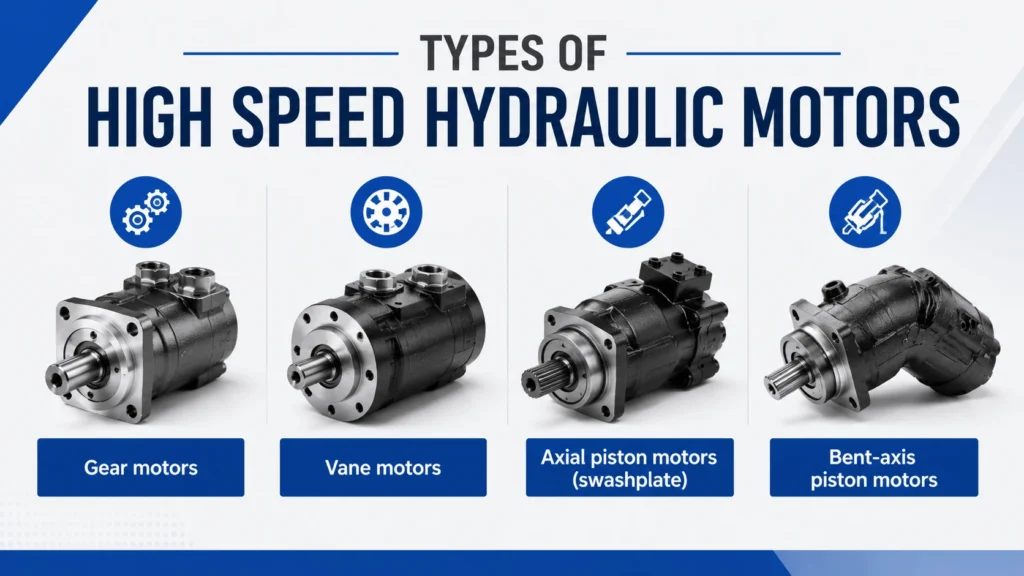
Gear motors
Gear motors use two meshing gears in a housing. Oil enters, pushes the gears apart, and exits. They are the cheapest and simplest high-speed motor. External-gear types run 500 to 3,000 rpm at 100 to 250 bar. Internal-gear types run quieter and slower.
Volumetric efficiency lands around 80 to 90%. That number drops fast as oil thins and clearances open with wear. Gear motors suit conveyors, fans, and low-pressure circulation loops. They struggle when you need precise speed control or high starting torque.
Vane motors
Vane motors use a rotor with sliding vanes inside an eccentric ring. Oil pressure pushes the vanes out and turns the rotor. They run 100 to 4,000 rpm at 100 to 210 bar. Volumetric efficiency sits at 85 to 92%.
Vane motors run smoothly and quietly. The vane tip wear is gradual, so performance decays slowly rather than failing abruptly. They suit industrial machinery, packaging equipment, and low-noise drives. Keep the oil clean. Vane tip scoring kills efficiency fast.
Axial piston motors (swashplate)
Swashplate axial piston motors use a rotating barrel with pistons that ride against a tilted plate. The tilt angle sets the stroke. A fixed-angle plate gives fixed displacement. A variable-angle plate gives variable displacement, which lets you change speed without changing flow.
These motors run 500 to 5,000 rpm at 250 to 450 bar. Volumetric efficiency reaches 92 to 98%. They cost more than gear or vane motors but pay it back in efficiency and pressure. They suit mobile machinery, winches, and closed-circuit drives.
Bent-axis piston motors
Bent-axis motors angle the whole piston barrel relative to the shaft. The pistons stroke as the barrel turns. The bend angle runs 25 to 45 degrees. A bigger angle means more displacement and more torque per revolution
Bent-axis motors lead the pack. They run 1,000 to 8,000 rpm at 350 to 450 bar, with peaks to 700 bar. Volumetric efficiency hits 95 to 98%. They cost the most and reward you with the highest speed, the best efficiency, and the longest bearing life at speed. Dynamometers, spindle drives, and marine propulsion use them.
Key Specifications and What They Mean
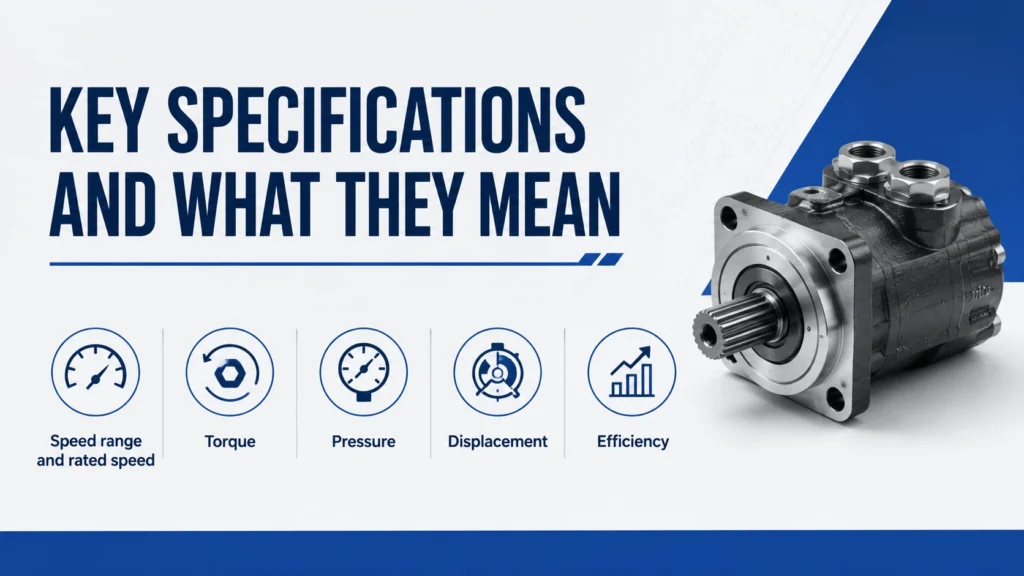
Speed range and rated speed
Rated speed is the rpm a motor turns at rated flow and rated pressure. Continuous rated speed is what the motor can sustain all day. Intermittent speed is higher but time-limited. Minimum speed is where the motor still turns smoothly without cogging. Most catalogs list all three.
At high speed, the motor’s own internal parts move fast. Piston pull-back, vane tip force, and gear tooth fill all depend on speed. Exceed the rated speed and the motor chokes, cavitates, or sheds parts. Stay inside the band.
Torque
Torque is the rotational force at the shaft. Theoretical torque equals displacement times pressure divided by two pi. Actual torque equals theoretical torque times mechanical efficiency. More displacement or more pressure means more torque. More speed at constant flow means the same torque but more power.
Starting torque matters for loads that begin under load. Piston motors deliver 85 to 95% of running torque at start. Gear and vane motors deliver 70 to 85%. If your load needs full breakaway torque, pick a piston motor.
Pressure
Pressure rating splits into continuous, intermittent, and peak. Continuous is the all-day rating. Intermittent covers short bursts. Peak is the maximum the housing survives without bursting. Always size to continuous pressure. Intermittent and peak are for transients, not steady operation.
High-speed piston motors run 350 to 450 bar continuously. Gear and vane motors run 100 to 250 bar. The pressure rating sets the torque ceiling. Exceed it and you either stall the motor or blow a seal.
Displacement
Displacement is the oil volume the motor consumes per shaft revolution, in cc/rev. Small displacement means high speed and low torque. Large displacement means low speed and high torque. Most high-speed motors range from 5 to 500 cc/rev.
Pick a displacement to match your load. Too small, and the motor spins fast but cannot lift the load. Too large, and the motor makes torque, but cannot reach the speed you need without exceeding the pump flow. Displacement is the first number you fix.
Efficiency
Three efficiency numbers matter. Volumetric efficiency is how much flow becomes rotation versus leakage. Mechanical efficiency is how much pressure becomes torque versus friction. Overall efficiency is their product. High-speed piston motors reach 90 to 95% overall. Gear motors land at 80 to 88%.
Efficiency drops as oil thins, pressure rises, and parts wear. A motor that runs 92% efficient at 40 cSt may drop to 85% at 20 cSt. Hot oil leaks past clearances faster. That leakage shows up as case drain flow and as lost speed.
Sizing a High Speed Hydraulic Motor
Sizing follows three formulas. Learn them, and you size any motor.
Theoretical torque: T = (Vg × Δp) / (20π), where T is in N·m, Vg is displacement in cc/rev, and Δp is pressure differential in bar. A 25 cc/rev motor at 300 bar makes (25 × 300) / 62.8 = 119 N·m.
Theoretical speed: n = (Q × 1000) / Vg, where n is rpm, Q is flow in L/min, and Vg is cc/rev. Feed that 25 cc/rev motor 75 L/min, and it spins (75 × 1000) / 25 = 3,000 rpm.
Hydraulic power: P_h = (p × Q) / 600, where P_h is kW, p is bar, and Q is L/min. At 300 bar and 75 L/min, hydraulic power is 37.5 kW. Output power equals hydraulic power times overall efficiency. At 92% efficiency, the shaft delivers 34.5 kW.
Always derate. Run the motor at 80 to 90% of rated pressure and speed. The last 10% costs you bearing life and efficiency out of proportion to the gain.
Cavitation: The Number-One High-Speed Killer
Cavitation happens when the inlet pressure falls below the oil’s vapor pressure. Bubbles form in the oil. They collapse when they reach the high-pressure zone. Each collapse hammers the metal surface. Over hours, the surface pits and erodes.
High speed makes cavitation worse. The motor tries to fill its chambers faster. If the suction line cannot deliver, the chamber fills only partway. The next stroke pulls a partial vacuum. Bubbles form. The damage begins.
Watch for these signs. The motor whines or rattles. Speed drops under load. The oil foams in the tank. The motor case runs hotter than normal. Fix the inlet before the metal fails. Open the suction line, add a charge pump, or reduce the speed.
Case Drain Flow and Shaft Seal Protection
Every high-speed piston motor leaks internally. That leakage exists through the case drain port. A typical bent-axis motor at 350 bar drains 2 to 8 L/min. The drain carries hot oil away from the case, which helps cool the motor.
The case drain line must return to the tank with low back pressure. Most motor shaft seals survive only 1 to 5 bar of case pressure. Exceed that and the seal pushes out. Oil sprays from the shaft. A blocked or undersized drain line causes the failure.
Plumb the drain line full bore to tank, with no sharp bends and no shared returns that can pressurize. If the drain must run uphill or through a cooler, check the back pressure at the case. Add a separate drain line if the shared return exceeds 2 bar.
Bearing Life at Speed
Speed shortens bearing life. The relationship is cubic, not linear. Double the speed, and you cut bearing life roughly eight times. A motor rated for 10,000 hours at 1,500 rpm may deliver 1,200 hours at 4,000 rpm. This is why overspeed kills motors fast.
Bearing life uses the L10 rating. L10 is the life at which 90% of a batch of bearings survive. Catalogs quote L10 at rated load and rated speed. Real life depends on your actual load, speed, and oil cleanliness. Dirty oil shortens L10 by half or more.
If your duty cycle runs near top speed, ask the supplier for the L10 under your conditions. Many catalogs bury this number. It tells you how often you will rebuild the motor. Plan the maintenance schedule around it, not around wishful thinking.
Oil Cleanliness Requirements
High speed means tight clearances. Tight clearances mean dirty oil destroys the motor fast. Gear and vane motors want ISO 4406 19/17/14. Axial and bent-axis piston motors want 18/16/13 or cleaner. Test rigs and servo-grade piston motors demand 15/13/11.
Use a return-line filter rated to the motor’s cleanliness target. Add a pressure filter if the circuit runs a servo or proportional valve. Check the oil with patch sampling every three months. A single batch of dirty oil can score a high-speed motor in one shift.
Oil viscosity matters too. Most high-speed motors want 30 to 50 cSt at operating temperature. Thin oil leaks past clearances and drops efficiency. Thick oil starves the inlet and causes cavitation. Match the oil grade to the motor’s viscosity band.
Mounting and Porting Standards
High-speed motors mount to standard flanges. ISO 3019-1 defines metric flanges. SAE J744 defines inch flanges. Both give a bolt pattern, a pilot diameter, and a shaft end spec. Match the flange to your housing and the shaft to your coupling.
Ports follow SAE J1926 (inch, 4-bolt split flange) or ISO 6149 (metric, O-ring boss). CETOP mounting plates suit European-built manifolds. Pick one standard per machine and stick to it. Mixed standards make spare parts a nightmare.
Work ports run at full system pressure. Case drain ports run at low pressure. Do not swap them. A work port line on the drain fitting pressurizes the case and blows the seal instantly. Label every line during assembly.
Common Failure Modes
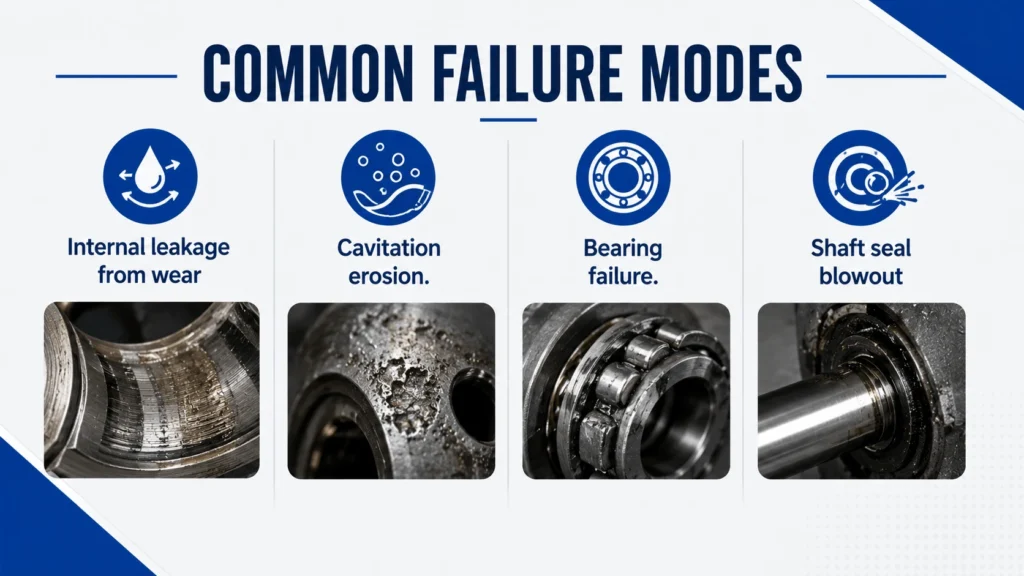
High-speed motors fail in predictable ways. Learn the patterns, and you catch problems early. Internal leakage from wear. Gear teeth, vane tips, and piston bores wear over time. Clearance opens. Oil leaks past the working surface. Speed drops at constant flow. Torque drops at constant pressure. Case drain flow rises. The motor still runs, just weaker.
Cavitation erosion. Inlet starvation pits the gear teeth or piston faces. The damage looks like dull, frosted patches. The motor gets louder. Efficiency drops. Fix the inlet or the new motor fails the same way.
Bearing failure. Pitting, spalling, or brinelling on the bearing races. The motor vibrates. Noise rises with speed. Oil shows metal particles. Replace the bearing before it seizes and wrecks the whole motor.
Shaft seal blowout. Case drain back pressure exceeds the seal rating. Oil leaks from the shaft. Check the drain line for blockage. Fix the line before you replace the seal, or the new seal blows too.
Troubleshooting Guide
| Symptom | Likely cause | Check first | Fix |
|---|---|---|---|
Motor runs slow |
Internal wear, low flow, relief bypassing |
Measure flow at motor inlet |
Rebuild or replace motor; fix pump or relief |
Motor will not start |
Low pressure, air in system, broken shaft |
Check pressure at inlet |
Bleed air; repair shaft; verify relief setting |
Loud whine or rattle |
Cavitation |
Suction line size, charge pressure |
Open inlet; add charge pump; reduce speed |
Oil leak at shaft |
Case drain blocked or undersized |
Back pressure at case drain |
Rerun drain line full bore to tank |
Excessive heat |
Low efficiency, high drain flow, thin oil |
Oil temperature and viscosity |
Change oil grade; rebuild worn motor |
Vibration rises with speed |
Bearing wear, misalignment, coupling |
Vibration at bearing housing |
Replace bearing; realign coupling |
Speed surges under load |
Relief chattering, air in oil, worn parts |
Relief valve operation |
Clean or replace relief; bleed system |
Case runs hotter than tank |
High drain flow from wear |
Drain flow rate vs catalog |
Rebuild motor; check oil cleanliness |
How to Select the Right High Speed Hydraulic Motor
Start with the load. You need three numbers. The torque the load demands. The speed it needs to turn. The duty cycle, continuous or intermittent. Get these before you look at a catalog.
Match displacement to the torque-speed pair. Use the torque and speed formulas from section 7. Try two or three displacements and compare. The right displacement lets the motor run at 70 to 85% of rated speed at your working pressure.
Pick a type by pressure and efficiency. Under 210 bar and 3,000 rpm, a gear or vane motor works and saves money. Above 250 bar or 4,000 rpm, move to a piston motor. Above 5,000 rpm or needing peak efficiency, choose a bent-axis design.
Check the case drain, bearing life, and cleanliness target against your system. A motor that needs ISO 15/13/11 oil will not survive in a system that runs 22/20/17. Either upgrade the filtration or pick a more tolerant motor.
Maintenance Best Practices
Check the case drain flow monthly. Compare it to the catalog value for your pressure and speed. A rising drain flow signals wear before the motor fails. Catch it early and you schedule the rebuild instead of responding to a breakdown.
Sample the oil every three months. Send it to a lab for particle count and metals analysis. High iron means bearing or gear wear. High copper means bushing wear. Trend the numbers. A sudden jump tells you something changed.
Measure motor temperature with a contact probe on the case. Compare it to tank temperature. A motor that runs 20°C above the tank has high internal leakage. It wastes energy and cooks the oil. Find the cause before the heat hardens the seals.
Inspect the coupling and shaft seal every service interval. A worn coupling misaligns the shaft and loads the bearing. A weeping seal admits dirt and loses oil. Both shorten bearing life. Replace them on schedule, not after they fail.
Industrial Applications
High-speed hydraulic motors drive anything that spins fast. Cooling fans on engines and hydraulic systems run gear or vane motors at 1,500 to 3,000 rpm. The motor turns the fan, and a thermostatic valve controls speed.
Centrifugal pumps and blowers use high-speed motors when electric drives are impractical or hazardous. A piston motor at 3,000 rpm drives a pump that moves fluid or gas in a remote or explosive environment.
Test rigs and dynamometers use bent-axis piston motors to absorb or deliver power at 4,000 to 8,000 rpm. The motor’s high efficiency and speed range suit the precision these rigs need. Marine propulsion water jets use the same motors for the same reasons.
Forestry and agricultural equipment drives saws, cutters, and spreaders through high-speed motors paired with gearboxes. The motor runs fast and efficient. The gearbox delivers the final torque the load demands.
FAQ
What is a high speed hydraulic motor?
A high speed hydraulic motor is a hydraulic motor that runs at 500 to 8,000 rpm. It converts pressurized oil flow into continuous shaft rotation. Gear, vane, axial piston, and bent-axis piston designs cover the range. It contrasts with low-speed high-torque motors, which run at 10 to 500 rpm.
What is the difference between high-speed and LSHT hydraulic motors?
High-speed motors run fast and deliver moderate torque. They often need a gearbox to drive a slow load. LSHT motors run slowly and deliver high torque directly. High-speed packages cost less and run more efficiently. LSHT packages are simpler and more compact.
How fast can a hydraulic motor spin?
Gear and vane motors reach 3,000 to 4,000 rpm. Swashplate axial piston motors reach 5,000 rpm. Bent-axis piston motors reach 8,000 rpm or more. The limit comes from inlet fill, bearing life, and internal part forces, not from the catalog top number alone.
How do I size a high speed hydraulic motor?
Start with the torque and speed your load needs. Use torque equals displacement times pressure over two pi. Use speed equals flow times 1000 over displacement. Pick a displacement that lands the motor at 70 to 85% of rated speed at your working pressure.
What causes cavitation in a high speed hydraulic motor?
Cavitation comes from inlet starvation. The motor tries to fill its chambers faster than the suction line can supply oil. Pressure drops below the oil’s vapor pressure. Bubbles form and collapse. The collapse erodes the metal. Causes include small inlet lines, low charge pressure, and excessive speed.
Which hydraulic motor type is most efficient at high speed?
Bent-axis piston motors. They reach 95 to 98% volumetric efficiency and sustain it at 5,000 rpm and above. Swashplate axial piston motors follow at 92 to 98% but cap at a lower speed. Gear and vane motors trail at 80 to 92% and lose efficiency faster as they wear.
What is case drain flow and why does it matter?
Case drain flow is the internal leakage that exits a piston motor through its case drain port. It carries hot oil away and cools the motor. The drain line must return to the tank at low back pressure. Case pressure above 1 to 5 bar blows the shaft seal. A blocked drain line causes the failure.
Conclusion
A high speed hydraulic motor rewards the engineer who sizes it right and punishes the one who guesses. The speed band, the torque formula, and the cavitation limit define the job. The case drain rule and the bearing life curve define the maintenance. Pick the type that matches your pressure and speed. Run it at 80% of the rating. Keep the oil clean, the inlet fed, and the drain open. The motor will run for years. Ignore any of that, and it will fail before the warranty expires. The math is simple. The discipline is not.
Our hydraulic engineers help OEMs and maintenance teams select, size, and source high-speed hydraulic motors for fan drives, pump drives, test rigs, and marine propulsion. Send us your load torque, target speed, duty cycle, and available pump flow. We will return a motor recommendation with displacement, type, pressure rating, case drain plumbing, and the L10 bearing life at your conditions. Contact the engineering team today.