
Introduction
Mobile equipment runs on a hydraulic axial piston pump. Your excavator, wheel loader, and crawler drill all use them. They pair high pressure with high flow at a speed gear and vane pumps cannot match.
This guide covers working principles, swashplate versus bent-axis types, open versus closed circuits, and selection. We wrote it for engineers who size and maintain these pumps. Real numbers follow: pressure bands, flow ranges, efficiency targets, and cleanliness rules.
What is a Hydraulic Axial Piston Pump
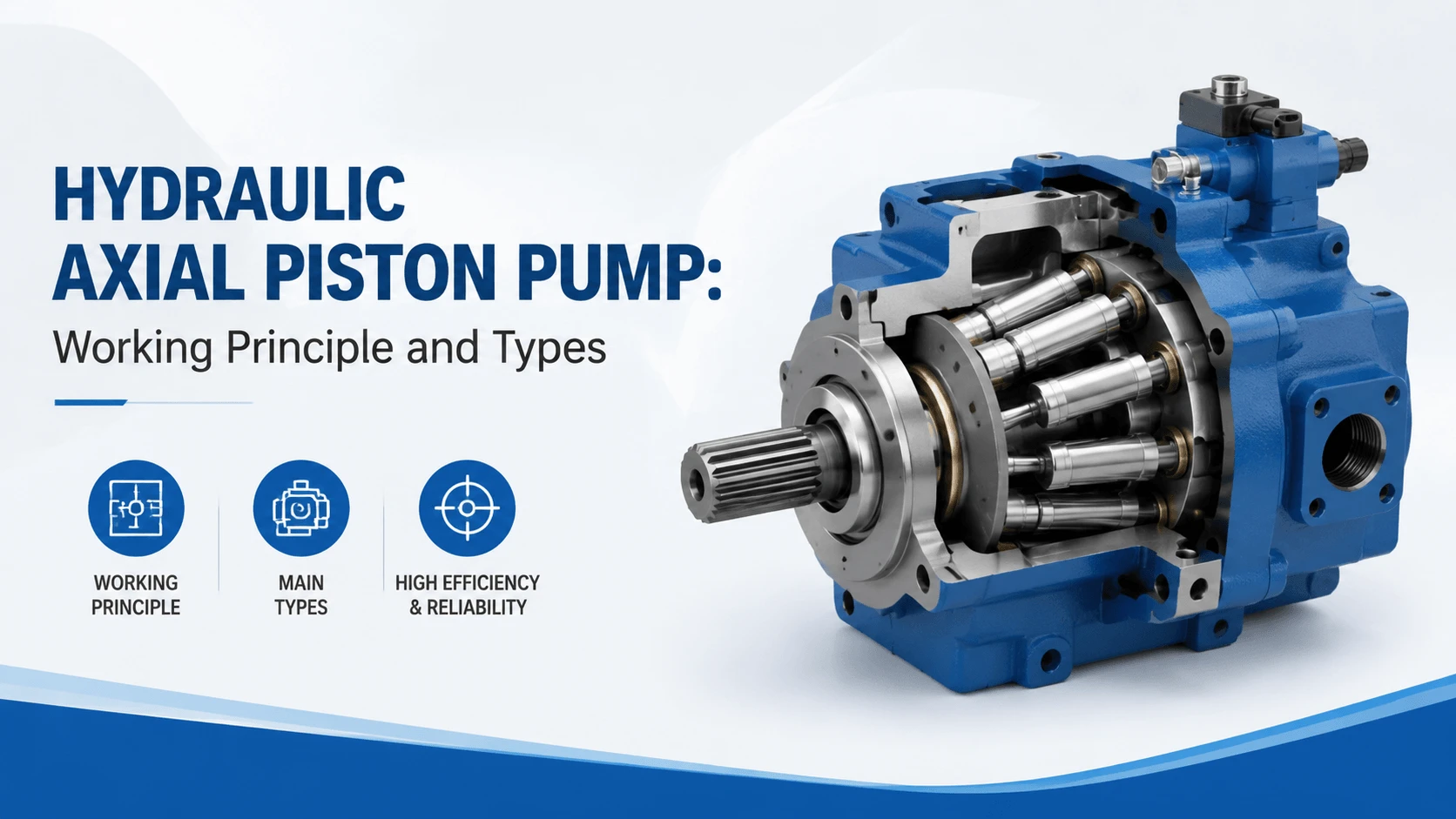
A hydraulic axial piston pump is a positive-displacement pump. Its pistons run parallel to the drive shaft, like shells in a revolver. Each piston slides in its own bore inside a rotating cylinder block.
The shaft turns the block, and a tilted plate or angled shaft converts that rotation into a piston stroke. Pistons draw fluid in on one half turn and push it out on the other. Output scales with piston size, count, and stroke.
Axial piston pumps own the high-flow end of the pressure spectrum. Most designs run 250 to 450 bar continuous. Peak ratings reach 500 bar for short bursts.
How a Hydraulic Axial Piston Pump Works
The drive shaft spins the cylinder block. A swashplate or bent-axis angle sets the piston stroke. Each piston bears against the swashplate through a slipper shoe.
As the block turns, the swashplate pushes each piston into its bore on one-half turn. The same piston slides out on the other half. A port plate at the end of the block feeds and discharges fluid.
The port plate has two kidney-shaped slots. One slot feeds the inlet side. The other collects discharge flow. Timing between piston travel and port plate slots controls flow direction and volume.
Unlike radial pumps, axial pumps seal with the port plate, not check valves. That plate runs on a thin oil film. The film holds pressure but accepts some slip.
Types of Hydraulic Axial Piston Pump
Swashplate Type
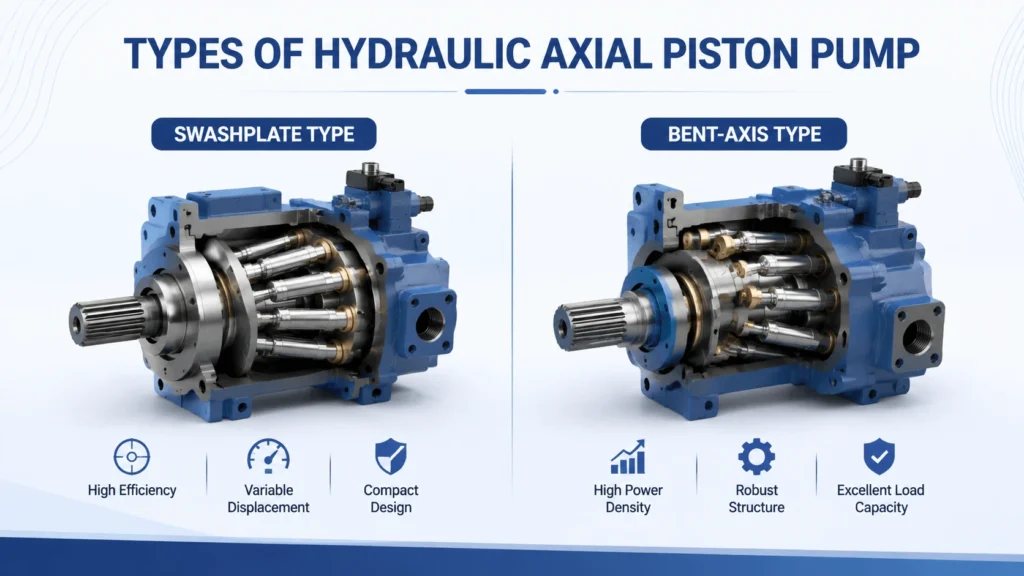
The swashplate design uses a fixed plate at an angle to the shaft. Pistons ride on the plate through slipper shoes. The plate angle sets the stroke.
Tilt the plate and you change the stroke. That makes variable displacement simple. Most mobile axial pumps use this design.
Bent-Axis Type
The bent-axis design angles the cylinder block relative to the shaft. Pistons link to the shaft flange through ball joints. Shaft rotation drives the block, and the angle sets the stroke.
Bent-axis pumps run more efficiently than swashplate types. They cost more and weigh more. They suit high-pressure, high-flow duty where efficiency pays.
Key Specifications of Hydraulic Axial Piston Pump
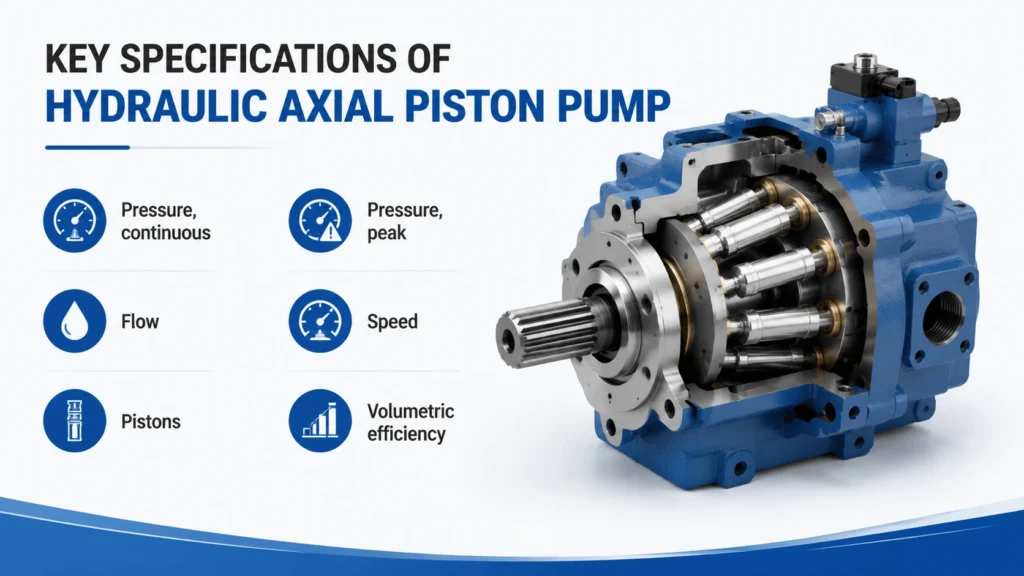
Match the pump to your circuit pressure and flow first. Then check the speed against your motor. Volumetric efficiency above 92 percent signals a healthy axial pump.
| Specification | Typical range | Notes |
|---|---|---|
Pressure, continuous |
250 to 450 bar |
Mobile and industrial duty |
Pressure, peak |
450 to 500 bar |
Short bursts only |
Flow |
20 to 500 L/min |
Size-dependent |
Speed |
1500 to 3000 rpm |
Higher than radial pumps |
Pistons |
7 or 9 |
Odd count cuts pulsation |
Volumetric efficiency |
92 to 96 percent |
Drops with port plate wear |
Axial vs Radial vs Vane Pump
Three pump families split the pressure and flow spectrum. Axial pumps own high flow at mid-high pressure. Radial pumps own the highest pressure. Vane pumps own the quiet mid-range.
| Feature | Axial piston | Radial piston | Vane |
|---|---|---|---|
Max pressure |
350 to 500 bar |
700 to 1000 bar |
70 to 250 bar |
Max flow |
to 500 L/min |
to 100 L/min |
to 400 L/min |
Speed |
1500 to 3000 rpm |
1000 to 2000 rpm |
600 to 3000 rpm |
Variable displacement |
Most designs |
Some designs |
Some designs |
Contamination tolerance |
Low |
Medium |
Medium |
Pick axial pumps for excavator travel and high-flow mobile circuits. Pick radial pumps when you need 500 bar or more. Pick vane pumps for quiet industrial mid-pressure.
Open-Circuit vs Closed-Circuit Axial Pumps
Open-Circuit Pumps
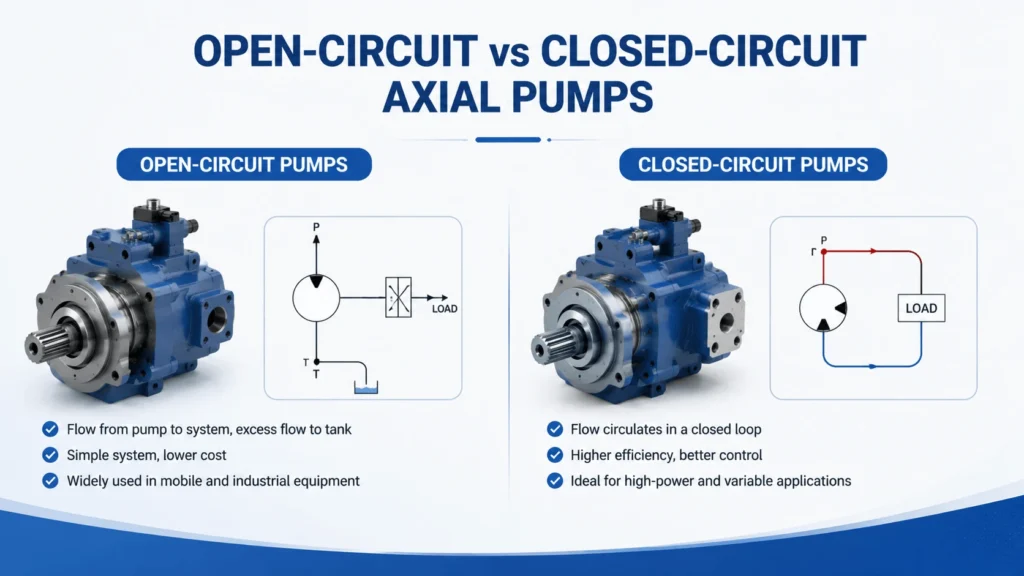
Open-circuit pumps draw fluid from a reservoir and dump it back through valves. Most industrial axial pumps work this way. They run variable displacement to save energy.
Open circuits need a large reservoir. They cool oil well through the tank. They suit presses, injection molders, and machine tools.
Closed-Circuit Pumps
Closed-circuit pumps feed flow straight to a motor and back. They form a hydrostatic transmission. Your excavator travel and skid-steer drive use this design.
Closed-loop pumps need a charge pump to make up internal leakage. The charge pump feeds 10 to 25 percent of the main flow at 15 to 35 bar. A hot oil shuttle flushes heat out of the loop.
Advantages and Disadvantages
Advantages
- High pressure with high flow in one pump}
- Variable displacement on most designs
- Compact for the power they deliver
- Speed range suits direct electric and diesel drive
- Efficient at rated pressure
- Tandem and through-drive options for mobile circuits
Disadvantages
- Costly versus gear and vane pumps
- Low contamination tolerance
- Port plate wear drops efficiency over time
- Noisy at high speed
- Needs clean oil and good filtration
Industrial Applications
Axial piston pumps dominate mobile hydraulic equipment. Excavators run tandem axial pumps for travel and implement circuits. Wheel loaders use them for the same reason.
Injection molding machines use variable axial pumps for clamp and injection. They save energy by cutting the flow at hold pressure. Presses and machine tools fit the open-circuit type.
Closed-loop axial pumps drive crawler travel, winches, and cutter heads. They pair with hydraulic motors in hydrostatic transmissions. The compact size suits tight mobile envelopes.
Common Problems and Troubleshooting
| Symptom | Likely cause | Action |
|---|---|---|
No flow at startup |
Air in case or low charge |
Bleed case, check charge pump |
Pressure drop under load |
Port plate wear |
Measure case drain, rebuild |
Loud knocking |
Piston or slipper wear |
Inspect rotating kit, replace |
Overheating |
Bypass at relief, low oil |
Check relief setting, top up |
Erratic flow |
Air in oil or cavitation |
Bleed air, inspect suction |
Case drain flow rising |
Internal wear |
Trend drain flow, plan rebuild |
Port-plate pumps fail differently than check-valve pumps. Worn plates leak flow back across the timing slots. Case drain flow rises as the slip grows. Trend that flow monthly.
Selection Guide
Start with your circuit type. Open circuit for industrial machines. Closed circuit for mobile travel and winch drive.
Then size pressure and flow. Axial pumps run 250 to 450 bar. If you need more than 500 bar, switch to a radial pump.
Pick variable displacement for clamp-and-hold cycles. Fixed displacement suits steady flow. For closed loops, pick a pump with an integrated charge pump and shuttle valve.
Match the port and mounting to your manifold. SAE 4-bolt flanges and ISO 3019-2 mounts cover most cases. Check the shaft end against SAE J744 or DIN standards.
Installation and Maintenance Tips
Mount the pump below reservoir level when you can. Flooded suction prevents cavitation at the port plate. Keep the suction line short and large.
Fill the case with filtered oil before startup. Dry starts score the port plate in seconds. Run the pump unloaded for the first few minutes to bleed air.
Keep the oil clean. ISO 4406 18/16/13 protects the port plate and slippers. Replace filters before the bypass trips. Trend case drain flow every month. Drain flow above 5 percent of nominal signals wear.
FAQ
What is a hydraulic axial piston pump used for?
Engineers use axial piston pumps for high-pressure, high-flow circuits. They run excavators, wheel loaders, injection molders, and presses. Closed-loop types drive mobile travel and winches.
How does an axial piston pump work?
Pistons run parallel to the drive shaft inside a rotating block. A swashplate or bent axis converts shaft rotation into piston stroke. A port plate times suction and discharge.
What pressure can an axial piston pump reach?
Most axial pumps run 250 to 450 bar continuous. Peak ratings reach 500 bar for short bursts. Above 500 bar, radial piston pumps take over.
Swashplate or bent-axis piston pump?
Pick swashplate for variable displacement and lower cost. Pick bent-axis for higher efficiency at high pressure and flow. Mobile pumps favor swashplate. Industrial high-duty pumps favor bent-axis.
Can an axial piston pump be variable displacement?
Yes. Most swashplate designs tilt the plate to change stroke. Zero angle means zero flow. That gives true variable displacement with pressure compensation.
Why does my axial pump run hot?
Heat usually comes from bypass at the relief valve. Check the relief setting first. Low oil, a clogged cooler, or port-plate wear also cause heat.
Conclusion
The axial piston pump owns the high-pressure, high-flow band. It costs more than gear or vane pumps but delivers more power per kilo. For mobile and industrial duty above 250 bar, it has no real rival.
Size it for circuit type, pressure, and flow. Keep the oil clean and the suction flooded. Trend the case drain flow. A well-maintained axial pump runs thousands of hours in hard duty.