
What is Hydraulic Fluid Viscosity?
ISO VG Grades Explained
| ISO VG Grade | Viscosity at 40C (cSt) | Typical Application |
|---|---|---|
ISO VG 15 |
15 |
Low-speed precision systems |
ISO VG 22 |
22 |
Aerospace and CNC hydraulics |
ISO VG 32 |
32 |
High-speed systems, tropical climates |
ISO VG 46 |
46 |
General industrial standard |
ISO VG 68 |
68 |
Heavy-duty, high-pressure systems |
ISO VG 100 |
100 |
Large presses, extruders |
How Temperature Changes Hydraulic Fluid Viscosity
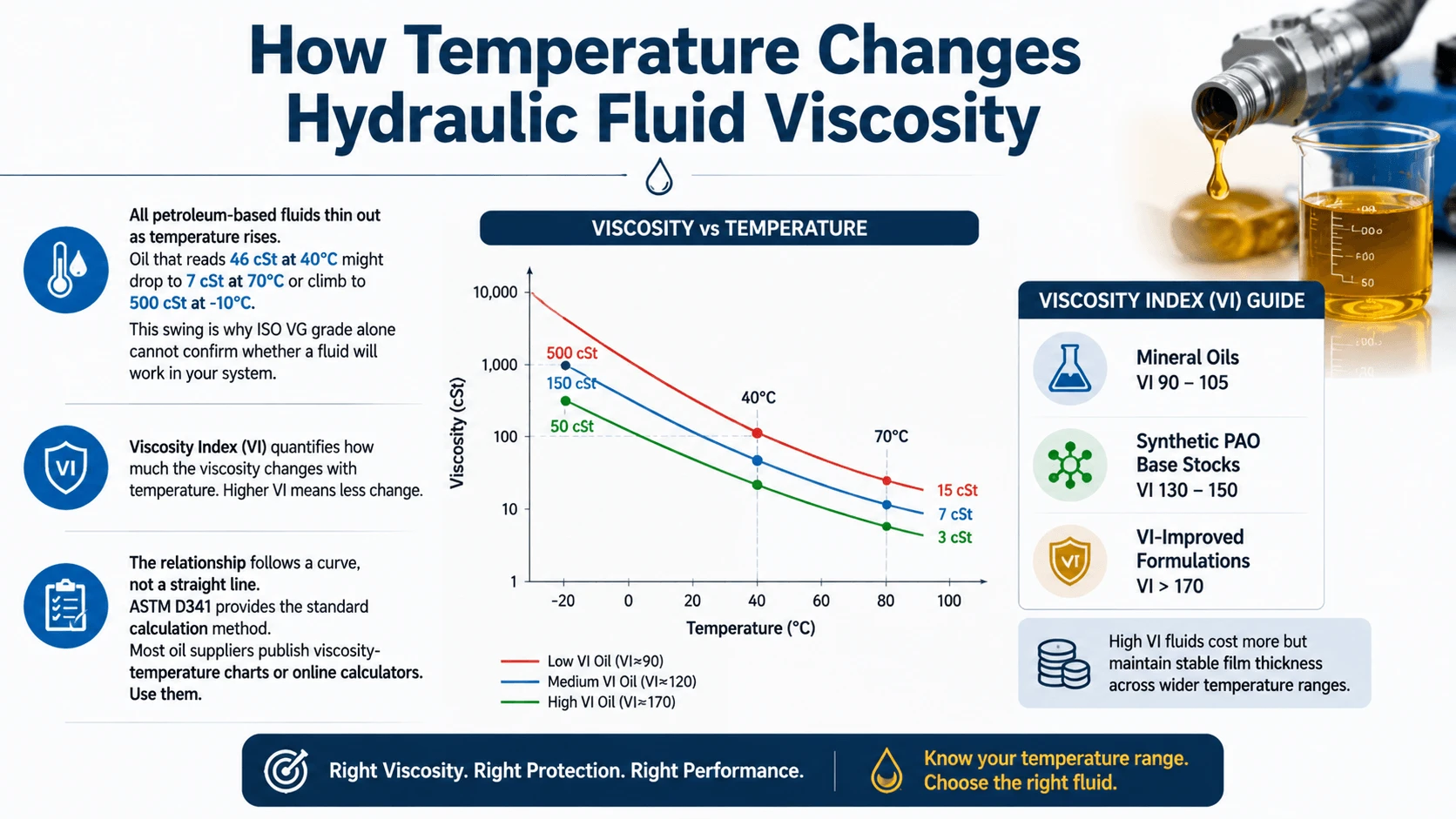
All petroleum-based fluids thin out as temperature rises. Oil that reads 46 cSt at 40C might drop to 7 cSt at 70C or climb to 500 cSt at -10C. This swing is why ISO VG grade alone cannot confirm whether a fluid will work in your system.
Viscosity Index (VI) quantifies how much the viscosity changes with temperature. Higher VI means less change. Mineral oils typically score VI 90 to 105. Synthetic PAO base stocks reach VI 130 to 150. VI-improved formulations with additives can exceed VI 170. High VI fluids cost more but maintain stable film thickness across wider temperature ranges.
The relationship follows a curve, not a straight line. ASTM D341 provides the standard calculation method. Most oil suppliers publish viscosity-temperature charts or online calculators. Use them.
Operating Viscosity Windows by Pump Type
Every pump type has a viscosity range where it works correctly. Go outside that range and failure accelerates. Here are typical limits from major manufacturers:
Gear Pumps
- Minimum continuous: 10 cSt
- Optimum range: 16 to 36 cSt
- Maximum: 1000 cSt (cold start)
- Cold start limit: 2000 cSt briefly acceptable
Gear pumps tolerate wide ranges. They handle dirty oil and moderate pressures. Low viscosity causes internal leakage and heat. Very high viscosity strains the gears and motor during startup.
Vane Pumps
- Minimum continuous: 13 cSt
- Optimum range: 20 to 40 cSt
- Maximum: 800 cSt (cold start)
- Cold start limit: 1600 cSt
Vane pumps need more lubrication than gear pumps because vanes slide against the cam ring. Low viscosity accelerates vane tip and cam ring wear. Many vane pump warranties require minimum 20 cSt at operating temperature.
Axial Piston Pumps
- Minimum continuous: 8 to 12 cSt (varies by design)
- Optimum range: 16 to 30 cSt
- Maximum: 600 cSt (cold start)
- Cold start limit: 1000 cSt
Piston pumps have tight internal clearances. They generate high pressure but suffer if viscosity drops below their minimum. Low viscosity lets slipper pads lose hydrostatic film, causing metal-to-metal contact. This failure mode destroys pumps in hours, not months.
Radial Piston Pumps
- Minimum continuous: 10 cSt
- Optimum range: 16 to 36 cSt
- Maximum: 800 cSt
Radial piston pumps share axial piston sensitivity to low viscosity but tolerate slightly higher maximums due to larger displacement volumes.
These numbers vary by manufacturer and model. Always check your pump manual before finalizing a viscosity grade selection.
What Happens When Viscosity is Wrong
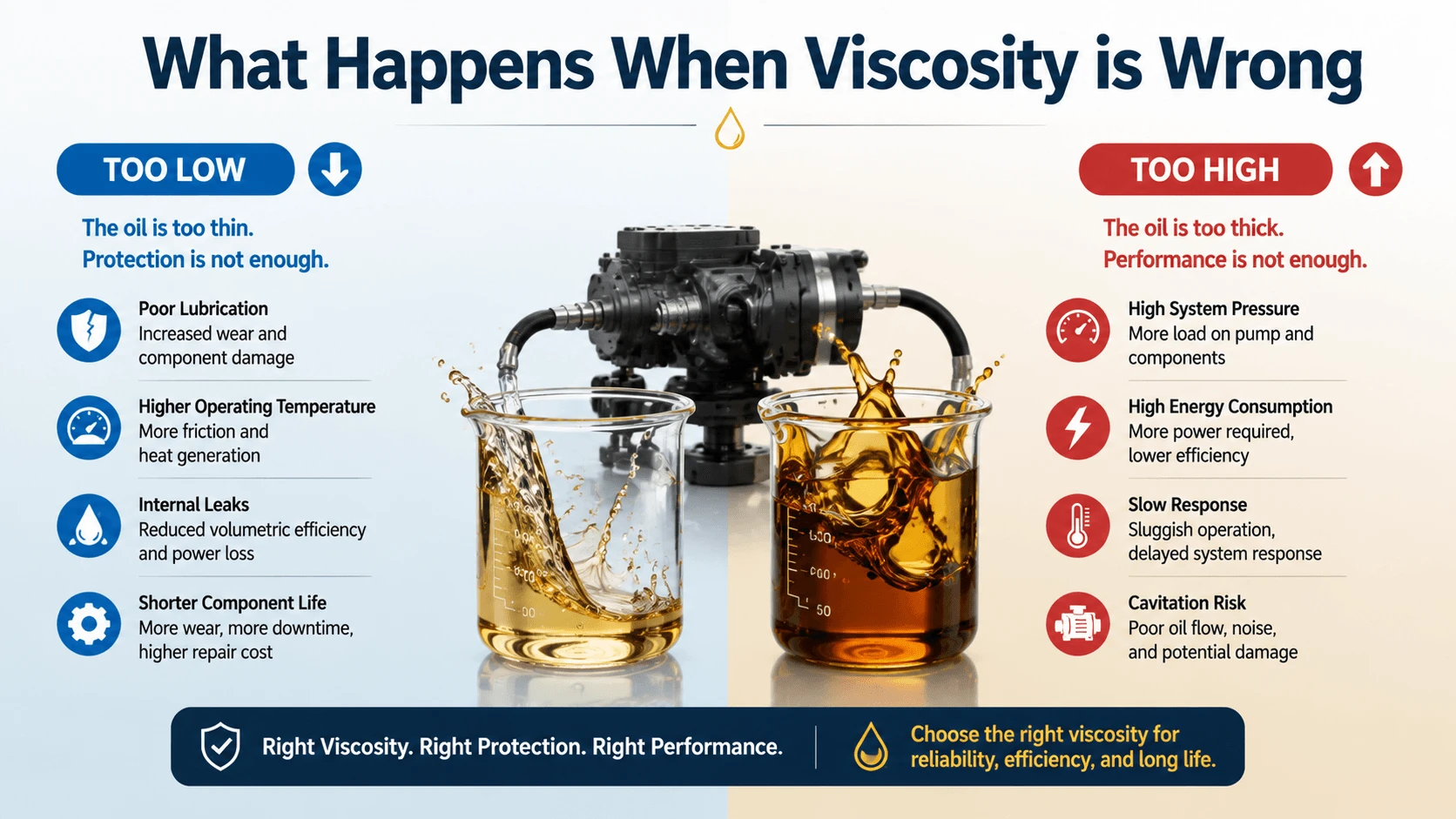
Too Low
Too High
Measuring Viscosity in Practice
Selecting the Right Hydraulic Fluid Viscosity Grade
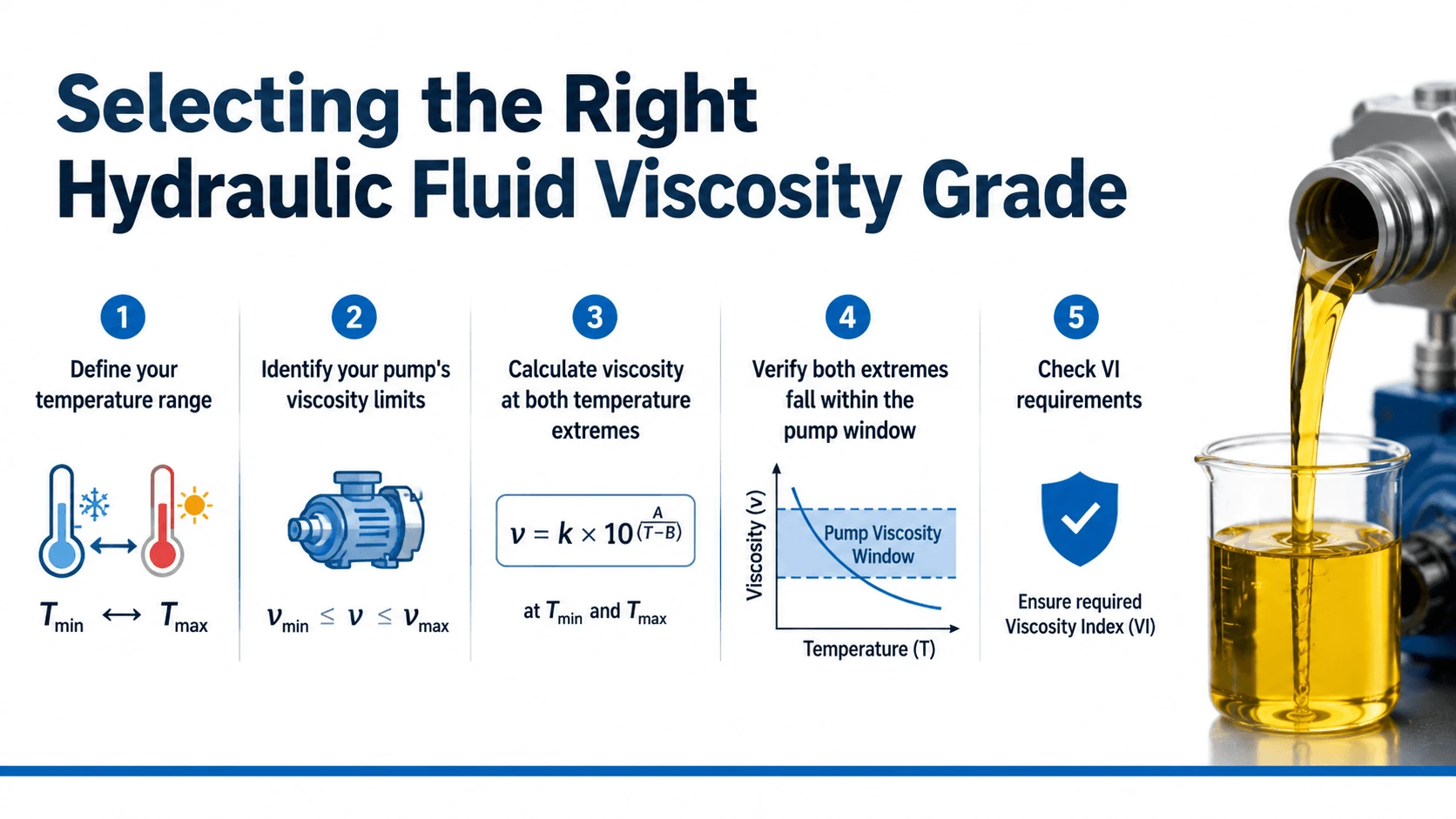
Follow these steps to match an ISO VG grade to your application:
Step 1: Define your temperature range
Record the minimum expected oil temperature at startup and the maximum expected temperature under full load. Consider seasonal variation, indoor versus outdoor installation, and whether the system has an oil cooler or heater.
Step 2: Identify your pump’s viscosity limits
Find the minimum continuous, optimum, and maximum allowable viscosity from the pump datasheet or manual. If your system uses multiple pump types, use the tightest limits among them.
Step 3: Calculate viscosity at both temperature extremes
Use the supplier’s V-T chart or ASTM D341 to convert ISO VG midpoint viscosity to expected cSt at your minimum and maximum temperatures.
Step 4: Verify both extremes fall within the pump window
The correct hydraulic fluid viscosity at your minimum temperature must stay below the pump’s maximum cold-start limit. The viscosity at your maximum temperature must stay above the pump’s minimum continuous limit. Ideally, hot viscosity lands near the middle of the optimum range.
Step 5: Check VI requirements
If no single ISO VG grade covers your temperature span, consider a higher-VI fluid or a multi-grade formulation. Multi-grade oils use VI improvers to flatten the V-T curve. Note that VI improvers can shear down in high-shear zones like pump pressure plates, temporarily reducing viscosity over time.
Worked Example
A mobile excavator operates in a climate ranging from -10C to +40C ambient. Oil temperature runs from -5C at cold start to 65C under heavy digging. The main pump is an axial piston unit with limits of 10 cSt minimum, 16 to 30 cSt optimum, 1000 cSt maximum cold start.
Test ISO VG 46 (midpoint 46 cSt at 40C, VI 95 mineral oil):
- At -5C: approximately 1200 cSt. Exceeds 1000 cSt max. Risk of cavitation and hard starting.
- At 65C: approximately 11 cSt. Below 10 cSt minimum. Risk of wear and internal leakage.
ISO VG 46 alone fails at both extremes. Options include:
- Install a tank heater to raise cold-start temperature above 0C
- Switch to ISO VG 32 with a reservoir cooling system to hold hot temperature below 60C
- Use a high-VI synthetic fluid (VI 150+) in ISO VG 46 or 48 that maintains adequate film at 65C without excessive thickening at -5C
Option 3 often costs least over equipment life despite higher per-liter fluid price. The hydraulic fluid viscosity stays within bounds across the full temperature range without additional hardware.
FAQ
Can I mix different ISO VG grades?
Mixing ISO VG 32 with ISO VG 64 does not produce ISO VG 48. The resulting blend falls somewhere in between, but additive packages may not be compatible. Some additives interact poorly. Mix only in emergencies and plan a complete drain and refill at the next service interval.
Does viscosity change as fluid ages?
Yes. Oxidation produces heavier molecules that raise viscosity. Thermal cracking and VI-improver shear reduce viscosity. Either shift moves the operating point away from optimum. Regular oil analysis tracks these changes.
What viscosity grade do I need for outdoor winter use?
Depends on your coldest expected startup temperature and your pump’s cold-start limit. Many northern operations use ISO VG 32 with tank heaters, or switch to a high-VI synthetic in a slightly higher grade. Viscosity above 2000 cSt at startup temperature will likely cause cavitation complaints regardless of pump type.
How often should I check viscosity?
Check at every oil change minimum. Systems running hot, heavy-duty cycles, or critical applications benefit from quarterly oil analysis including viscosity. The test costs far less than one unplanned downtime event.
Is higher viscosity always better?
No. Higher viscosity within the optimum range improves film strength and reduces wear. Above the optimum range, efficiency drops, heat rises, and cold-start problems appear. The goal is correct viscosity, not maximum viscosity.
Conclusion
Getting hydraulic fluid viscosity right requires matching three things: your pump’s specifications, your actual operating temperatures, and your fluid’s V-T behavior. Most hydraulic failures trace back to a mismatch in one of those three areas. Spend thirty minutes on proper selection now, or spend thirty hours on a pump rebuild later. The choice is straightforward.