
Introduction
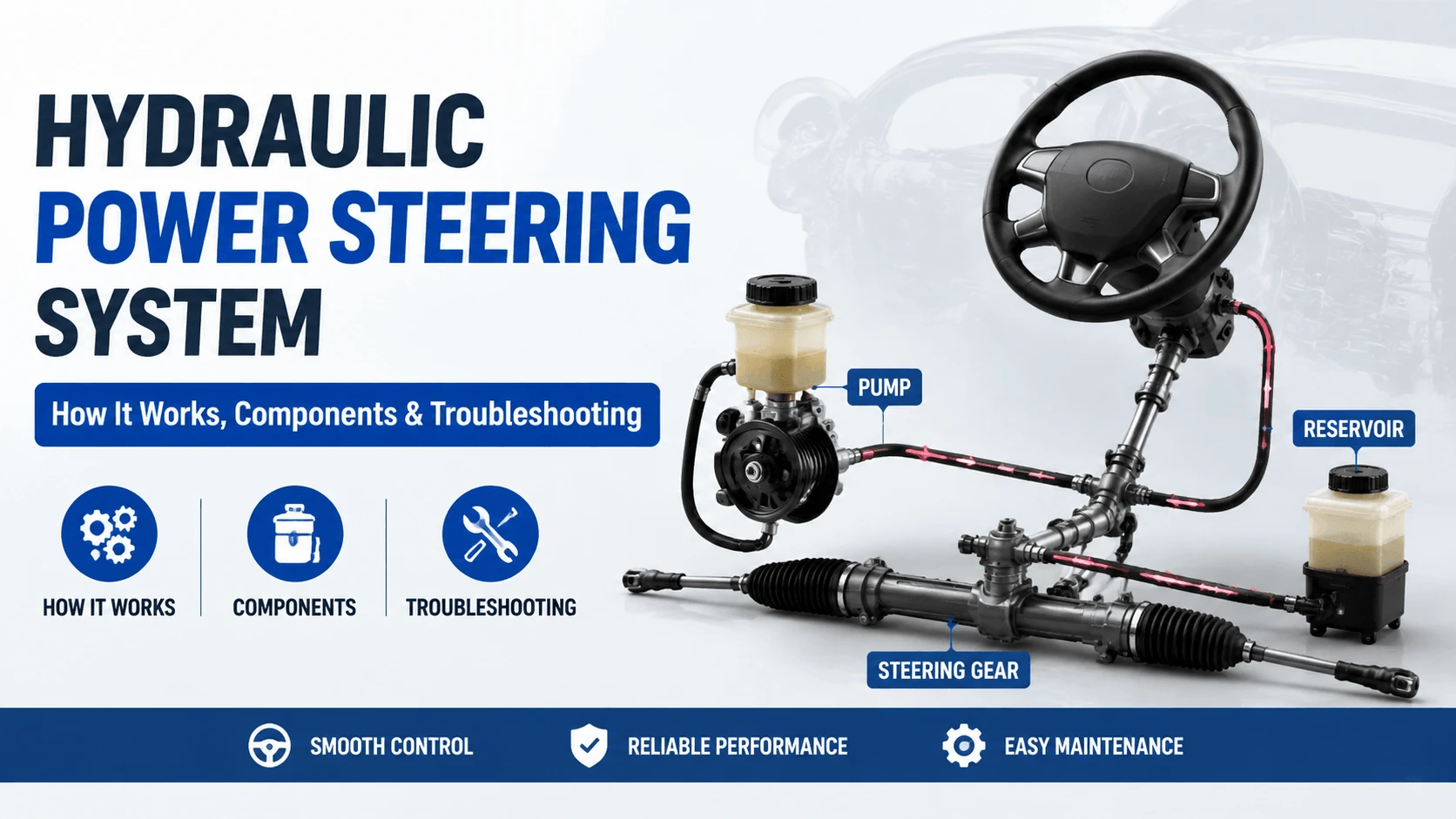
The hydraulic power steering system (HPS) has been around since the 1950s. It remains standard on most heavy trucks, agricultural tractors, construction machines, and many passenger cars.
This guide explains what happens between the steering wheel and the front tires. It covers the two main system types, the parts that fail most often, and a diagnostic procedure. The procedure works on anything from a pickup truck to a wheel loader. All pressure values and flow rates come from OEM service data and field measurements.
What is a Hydraulic Power Steering System
A hydraulic power steering system uses pressurized fluid to multiply the force from the driver at the steering wheel. The driver still controls direction. The hydraulics supply the muscle to move the front wheels against road resistance, tire friction, and steering knuckle weight.
Two distinct architectures exist. Automotive HPS uses a rack-and-pinion steering gear with an integrated hydraulic assist cylinder. A power steering pump driven by the engine crankshaft supplies flow. The other architecture is the heavy-duty type found on trucks and off-road equipment. It uses a separate steering control unit, often called an orbitrol or OSPC valve. This unit connects to one or more double-acting steering cylinders on the axle or frame.
Both types share the same core idea. A rotary valve or control unit senses driver input torque and opens fluid ports in proportion. More torque means more flow to the assist cylinder. The driver feels less resistance at the wheel.
How Hydraulic Power Steering Works
Start the engine. The power steering pump turns and draws fluid from the reservoir through the suction line. Most automotive pumps are vane-type or roller-type units. They produce a flow proportional to engine RPM. At idle, a typical passenger-car pump delivers 3 to 5 L/min. At 3,000 RPM, it delivers 8 to 12 L/min.
This flow passes through the pump’s internal flow control valve. It exists the pressure line toward the steering gear. When the steering wheel sits centered, the rotary valve inside the gear blocks the flow. Pressure builds only to the level needed to overcome line resistance, usually 4 to 7 bar. Fluid circulates back to the reservoir through the gear’s return port and the oil cooler if fitted.
The moment the driver applies torque to the steering wheel, a torsion bar inside the rotary valve twists. This twist offsets the valve spool relative to the valve sleeve. Openings align between the pressure port and one side of the assist cylinder. Fluid flows into the cylinder chamber. The piston moves. Rack-and-pinion gears convert this linear motion into steering knuckle rotation. The wheels turn.
Release the steering wheel. The torsion bar untwists. The valve returns to the center position. Flow bypasses the cylinder again. Centering forces in the steering geometry bring the wheels back toward straight-ahead.
On heavy-duty systems with an orbitrol, the principle is similar. But the metering happens in a rotary control valve that also measures how much the wheel turned. The orbitrol ports flow to a double-acting cylinder that directly pushes the steering linkage.
Main Components of Hydraulic Power Steering System
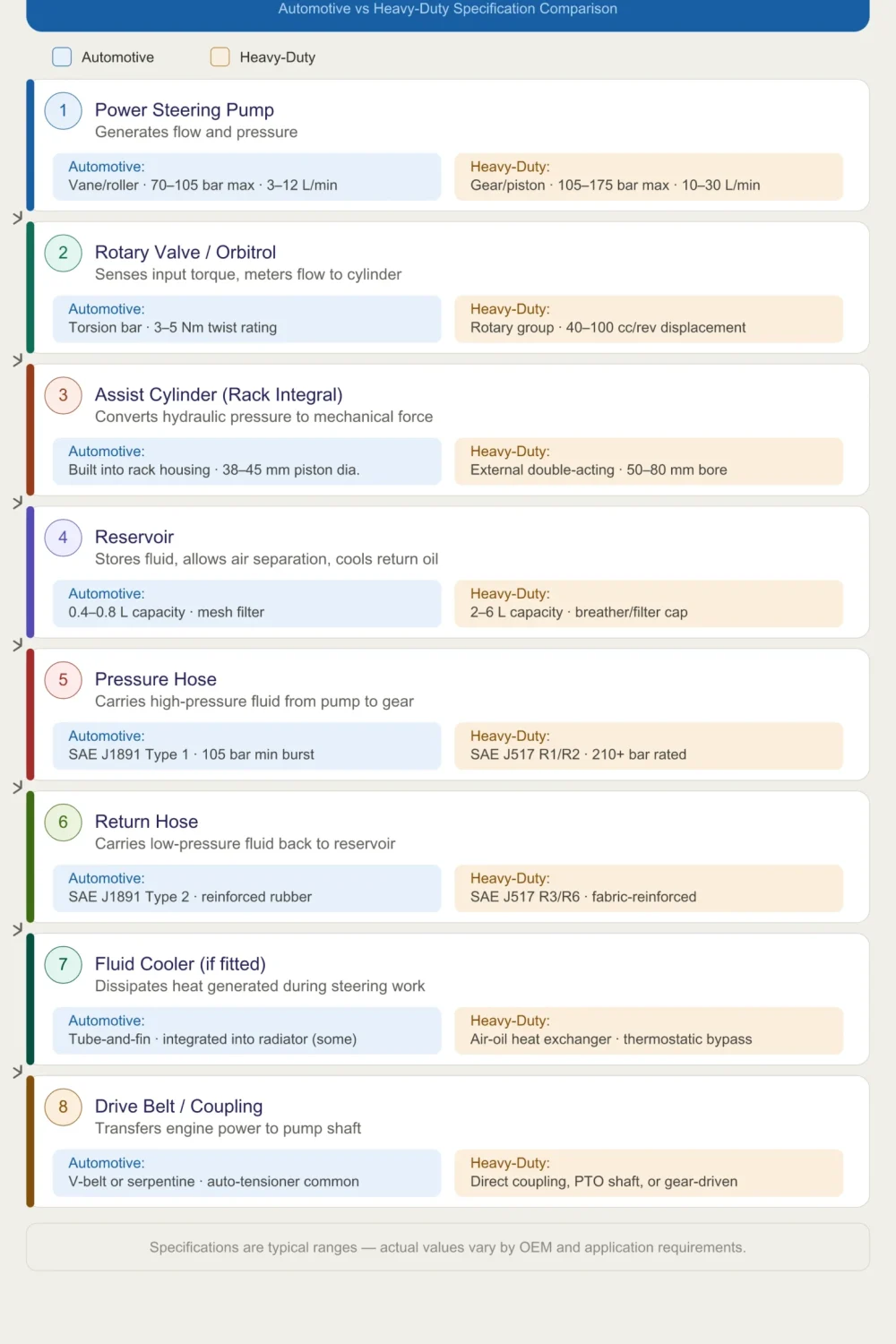
You can replace each component separately on almost every vehicle and machine in production today. The exception is some light-passenger racks where manufacturers sell the complete assembly only. Heavy-duty orbitrols and cylinders are always individual service items.
Automotive HPS vs Heavy-Duty Hydraulic Steering
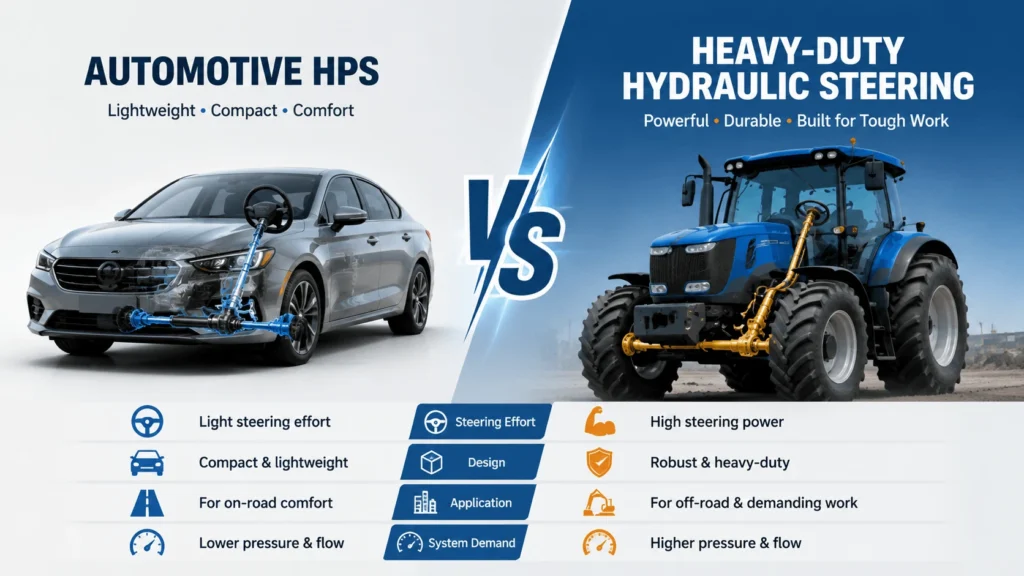
The distinction matters when you order parts or diagnose problems.
Automotive HPS covers passenger cars, SUVs, and light trucks. The pump is crankshaft-driven via a belt. The gear is an integral rack-and-pinion unit with a built-in assist cylinder. Operating pressure peaks at 70 to 105 bar. Flow rate runs 3 to 12 L/min, depending on engine speed. Total system fluid volume is 0.8 to 1.2 L. Power assistance varies with engine RPM, giving more assist at higher RPM. The temperature range spans -40 degrees C to +125 degrees C at the pump outlet under extreme conditions.
Heavy-duty hydraulic steering covers trucks, buses, tractors, and loaders. The pump may be gear-driven, PTO-driven, or powered by a separate engine. The system uses a separate steering control unit (Orbitrol or OSPC valve) plus external cylinders. Operating pressure runs 105 to 175 bar. Some systems reach 210 bar. Flow rate is 10 to 30 L/min or higher on large equipment. System fluid capacity ranges from 4 to 20 L, depending on cylinder size. A priority valve or load-sensing pump keeps steering response constant regardless of engine speed. Most systems include a dedicated oil cooler because duty cycles run longer and loads are heavier.
The fundamental hydraulics are identical. But sizing, mounting, and service procedures differ enough that mixing them up leads to wrong parts and failed repairs.
Advantages
HPS has lost ground to electric power steering (EPS) in passenger cars since roughly 2010. It still holds strong advantages in several areas.
A properly sized hydraulic steering gear produces 8,000 to 15,000 Nm of assist torque at the steering knuckle. An equivalent electric assist motor with a gearbox costs more, weighs more, and requires larger electrical current capacity. This torque-per-dollar advantage keeps HPS dominant on heavy vehicles.
HPS designs have accumulated decades of field data. Failure modes are well documented. Replacement parts are available worldwide for virtually every vehicle ever sold with HPS. This proven reliability matters for fleet operators and equipment owners.
The hydraulic circuit provides a natural restoring force that helps the steering return to center after a turn. EPS must replicate this behavior through software tuning, which is never quite as seamless.
A tractor or loader already has a hydraulic pump and reservoir for the implements. Adding a priority valve, an orbitrol, and a steering cylinder costs little extra. It uses the existing hydraulic infrastructure rather than requiring a separate electric system.
EPS runs substantial current through the column area or dashboard. HPS keeps all power transmission in fluid lines. This simplifies crash safety certification for some vehicle programs.
Disadvantages / Limitations
HPS has drawbacks that pushed the industry toward EPS, where regulations allow.
The pump consumes 0.5 to 2 kW of engine power continuously while running. This burns fuel even when driving straight. Estimates put HPS at 2 to 4% higher fuel consumption versus EPS-equipped vehicles in city driving.
At low RPM during parking lot maneuvers, the pump delivers less flow. The steering feels heavier. At highway RPM, assist increases whether you need it or not. Some pumps include a flow-control valve or variable-displacement mechanism to reduce this effect. That adds cost and complexity.
Power steering fluid degrades over time, absorbs moisture, and accumulates wear particles. Neglected fluid causes valve sticking, seal hardening, and accelerated pump wear. Most OEMs specify inspection or replacement intervals that owners ignore.
Any hose connection, shaft seal, or O-ring in the system can leak. A pressure hose failure dumps fluid on the road or hot exhaust in seconds. Environmental regulations in Europe and North America have tightened against this risk.
Below -30 degrees C, conventional power steering fluid thickens noticeably. Cold-start steering effort spikes until the fluid warms up. Synthetic fluids help, but add cost.
The pump, reservoir, hoses, and cooler consume under-hood packaging space. Designers would rather use that space for other components. This constraint matters more in compact car segments than in heavy equipment.
Industrial Applications of Hydraulic Power Steering System
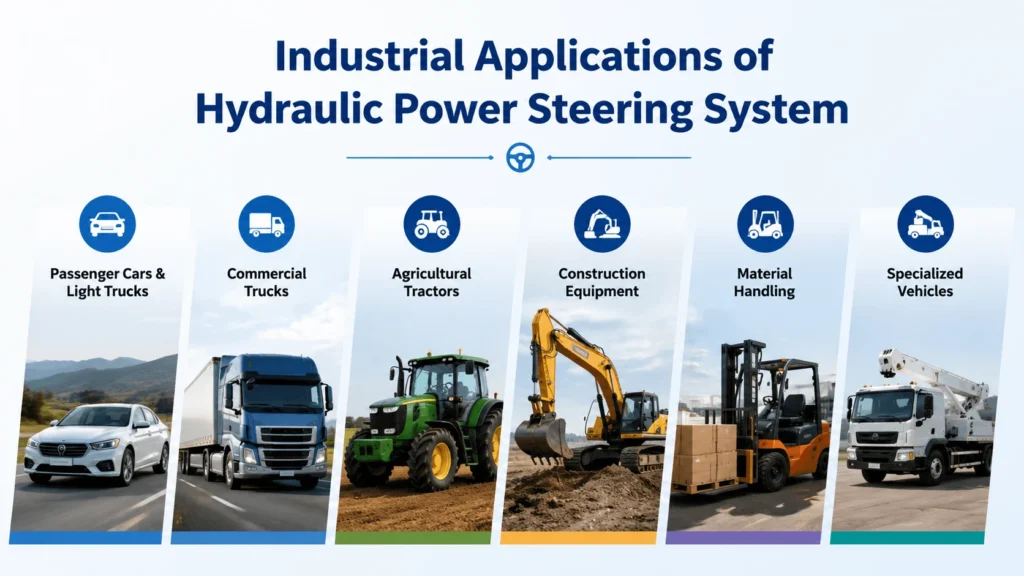
Hydraulic power steering appears across a wider range of vehicles than most people realize.
| Application Category | Examples | Typical Pressure | Notes |
|---|---|---|---|
Passenger Cars & Light Trucks |
Toyota Hilux, Ford F-150 (pre-2015), most pickup/SUV platforms |
70 to 105 bar |
Belt-driven vane pump; integral rack |
Commercial Trucks |
Class 4 to 8 trucks, buses, RV chassis |
105 to 140 bar |
Gear or piston pump; separate orbitrol + cylinder |
Agricultural Tractors |
John Deere, Case IH, Kubota mid-size tractors |
120 to 175 bar |
PTO-driven pump; priority valve for constant flow |
Construction Equipment |
Backhoe loaders, wheel loaders, telehandlers, forklifts |
140 to 210 bar |
Load-sensing or priority system; large-bore cylinders |
Material Handling |
Forklifts (counterbalance and reach trucks), pallet stackers |
105 to 175 bar |
Electric-motor-driven pump on electrics; engine-driven on IC trucks |
Specialized Vehicles |
Airport ground support, military tactical vehicles, mining haul trucks |
140 to 210 bar |
Dual-circuit redundancy common on critical applications |
The heaviest machines sometimes use dual redundant steering circuits. If the primary pump or circuit fails, a backup takes over automatically. This is mandatory on certain categories of agricultural and earth-moving equipment under ISO 5010 and EN 15830 safety standards.
Common Failure Modes
Field service records consistently show recurring patterns of HPS system failures. Here are the common failure modes and their root causes:
Pump Whine or Groan Noise
- Cavitation Noise: A noise that rises and falls with engine RPM. It is usually caused by a low fluid level, aerated fluid from a leaking suction hose, or a restricted reservoir filter.
- Mechanical Wear Noise: A steady whine that does not change much with steering input. This indicates worn vanes or a scored rotor plate. Internal wear also increases case drain flow and reduces pressure output.
Hard Steering (Excessive Effort)
- Primary Cause: Low pump pressure due to internal wear or a slipping drive belt.
- Secondary Cause: A stuck or binding rotary valve.
- Tertiary Cause: A blown shaft seal on the integral rack cylinder, which lets pressure bleed off instead of moving the piston. On heavy-duty systems, also verify the priority valve setting and rated pump flow.
Steering Drift or Pull
- Mechanical Causes: Worn tie rod ends or loose suspension components.
- Hydraulic Causes: A rotary valve failing to return fully to neutral (due to torsion bar fatigue or debris lodged in spool lands), or unequal cylinder seal leakage causing asymmetric assist force.
Foaming or Aerated Fluid
- Appearance: Milky, bubbly fluid inside the reservoir.
- Causes: Air drawn through a cracked suction hose or a loose hose clamp at the pump inlet, or fluid dropping below the minimum fill level during sharp turns.
- Effects: Aerated fluid compresses under load, resulting in a spongy steering feel and accelerated pump cavitation damage.
Overheating
- Indicator: Reservoir fluid runs too hot to touch after normal operation.
- Causes: Continuous low-speed turning, a blocked cooler, or a pump forced to run at high pressure by a binding linkage.
- Effects: Operating temperatures above 110°C drastically accelerate seal degradation.
Pressure Hose Failure
- Causes: Sudden fluid loss caused by age-related rubber degradation combined with peak-pressure spikes during full-lock turns.
- Specifications: SAE J1891 specifies a minimum burst pressure of 420 bar for Type 1 automotive hoses, but aged rubber loses strength well before that. Replace hoses every 5 to 6 years regardless of appearance.
Troubleshooting Guide
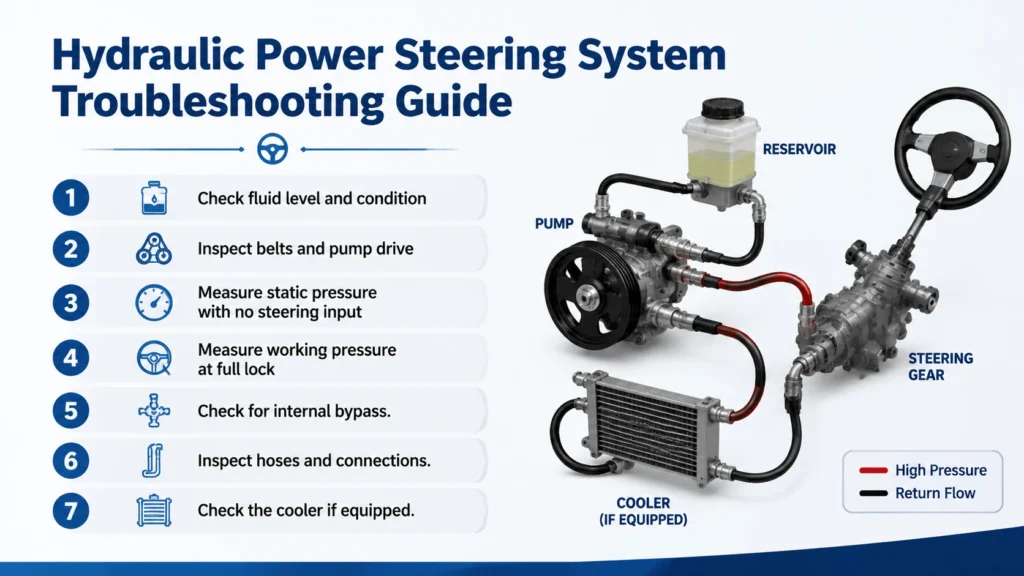
Follow this sequence when HPS acts up. Each step isolates a subsystem.
Check fluid level and condition
Pull the dipstick or look at the reservoir sight glass. Fluid should sit at the correct mark, transparent red or amber, free of bubbles and metal particles. Dark brown or black fluid means oxidation and overdue change. Milky fluid means water or air contamination. Top up only with the specified fluid type. Mixing ATF, PSF, and hydraulic oils causes seal swelling and valve problems.
Inspect belts and pump drive
For belt-driven pumps, check tension by pressing the belt midway between pulleys. Deflection should run about 6 to 10 mm under moderate thumb pressure. Look for glazing, cracks, or fraying on the belt ribs. For direct-driven or PTO pumps, confirm coupling integrity. Check for abnormal vibration at the pump shaft.
Measure static pressure with no steering input
Install a gauge in the pressure line using a T-fitting. Use the test port if the gear has one. Start the engine. With the wheel centered, pressure should read 4 to 7 bar on a typical automotive system. On heavy equipment with a closed-centered setup, expect 10 to 20 bar. Zero or near-zero pressure points to pump failure or a completely open relief path.
Measure working pressure at full lock
Turn the steering wheel slowly to either stop. Do not hold the lock for more than 3 to 5 seconds. Record the peak pressure. Compared to the manufacturer spec, usually 70 to 105 bar for cars and 105 to 175 bar for heavy equipment. Low reading confirms pump wear or relief valve malfunction. Correct reading with poor assist suggests internal leakage in the steering gear or cylinder seals.
Check for internal bypass
With the gauge still installed, hold a moderate steering force against the tires. Have an assistant turn the wheel against your hands. Pressure should hold steady within 5 to 10 bar of the peak reading. A pressure that drops steadily while holding indicates internal leakage. The source is past cylinder seals, valve spool clearance, or a worn torsion bar assembly.
Inspect hoses and connections
Trace every pressure and return hose. Look for wet spots, cracked outer cover, soft, swollen sections, and rusted clamps. Pinch-test return hoses with the engine off. They should feel firm, not mushy. Check the crimp fittings for weepage.
Check the cooler if equipped
Feel the inlet and outlet tubes after 10 minutes of driving. The inlet should feel noticeably hotter than the outlet. Equal temperature means the cooler has a blockage or internal bypass. No flow through the cooler at all means a blockage or collapsed line upstream.
Document each reading. A pattern of symptoms with matching pressure and flow data usually identifies the failed component before any disassembly begins.
Maintenance Tips
Preventive maintenance costs far less than emergency repairs or towing. Here are the essential maintenance tips for your HPS system:
Fluid Level Check
- Frequency: Check monthly or at every fuel fill.
- Procedures: Check cold for accuracy; do not overfill to prevent thermal expansion and venting mess.
Fluid Replacement & Flush
- Interval: Every 2 years or 48,000 km for passenger cars; annually for commercial/heavy equipment.
- Method: Disconnect the return line to drain old fluid, flush with fresh fluid until clear. Bleed air by cycling the steering lock-to-lock with front wheels off the ground.
Filter Servicing
- Clean or replace the reservoir mesh screen/cartridge filter at every fluid change.
- Service inline filters on heavy-duty systems on the same schedule to prevent pump cavitation.
Belt Inspection
- Inspect every 6 months or 25,000 km.
- Replace immediately at the first sign of cracking, glazing, or noise to avoid pump starvation and failure.
Hose Replacement
- Pressure Hoses: Replace every 5 to 6 years regardless of appearance due to rubber degradation.
- Return Hoses: Inspect for softness, bulging, or abrasion at each service; they can last longer.
Suspension & Alignment
- Keep suspension components and alignment in check. Worn ball joints or bad tie rods increase steering effort, forcing the pump to run at higher pressures and accelerating system wear.
Cooler Maintenance
- Blow out the air-oil heat exchanger fins with compressed air at seasonal services to remove dirt and bugs, preventing overheating.
FAQ
What is the difference between hydraulic power steering and electric power steering?
HPS uses fluid pressure from an engine-driven pump. EPS uses an electric motor on the steering column or rack. HPS provides more absolute assist torque at a lower cost. That makes it the choice for heavy vehicles. EPS saves fuel by eliminating the constant parasitic pump load. It also enables driver-assist features like lane-keep assist and automated parking. Both systems can feel good when designed correctly. The deciding factors are vehicle weight class, cost targets, and whether the OEM needs electronic integration for ADAS features.
Why is my power steering pump making noise?
Three causes account for 90% of noisy pumps. Low fluid level or air in the fluid causes cavitation. This sounds like a grinding or whining that changes pitch when you turn the wheel. Worn internal components (vanes, rotor plate, pressure plate) produce a steady whine or groan. This gets louder as RPM increases. A slipping or loose drive belt squeals independently of the pump condition. Fix the fluid and belt issues first. If noise continues, measure pump output pressure. Pressure below specification confirms internal wear. That means rebuild or replacement.
Can I use automatic transmission fluid in my power steering system?
Some vehicles explicitly permit ATF in the power steering system. The owner’s manual will say so. Many Asian-market vehicles from the 1990s and 2000s use Dexron-type ATF. European and domestic vehicles typically require dedicated power steering fluid (PSF). PSF has different friction modifiers and a viscosity profile. Never put universal hydraulic oil or brake fluid in an HPS system. Brake fluid destroys seals within hours. Wrong-viscosity hydraulic oil causes poor valve response and potential pump damage in cold weather. Check the reservoir cap or owner’s manual before adding anything.
What pressure should a hydraulic power steering system operate at?
Typical automotive HPS systems run 70 to 105 bar maximum at the pump outlet during full-lock steering. Idle-centered pressure reads 4 to 7 bar. Heavy-duty truck and equipment systems run 105 to 175 bar. Some loader applications reach 210 bar. The exact value depends on the vehicle or machine model. Consult the OEM service information for the specific pressure specification. Testing with a gauge is the only reliable way to know what your system produces. Guesswork leads to replacing good parts or leaving a marginal pump in service.
How do I bleed air from a power steering system?
Air trapped in the lines causes spongy steering and pump noise. To bleed it, raise the front wheels off the ground using jack stands. Fill the reservoir to the correct cold-level mark. Start the engine and let it idle. Turn the steering wheel slowly from lock to lock 5 to 6 times. Pause briefly at each end without holding against the stops. Watch the reservoir for bubbles. Top up fluid as the level drops. Repeat until no more bubbles appear and the fluid level stabilizes. Lower the wheels. Test-drive and verify that steering feels normal and quiet. Some heavy-duty systems have a dedicated bleeder screw on the steering cylinder or orbitrol. Check the service manual.
When should I replace my power steering pump?
Replace or rebuild when any of these conditions appear. Output pressure measures more than 15% below OEM spec at rated RPM. The pump makes a continuous noise that does not change with steering input, pointing to internal mechanical wear. External shaft seal leakage exceeds a slow seep, meaning dripping rather than just dampness. The pulley or bearing shows radial play or wobble. A pump with 150,000+ km on passenger vehicles or 8,000+ hours on heavy equipment merits proactive replacement. This is especially true on fleet vehicles where downtime costs exceed the pump price.
Conclusion
The hydraulic power steering system is a straightforward technology that has served the automotive and off-road industries for over seven decades. Understanding the pump-valve-cylinder circuit tells you exactly where to look when something goes wrong. Most failures trace to three root causes. Contaminated or degraded fluid. Hose age and deterioration. Pump wear from running low on fluid or with a slipping belt. Stay on top of those three items. HPS systems then routinely last the life of the vehicle or machine.
For new applications, the decision between HPS and EPS comes down to weight class, duty cycle, and cost structure. Neither solution is universally better. Heavy trucks and off-road equipment will keep hydraulic steering for the foreseeable future. The torque-per-dollar equation still favors fluid power.