
What is a Tractor Power Take Off?
Definition and Function
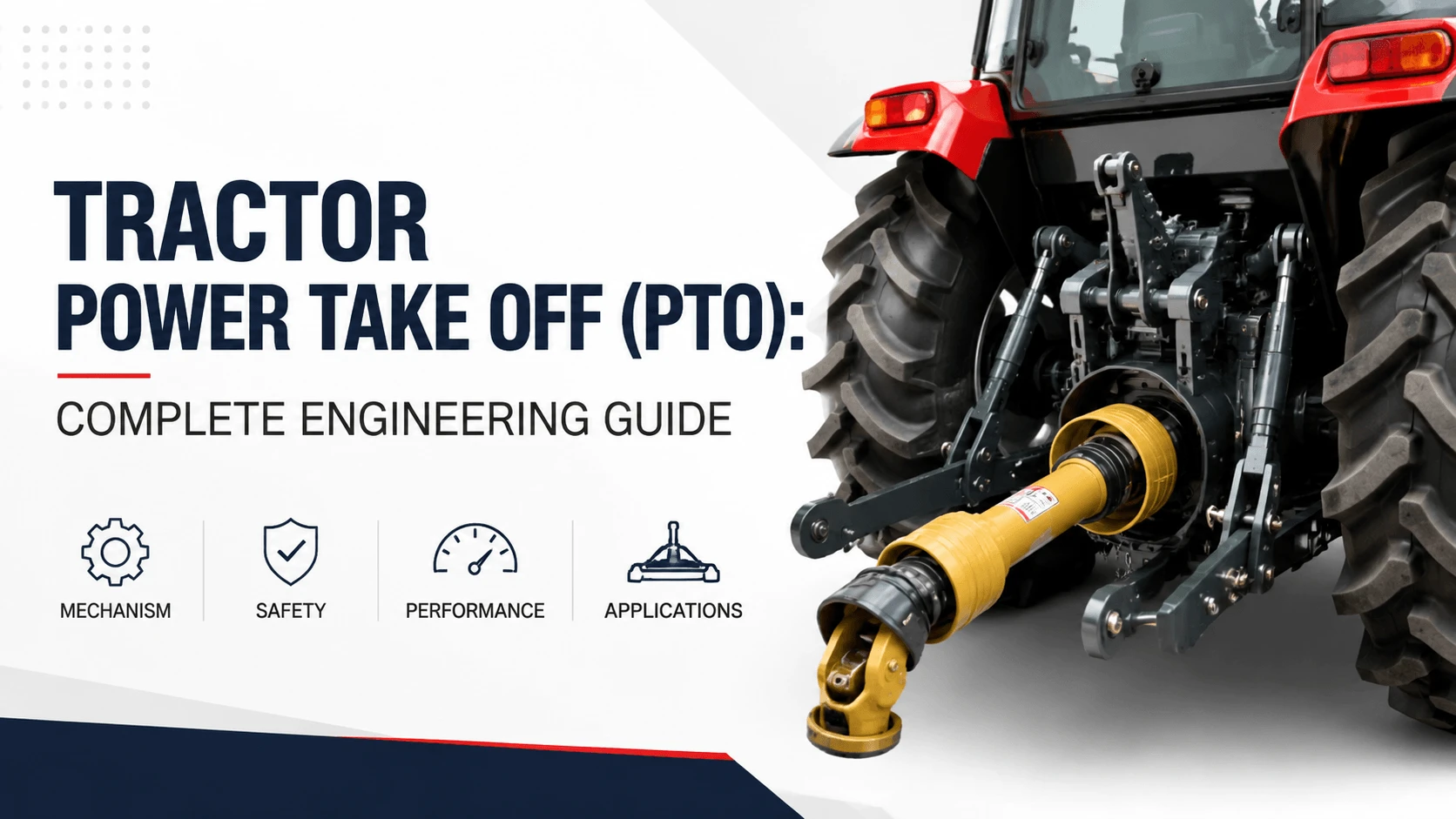
A tractor power take off, usually abbreviated as PTO, is a splined shaft on the tractor rear that transfers engine power to attached implements. The engine turns the transmission, and transmission gears spin the PTO shaft at a fixed speed regardless of ground speed. This lets you run a mower, baler, pump, or generator from the diesel engine without a separate motor on each implement.
History and Standards
The concept dates back to around 1918 when IHC introduced the PTO on the Farmall tractor. Before that, implements carried their own engines or ran off a ground-driven wheel. The tractor power take off changed farm mechanization by letting one engine handle multiple jobs. ISO 500 and EN 12750 now govern international standards for PTO dimensions, speeds, and safety requirements.
How Tractor Power Take Off Works
Power Flow Path
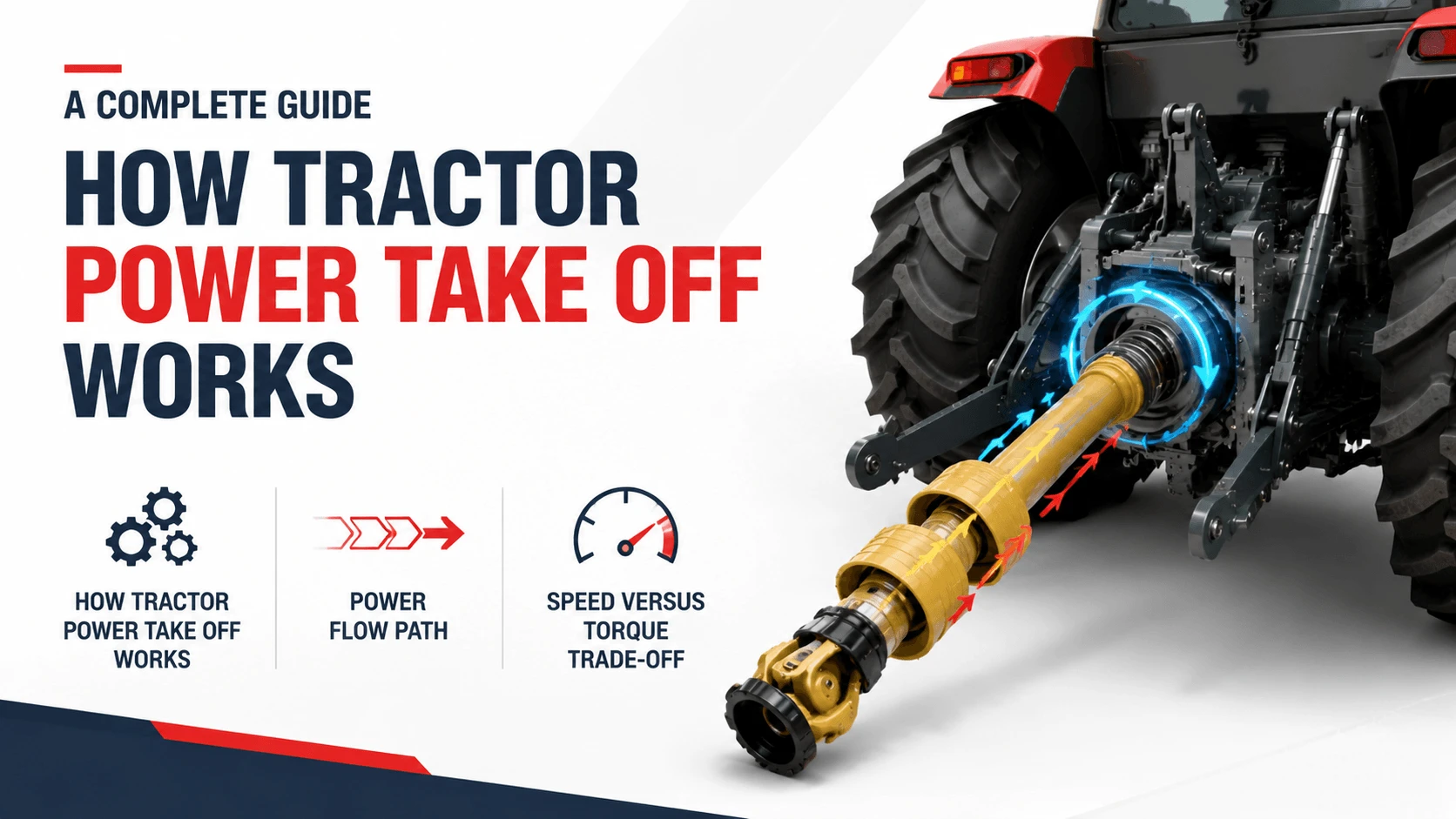
Power flows from the crankshaft through the clutch and transmission gears to the PTO output shaft. On most modern tractors, you can engage or disengage the PTO independently of the drive wheels. This matters because you might want to spin a stationary pump or mixer while the tractor sits still. The tractor power take off runs at either 540 rpm or 1,000 rpm when the engine operates at rated speed.
Speed Versus Torque Trade-Off
Torque at the PTO shaft follows a simple relationship. A 50 hp engine delivers roughly 700 Nm of torque at 540 rpm, or about 377 Nm at 1,000 rpm for the same power output. The higher-speed option carries less torque. This allows smaller shaft diameters and lighter yoke assemblies on high-horsepower tractors. Most compact tractors under 80 hp use the 540-rpm standard. Larger machines above 100 hp usually offer both speeds or default to 1,000 rpm.
PTO Shaft Types and Spline Specifications
Four Standard Sizes
The tractor power take off comes in four standardized sizes defined by shaft diameter, spline count, and speed. Getting this wrong means the implement will not fit. Worse, it might fit loosely and destroy the splines under load.
| PTO Type | Diameter | Splines | Speed | Typical HP Range |
|---|---|---|---|---|
Type 0 |
1-1/8 in (28.6 mm) |
6 |
540 rpm |
Pre-1950s tractors |
Type 1 |
1-3/8 in (35 mm) |
6 |
540 rpm |
20-80 hp |
Type 2 |
1-3/8 in (35 mm) |
21 |
1,000 rpm |
80-150 hp |
Type 3 |
1-3/4 in (45 mm) |
20 |
1,000 rpm |
150+ hp |
Which Type Do You Have?
Type 1 dominates the compact utility tractor market. If you own a Kubota, John Deere 3-series, or similar machine under 80 hp, you almost certainly have a Type 1 tractor power take off. Count the splines if unsure. Six fat splines mean 540 rpm. Twenty-one fine splines mean 1,000 rpm at the same diameter. The larger Type 3 shaft appears only on high-horsepower row crop and 4WD tractors.
Rotation Direction
All standard PTO shafts rotate clockwise when viewed from the rear. Some older models like the Farmall Cub ran counter-clockwise at non-standard speeds, but these are rare today. Always check your operator manual before connecting any implement.
Cardan Joint Physics and Working Angles
How Universal Joints Handle Misalignment
The PTO drive shaft between the tractor and implement contains one or two Cardan (universal) joints. These U-joints accommodate misalignment as the implement hitch moves up and down behind the tractor. A single Cardan joint does not transmit rotation uniformly. The output shaft speeds up and slows down twice per revolution in a cyclic pattern called the second-order harmonic effect.
Working Angle Limits
At 15 degrees, this speed variation stays manageable. Push past 20 degrees, and vibration increases sharply. At 30 degrees, cyclic torque fluctuation can exceed 15% of the mean value. This accelerates wear on the implement gearbox and the PTO stub. Double-joint shafts exist for this reason. Two properly phased U-joints cancel most of the velocity error and allow working angles up to 35-40 degrees on wide-angle designs.
Cross-Journal Bearing Maintenance
Cross-journal bearings take the brunt of the load. Standard T-series shafts use 22×54 mm to 35×80 mm cross kits, depending on torque class. Grease these every 8 hours of operation under heavy angles, or at a minimum every 40 hours of normal use. A dry cross journal seizes within minutes under full torque.
Torque Ratings and Shaft Selection
Understanding Torque Ratings
Selecting the right PTO shaft means matching torque capacity to your tractor’s output plus a safety margin. Manufacturers rate shafts in Newton-meters (Nm) at a stated RPM. A light-duty T6 shaft handles around 2,800 Nm at 1,000 rpm. A heavy-duty T8 rates up to 9,500 Nm. Remember that the same shaft at 540 rpm carries roughly 85% more torque at the same power level. Torque equals power divided by angular velocity.
Sizing Calculation Method
Here is a practical method. Take your tractor’s PTO horsepower, multiply by 5252, then divide by PTO rpm. That gives approximate torque in lb-ft. Convert to Nm by multiplying by 1.356. Pick a shaft series whose rated torque exceeds your calculated value by at least 30%. Running a PTO shaft at its torque limit shortens bearing life and raises the risk of tube failure.
Tube Construction Options
Tube construction also matters. Star tubes (triangular cross-section) resist torsion better than round tubes at the same weight. Gear tubes add an anti-rotation feature. It prevents the inner and outer tubes from spinning independently. This matters for shafts with integrated torque limiters. Rectangular tubes offer the lowest cost but the least torsional stiffness.
Safety Devices: Shear Bolts, Slip Clutches, and Overrun Clutches
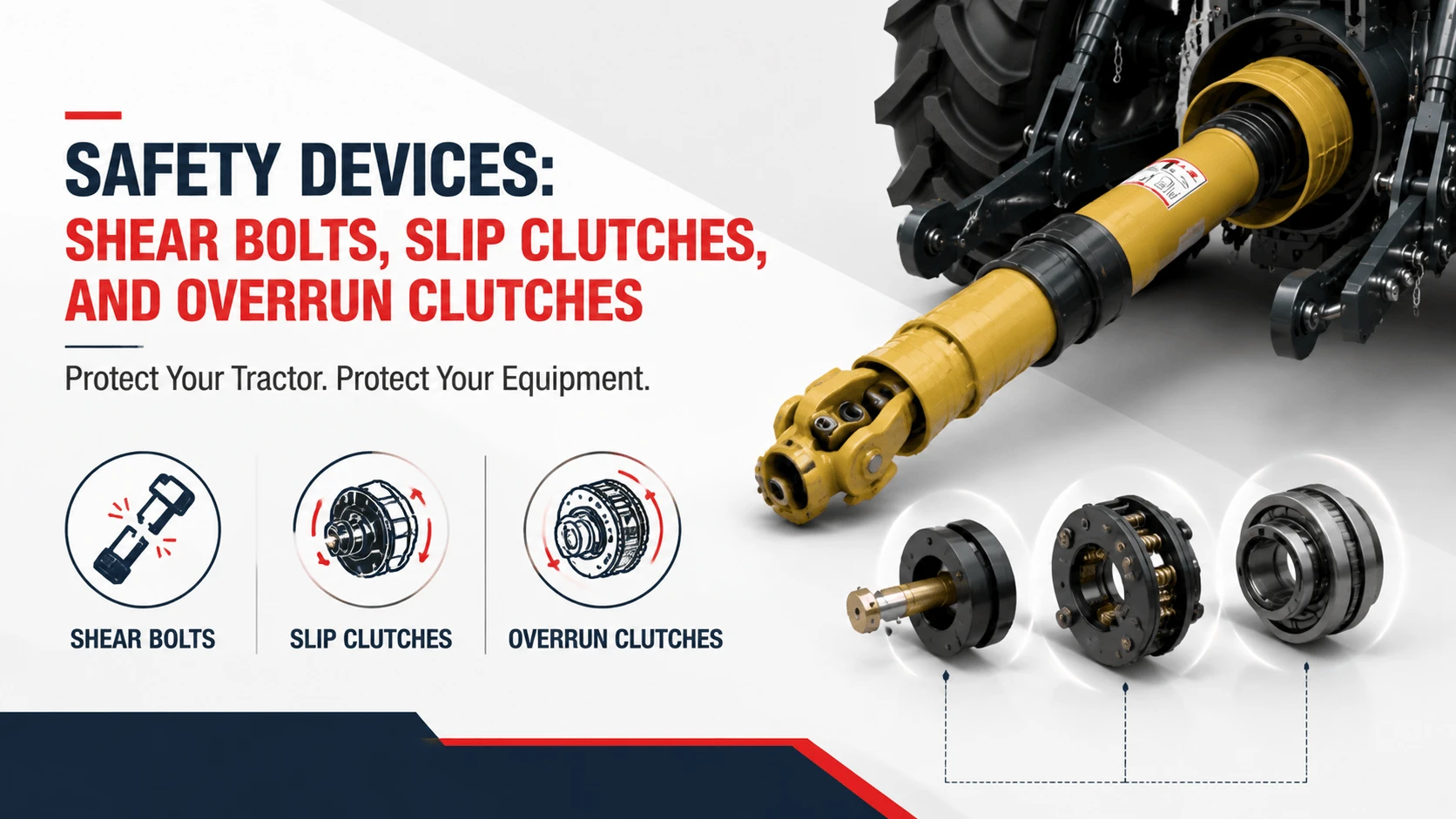
Three protective devices commonly appear on PTO drivelines. Each serves a different purpose. Understanding the distinction prevents damage and injury.
Shear Bolt Protection
A shear bolt sacrifices itself when torque exceeds a calibrated threshold. The bolt snaps and the drive disconnects. Cheap and simple, but you stop work to replace it. Common on balers and forage harvesters where sudden overload risks major gearbox damage.
Slip Clutch Protection
A slip clutch uses spring-loaded plates that slide past each other when overloaded. It resets automatically once the load drops. More expensive than a shear bolt upfront, but you keep working through minor obstructions. Most manufacturers recommend a slip clutch on mowers and rotary tillers where rocks and roots cause frequent momentary spikes.
Overrunning Clutch
An overrunning clutch (also called an overrun clutch) sits on the tractor-side input of the PTO shaft. It lets the implement coast down freely when you disengage the PTO or clutch. Without it, implement momentum keeps the PTO spinning after you push the clutch in. This pushes the tractor forward whether you want it to or not. Essential for any implement with significant rotating mass: mowers, blowers, and augers.
Guarding Standards and Compliance
What Standards Require
ISO 500 and EN 12750 require that PTO shafts carry fully enclosing guards on both the tractor and implement ends. The guard must rotate independently of the inner shaft. This way, clothing or limbs caught against it get pushed away rather than wrapped into the driveline. A proper guard consists of a plastic or metal shield supported by end bearings or bushings that allow free rotation.
Real-World Guard Usage
In practice, many operators remove guards because they interfere with hitching or get in the way during greasing. This accounts for a large share of PTO-related injuries on farms. Every reputable PTO manufacturer now produces guards with quick-release features or interlocking shields that stay attached during normal operation. The extra thirty seconds to reattach a guard beats a hospital visit.
Regulatory Consequences
European CE marking requires compliant guarding on all new machinery sold in the EU. North American OSHA regulations reference ANSI/ASAE S349 for shielding requirements. If you manufacture or import implements, non-compliant guarding creates liability exposure that no insurance policy fully covers.
Common Failure Modes and Troubleshooting
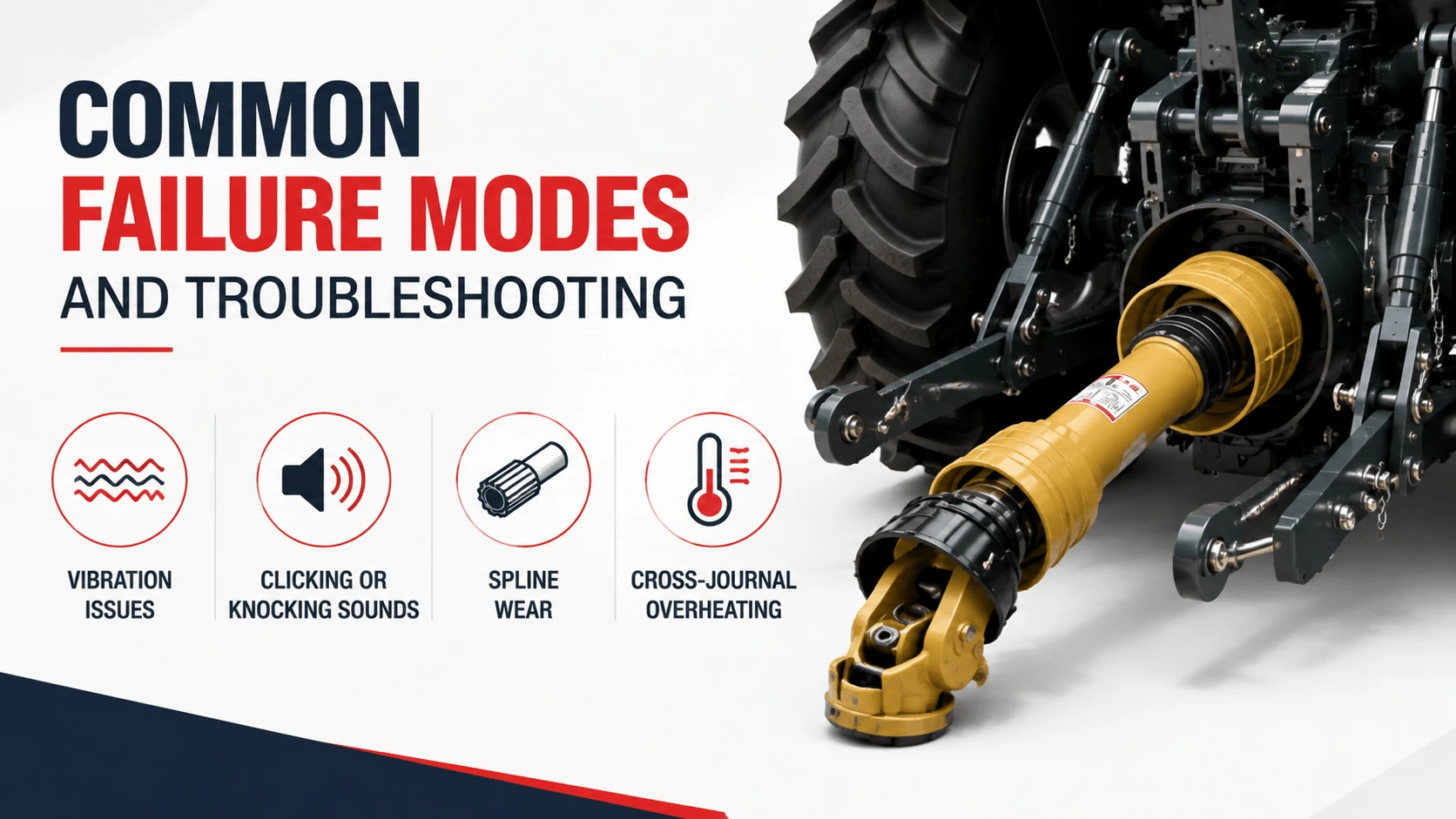
Field experience shows that most PTO problems fall into a handful of predictable categories.
Vibration Issues
Vibration at normal operating speed usually indicates a worn cross-journal bearing or a bent tube. Check for play in the U-joint spiders by hand. Any perceptible movement means replacement. A bent tube often results from hitting a solid object while the shaft was under tension. Backing into a fence post with a rigidly mounted implement causes this kind of damage.
Clicking or Knocking Sounds
Clicking or knocking sounds under load point to a failing hook-and-pin or snap-ring retention system on the telescoping profile. The inner tube moves in and out as the hitch articulates. If the retention mechanism wears loose, the tubes can separate partially under compression, causing impact noise and eventual disconnection.
Spline Wear
Spline wear on the tractor stub shaft or the implement input shows as fretting corrosion and dust around the coupling. Once spline clearance exceeds 0.005 inches (0.13 mm), replace the part. Continued operation accelerates wear on both mating parts and can leave you stranded with a stuck implement that will not uncouple from the PTO hub.
Cross-Journal Overheating
Overheating at the cross journals signals insufficient lubrication or excessive working angle. Reduce the angle if possible, grease immediately, and inspect for discoloration on the bearing cups. Blue or brown coloring means the steel has exceeded its tempering temperature. Replace the part regardless of how it feels by hand.
Matching Implements to Your Tractor Power Take Off
Three Things to Confirm Before Buying
Before buying any PTO implement, confirm three things. Check the PTO type (spline count and diameter), speed requirement (540 or 1,000 rpm), and horsepower match. An implement rated for 40 hp minimum on a 25 hp tractor will overload the engine, stall the PTO, and overheat the clutch. A 120 hp tractor running a 15 hp implement wastes fuel. It also risks overspeeding the implement gearbox if the operator is not careful with throttle.
Dual-Speed Tractor Considerations
Many modern tractors offer gear selections for both 540 and 1,000 rpm output from the same physical shaft. Check whether your tractor has this dual-speed capability before investing in a 1,000-rpm-only implement. Some older machines require a different internal gear set to change PTO speed, which is not a field adjustment.
Size for Worst-Case Load
Implement width and operating depth determine the actual power draw. A 6-foot rotary cutter in light grass might pull 18 hp from a 45 hp tractor. The same cutter in heavy briars can demand 38 hp. Size your tractor power take off shaft and safety device for the worst-case load you expect to encounter. Do not size for the average.
Maintenance Schedule
Inspection and Lubrication Intervals
PTO shafts last for years with basic care. Follow this schedule:
Daily: Visual inspection of guards. Check for grease leaks on cross journals.
Every 8 hours (or when operating above 15-degree working angle): Grease all cross-journal bearings until fresh grease appears at the seal lips.
Every 40 hours: Check tightness of all bolted connections. Inspect tube profile for dents or bends. Verify free rotation of guards.
Annually: Disassemble, clean, and inspect internal components. Replace cross-journal bearings as a set even if only one feels worn. Check spline dimensions with calipers.
Grease Selection
Use a lithium-based EP grease with NLGI grade 2 consistency. Molybdenum disulfide additives help under extreme pressure but attract dirt in dusty conditions. Plain EP grease works better for most applications.
FAQ
What does PTO stand for on a tractor?
PTO means Power Take Off. It describes the splined output shaft that routes engine power to external implements.
What is the difference between 540 and 1,000 RPM PTO?
Speed and torque. A 540-rpm tractor power take off delivers higher torque at lower shaft speed. It suits implements needing grunt rather than spin rate. A 1,000-rpm PTO carries less torque for the same horsepower but spins faster, which lets high-power tractors use smaller-diameter shaft components.
How do I know what PTO type my tractor has?
Count the splines and measure the diameter. Six splines at 1-3/8 inches equals Type 1 (540 rpm). Twenty-one splines at 1-3/8 inches equals Type 2 (1,000 rpm). Twenty splines at 1-3/4 inches equals Type 3 (1,000 rpm, high horsepower). Your operator manual lists the exact specification.
Can I use a 540 implement on a 1,000 PTO tractor?
Not directly. The spline profiles differ. You would need a reducing gearbox on the implement side that converts 1,000 rpm input down to 540 rpm output while adapting the spline connection. Some implements offer this as an option. Running a 540-rated implement at double speed destroys it quickly.
How much torque does a tractor PTO produce?
Divide horsepower by PTO rpm, then multiply by 5,252 for lb-ft or 7,121 for Nm. A 75 hp tractor at 540 rpm puts out roughly 729 Nm of torque at the tractor power take off shaft. The same tractor at 1,000 rpm delivers about 395 Nm.
Why does my PTO shaft vibrate?
Excessive working angle (usually over 15-20 degrees for single-joint shafts), worn cross-journal bearings, a bent tube, or improper phasing on a double-joint assembly. Start by measuring the tractor-to-implement angle with the hitch at operating height. Reduce the angle or switch to a wide-angle shaft if it exceeds the rating.
How often should I grease PTO joints?
Every 8 hours of operation when working above a 15-degree angle, or every 40 hours under normal conditions. Never run a dry joint under load. One dry session can permanently damage the bearing cups and spider rollers.
Conclusion
A tractor power take off is straightforward in concept but demands attention to detail in practice. Match the spline type, verify the speed, size the shaft for peak torque, keep the guards on, and grease the joints on schedule. Most PTO failures trace back to ignoring one of those steps. Get the spec right the first time, maintain it consistently, and the shaft will outlast the tractor it connects.