
What Is a Truck Hydraulic System?
How It Works
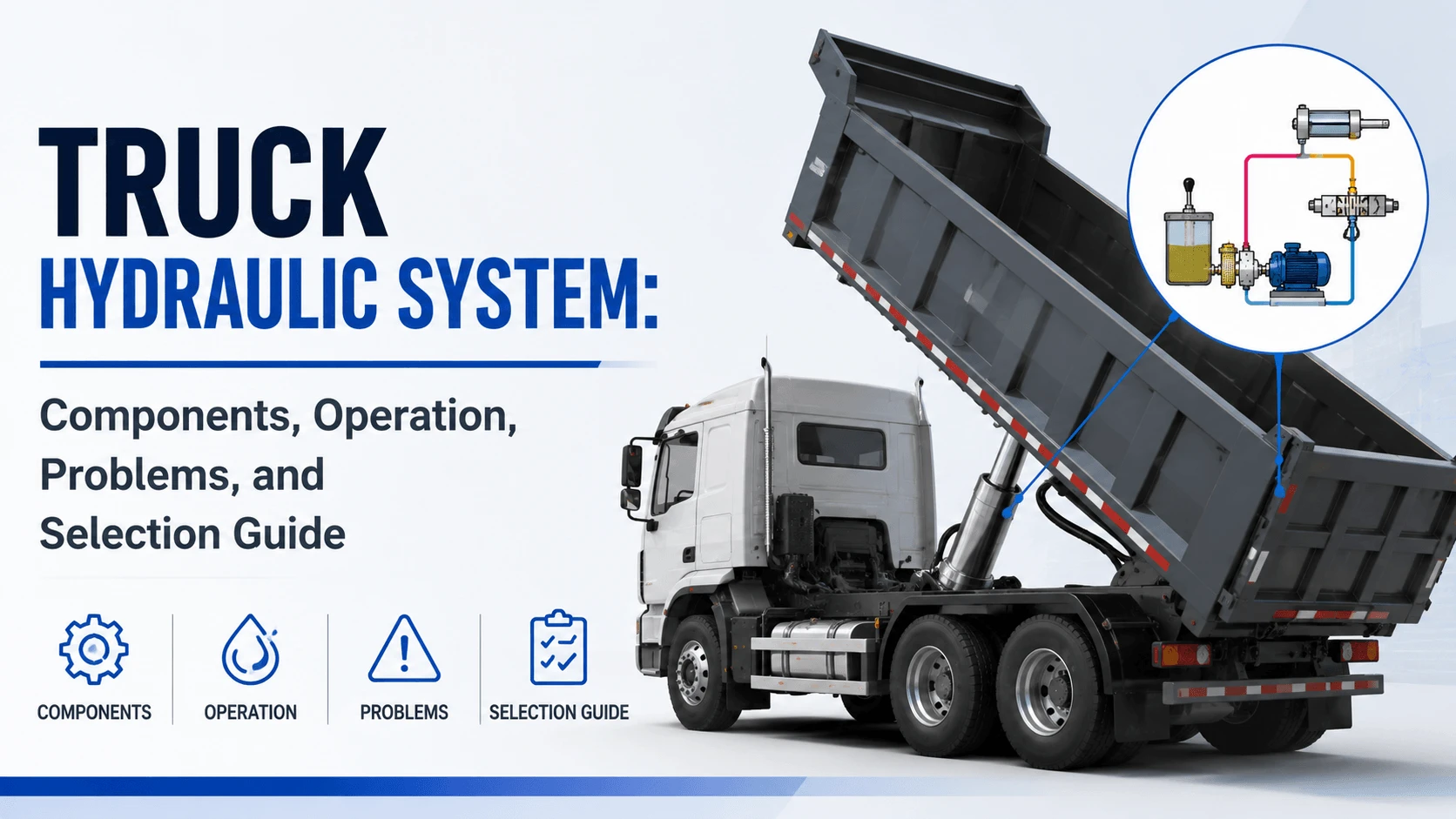
Most truck hydraulic systems follow this basic process:
- The truck engine drives a PTO connected to the transmission.
- The PTO drives a hydraulic pump.
- The pump draws oil from the reservoir.
- Pressurized oil flows through control valves.
- Valves direct oil to cylinders or motors.
- The actuator converts hydraulic energy into mechanical movement.
- Oil returns to the reservoir through return lines and filters.
When the control valve is neutral, oil may return to tank in an open-center system. When the operator activates a lever or electric control, flow is directed to the required function.
Main Components
| Component | Function | Engineering Note |
|---|---|---|
PTO |
Transfers engine power to hydraulic pump |
Must match torque, speed, and duty cycle |
Hydraulic pump |
Generates oil flow |
Gear pumps are common; piston pumps suit higher efficiency or variable flow |
Reservoir |
Stores and cools hydraulic oil |
Poor sizing causes heat, aeration, and foaming |
Control valve |
Directs oil to actuators |
Manual, pneumatic, electric, or proportional control |
Relief valve |
Limits maximum pressure |
Critical for overload protection |
Cylinder |
Converts pressure into linear force |
Bore, rod, stroke, and mounting style must match load |
Hydraulic motor |
Converts flow into rotation |
Used for winches, augers, conveyors, and mixers |
Filters |
Remove contamination |
Essential for pump, valve, and seal life |
Hoses and fittings |
Carry pressurized oil |
Must match pressure, impulse, bend radius, and routing conditions |
Common Pressure and Flow Ranges
| Application | Typical Pressure | Typical Flow |
|---|---|---|
Dump truck hoist |
2,000-3,000 psi |
10-40 GPM |
Tow truck or car carrier |
2,500-3,500 psi |
8-30 GPM |
Truck-mounted crane |
2,500-4,000 psi |
10-60 GPM |
Snowplow or tailgate lift |
1,500-3,000 psi |
3-15 GPM |
Refuse truck body |
2,500-4,500 psi |
20-80 GPM |
Advantages
A truck hydraulic system provides high force in a compact package. Hydraulic cylinders can lift heavy loads that would be impractical for electric actuators of similar size.
Key advantages include:
- High power density
- Smooth control of heavy loads
- Flexible hose routing
- Multiple functions from one pump
- Reliable operation in harsh mobile environments
- Proven technology for vocational trucks
Disadvantages
Hydraulics are powerful, but they require disciplined design and maintenance.
Common limitations include:
- Oil leaks from hoses, fittings, and seals
- Heat generation during continuous duty
- Contamination sensitivity
- Noise from pumps or relief flow
- Efficiency losses at idle or high pressure
- Safety risks if pressure is not properly controlled
Many failures are not caused by a single bad component. They often come from incorrect sizing, poor filtration, overheated oil, or repeated operation over relief pressure.
Industrial Applications
Truck hydraulic systems are used in:
- Dump trucks and tipper trucks
- Hook loaders and roll-off trucks
- Truck-mounted cranes
- Tow trucks and wreckers
- Refuse collection vehicles
- Concrete mixers
- Snowplow trucks
- Forestry and utility trucks
- Car carriers
- Service trucks with hydraulic tools
Each application has different priorities. A dump truck needs high lifting force and reliable lowering control. A crane truck requires precise metering, load holding, and safety valves. A refuse truck needs high cycle life and heat management.
Common Problems
| Problem | Likely Causes | Recommended Check |
|---|---|---|
Slow cylinder movement |
Low pump flow, clogged filter, low oil level, worn pump |
Check flow, filter restriction, oil level |
No lifting force |
Relief valve stuck open, pump failure, valve leakage, overloaded cylinder |
Test system pressure under load |
Excessive heat |
Undersized reservoir, continuous relief flow, wrong oil viscosity |
Check duty cycle and relief setting |
Foaming oil |
Air leak on suction side, low oil, wrong return design |
Inspect suction hose and reservoir |
Jerky movement |
Air in system, cylinder seal issue, contaminated valve |
Bleed circuit and inspect seals |
Pump noise |
Cavitation, blocked suction strainer, high oil viscosity |
Check inlet restrictions |
External leakage |
Damaged hose, loose fitting, worn seal |
Repair before operating under pressure |
Troubleshooting Guide
Start with simple checks before replacing expensive parts.
- Check the hydraulic oil level and oil condition.
- Inspect suction lines for air leaks or collapsed hoses.
- Verify PTO engagement and pump rotation direction.
- Measure system pressure with a calibrated gauge.
- Check the return filter restriction.
- Confirm relief valve setting.
- Test the pump flow if the pressure is low under load.
- Inspect cylinder drift, internal leakage, and rod damage.
- Review whether the load exceeds the system design.
A common mistake is replacing the pump when the real problem is suction restriction, wrong oil viscosity, or a relief valve bypassing continuously.
Selection Guide
When selecting a truck hydraulic system, define the working requirement first.
Important criteria:
- Required load force
- Cylinder bore, rod diameter, and stroke
- Desired cycle time
- Pump displacement and flow rate
- PTO speed and torque rating
- Maximum system pressure
- Reservoir size and mounting space
- Duty cycle and cooling requirement
- Valve type and control method
- Hose pressure rating and routing
- Filtration level
- Environmental conditions
For simple dump applications, a fixed-displacement gear pump is often practical and cost-effective. For cranes, refuse trucks, and multi-function vehicles, a load-sensing piston pump or proportional valve system may improve control and efficiency.
Maintenance Tips
- Check oil level regularly.
- Replace filters according to service hours or restriction indicators.
- Keep hydraulic oil clean and dry.
- Inspect hoses for abrasion, cracking, and swelling.
- Tighten fittings correctly; do not overtighten.
- Keep reservoir breathers clean.
- Monitor operating temperature.
- Test relief pressure during scheduled maintenance.
- Replace damaged cylinder seals before contamination spreads.
- Use hydraulic oil with the correct viscosity grade for climate and duty cycle.
FAQs
What is a truck hydraulic system?
A truck hydraulic system uses pressurized oil to power equipment mounted on a truck, such as dump bodies, cranes, tow beds, snowplows, and stabilizers.
What pump is used in a truck’s hydraulic system?
Gear pumps are common for dump trucks and simple work trucks because they are durable and cost-effective. Piston pumps are used when higher efficiency, variable flow, or multi-function control is required.
What pressure does a truck’s hydraulic system use?
Many truck hydraulic systems operate between 2,000 and 3,500 psi. Heavy-duty mobile applications may use higher pressures depending on the design.
Why is my truck’s hydraulic system slow?
Slow operation may be caused by low oil level, clogged filters, worn pump, low engine/PTO speed, internal leakage, or undersized hydraulic lines.
What is a hydraulic wet kit?
A hydraulic wet kit is a PTO-powered hydraulic package installed on a truck to run trailers or truck-mounted equipment. It usually includes a pump, reservoir, hoses, valves, and fittings.
Authority Sources
Need help selecting hydraulic pumps, valves, cylinders, or complete wet kits for truck applications? Contact our engineering team with your vehicle type, working pressure, flow requirement, PTO details, and application drawings to receive a technical recommendation or quotation.